Cranfield Centre for Water, Environment and Development, Cranfield University, Bedford, UK.
Environ Monit Assess. 2023 Oct 17;195(11):1328. doi: 10.1007/s10661-023-11694-9.
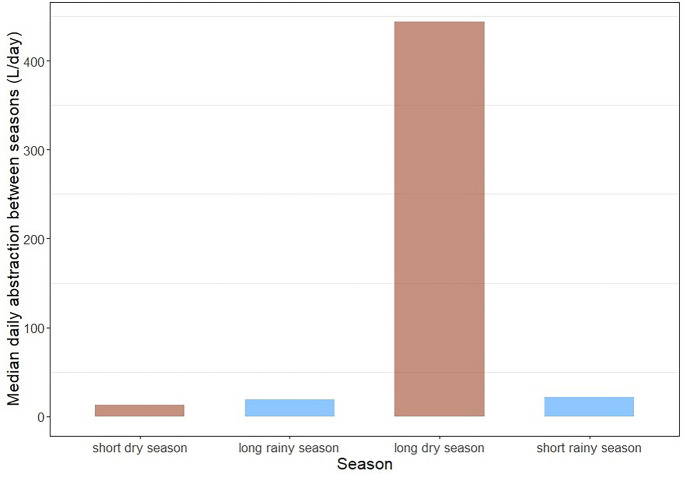
Sand dams are a form of rainwater harvesting, prolific in arid and semi-arid lands. Water is provided partly via handpumps, which, as the only improved method of abstraction from sand dams, are important for drinking water security. Accelerometers and cellular transmitters were fitted to 30 handpumps by the Africa Sand Dam Foundation (ASDF) in 2019 to monitor the use and reliability of the handpumps by recording hourly water volume abstracted. Data from April 2019 to October 2021 for 26 of these sites, alongside qualitative data, were analysed and each handpump's contribution to year-round water security was explored, focusing on the long dry season when water supply from other sources is compromised. Abstraction was over 20 times higher in the long dry season than in any other season, and at sites with higher salinity, higher livestock use, and larger dam wall area. At 21 wells, abstraction was still being recorded at the end of at least one long dry season; however, high spatial and temporal heterogeneity between pumps and seasons means that not all sand dams deliver reliable water supply year-round. Quantifying the contribution that sand dams make to water security is crucial for understanding their resilience against a changing climate and can aid decision makers when choosing the most appropriate water management technique. Knowledge of temporal and site heterogeneity in abstraction can inform when other water sources need increasing and can help with sand dam design optimisation. Overall, our results indicate the positive contribution that sand dams make to year-round water security through the water that is abstracted through handpumps.
沙坝是一种雨水收集形式,在干旱和半干旱地区非常普遍。水的供应部分来自手压泵,作为沙坝唯一的改良提取方法,对于饮用水安全非常重要。2019 年,非洲沙坝基金会(ASDF)在手压泵上安装了加速度计和蜂窝传输器,以记录每小时提取的水量,从而监测手压泵的使用情况和可靠性。对其中 26 个站点的 2019 年 4 月至 2021 年 10 月的数据以及定性数据进行了分析,探讨了每台手压泵对全年水安全的贡献,重点关注长期干旱季节,因为此时其他水源的供水受到影响。在长期干旱季节,手压泵的抽水量比其他任何季节都高出 20 多倍,而且在盐度较高、牲畜使用较多和大坝墙面积较大的地方,抽水量更高。在 21 口井中,至少有一口井在一个长旱季结束时仍在记录抽水量;然而,由于泵和季节之间存在很高的空间和时间异质性,并非所有沙坝都能全年提供可靠的供水。量化沙坝对水安全的贡献对于了解其应对气候变化的弹性至关重要,并且可以帮助决策者在选择最合适的水管理技术时做出决策。了解抽水量的时间和地点异质性可以告知何时需要增加其他水源,并有助于沙坝设计优化。总的来说,我们的结果表明,沙坝通过手压泵抽取的水对全年水安全做出了积极贡献。