School of Biosciences, University of Nottingham, Sutton Bonington Campus, Loughborough, LE12 5RD, UK.
Department of Neuroscience and Brain Technologies, Istituto Italiano di Tecnologia, Via Morego 30, 16163, Genova, Italy.
Sci Rep. 2023 Oct 17;13(1):17631. doi: 10.1038/s41598-023-44772-6.
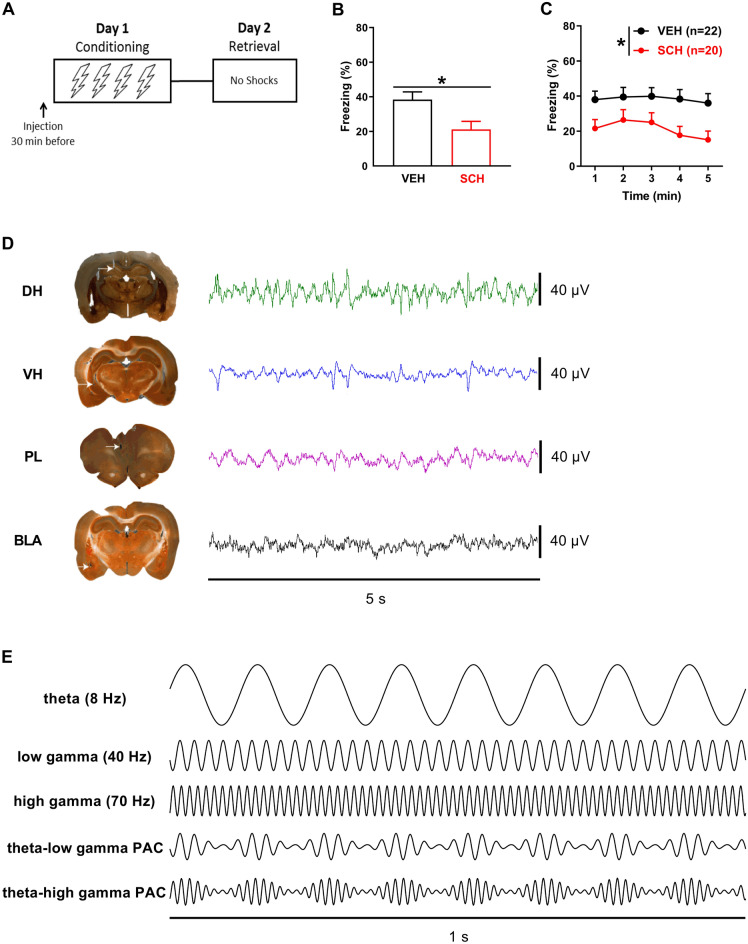
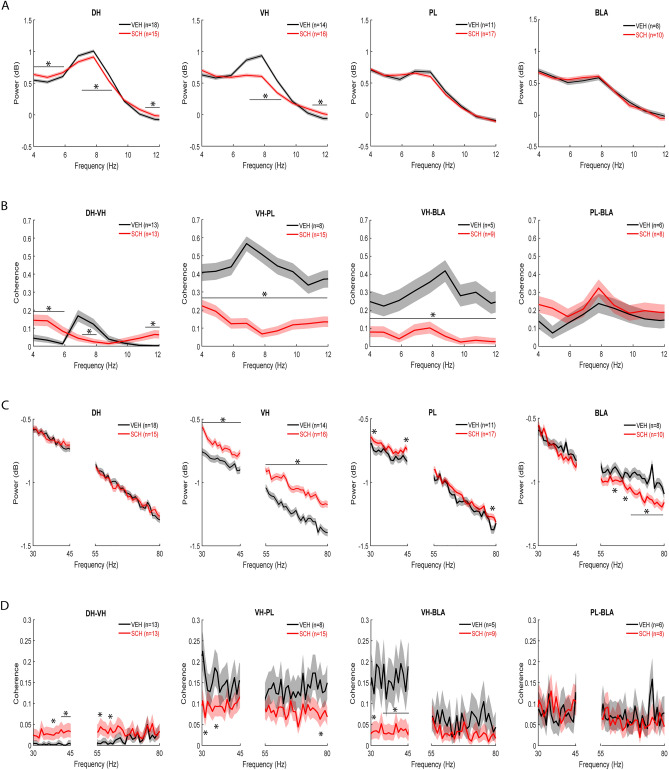
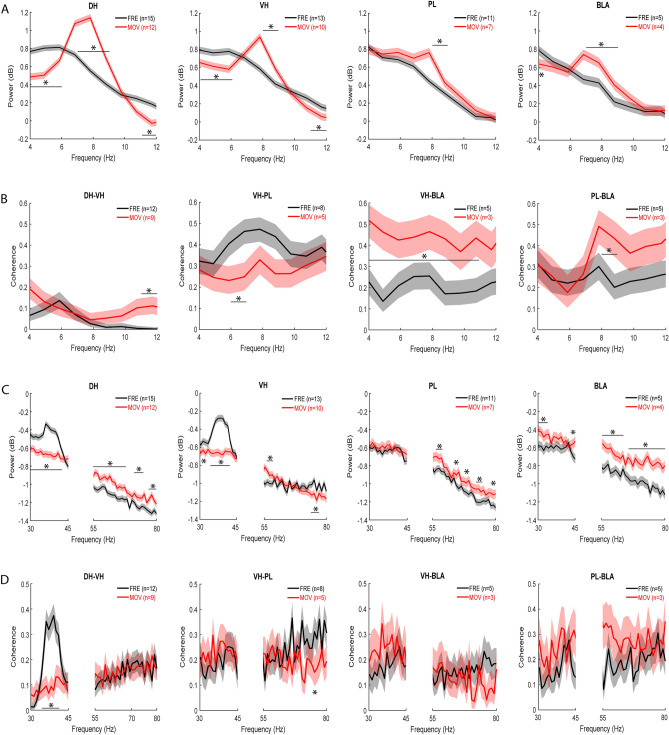
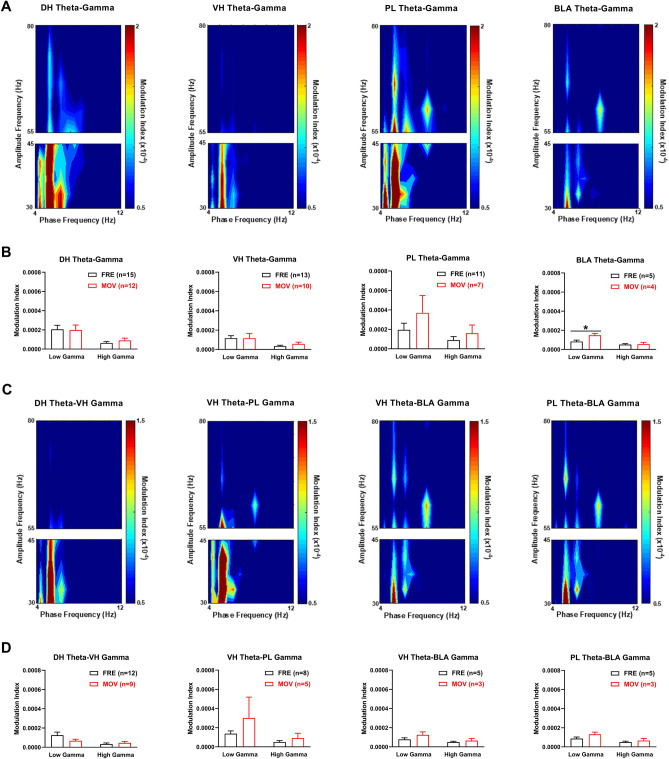
Contextual fear conditioning (CFC) is mediated by a neural circuit that includes the hippocampus, prefrontal cortex, and amygdala, but the neurophysiological mechanisms underlying the regulation of CFC by neuromodulators remain unclear. Dopamine D1-like receptors (D1Rs) in this circuit regulate CFC and local synaptic plasticity, which is facilitated by synchronized oscillations between these areas. In rats, we determined the effects of systemic D1R blockade on CFC and oscillatory synchrony between dorsal hippocampus (DH), prelimbic (PL) cortex, basolateral amygdala (BLA), and ventral hippocampus (VH), which sends hippocampal projections to PL and BLA. D1R blockade altered DH-VH and reduced VH-PL and VH-BLA synchrony during CFC, as inferred from theta and gamma coherence and theta-gamma coupling. D1R blockade also impaired CFC, as indicated by decreased freezing at retrieval, which was characterized by altered DH-VH and reduced VH-PL, VH-BLA, and PL-BLA synchrony. This reduction in VH-PL-BLA synchrony was not fully accounted for by non-specific locomotor effects, as revealed by comparing between epochs of movement and freezing in the controls. These results suggest that D1Rs regulate CFC by modulating synchronized oscillations within the hippocampus-prefrontal-amygdala circuit. They also add to growing evidence indicating that this circuit synchrony at retrieval reflects a neural signature of learned fear.
情境恐惧条件反射(CFC)是由包括海马体、前额叶皮层和杏仁核在内的神经网络介导的,但神经调质调节 CFC 的神经生理机制仍不清楚。该回路中的多巴胺 D1 样受体(D1Rs)调节 CFC 和局部突触可塑性,这些区域之间的同步振荡促进了局部突触可塑性。在大鼠中,我们确定了系统 D1R 阻断对 CFC 和背侧海马体(DH)、前扣带回皮层(PL)、基底外侧杏仁核(BLA)和腹侧海马体(VH)之间振荡同步性的影响,后者向 PL 和 BLA 发送海马体投射。D1R 阻断改变了 DH-VH,并减少了 VH-PL 和 VH-BLA 的同步性,这可以从θ和γ相干性和θ-γ耦合推断出来。D1R 阻断还损害了 CFC,这表现为在检索时冻结减少,这表现为 DH-VH 和 VH-PL、VH-BLA 和 PL-BLA 同步性的改变。这种 VH-PL-BLA 同步性的减少不能完全归因于非特异性运动效应,这可以通过在对照组中比较运动和冻结时段来揭示。这些结果表明,D1Rs 通过调节海马体-前额叶-杏仁核回路中的同步振荡来调节 CFC。它们还增加了越来越多的证据表明,该回路在检索时的同步性反映了习得性恐惧的神经特征。