Bajra Rika, Srinivasan Malathi, Torres Elise Cheng, Rydel Tracy, Schillinger Erika
Division of Primary Care and Population Health, Department of Medicine, Stanford University School of Medicine, Stanford, CA, United States.
One Health Teaching Scholars Program, Stanford CARE Internships Programs, Stanford Center for Asian Healthcare Research and Education, Department of Medicine, Stanford University School of Medicine, Stanford, CA, United States.
Front Med (Lausanne). 2023 Oct 2;10:1222181. doi: 10.3389/fmed.2023.1222181. eCollection 2023.
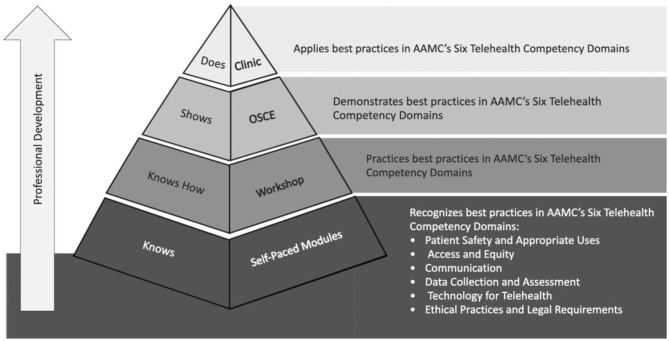
This study describes the program and learning outcomes of a telehealth skills curriculum based on the Association of American Medical Colleges (AAMC) telehealth competencies for clerkship-level medical students.
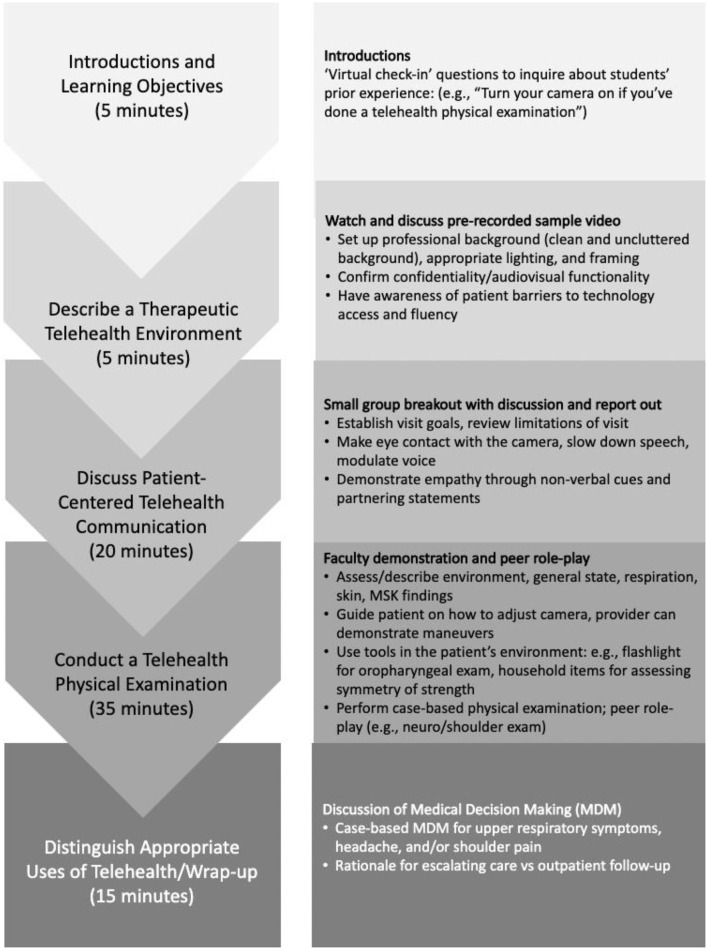
A total of 133 third- and fourth-year medical students in a required family medicine clerkship at Stanford University School of Medicine participated in a telehealth curriculum, including a telehealth workshop, site-specific telehealth clinical encounters, and telemedicine objective structured clinical examinations (teleOSCEs) between July 2020 and August 2021. Their workshop communication and physical examination competencies were assessed in two teleOSCEs utilizing a novel telehealth assessment tool. Students' attitudes, skills, and self-efficacy were assessed through voluntary pre-clerkship, post-workshop, and post-OSCE surveys.
Most learners reported low confidence in their telehealth physical examinations [ = 79, mean = 1.6 (scale 0-5, 5 = very confident, SD = 1.0)], which improved post-workshop [ = 69, 3.3 (0.9), < 0.001]; almost all (97%, 70/72) felt the workshop prepared them to see patients in the clinic. In formative OSCEs, learners demonstrated appropriate "webside manner" (communication scores 94-99%, four items) but did not confirm confidentiality (21%) or review limitations of the visit (35%). In a low back pain OSCE, most learners assessed pain location (90%) and range of motion (87%); nearly half (48%) omitted strength testing.
Our telehealth curriculum demonstrated that telehealth competencies can be taught and assessed in medical student education. Improvement in self-efficacy scores suggests that an 80-min workshop can prepare students to see patients in the clinical setting. Assessment of OSCE data informs opportunities for growth for further development in the curriculum, including addressing visit limitations and confidentiality in telehealth visits.
本研究描述了一项基于美国医学院协会(AAMC)针对临床实习阶段医学生的远程医疗能力要求所开展的远程医疗技能课程计划及学习成果。
2020年7月至2021年8月期间,斯坦福大学医学院必修家庭医学实习课程中的133名三、四年级医学生参加了远程医疗课程,包括远程医疗工作坊、特定地点的远程医疗临床见习以及远程医学客观结构化临床考试(teleOSCEs)。利用一种新型远程医疗评估工具,在两次teleOSCEs中评估了他们在工作坊中的沟通和体格检查能力。通过自愿参加的实习前、工作坊后和OSCE后调查,评估了学生的态度、技能和自我效能感。
大多数学习者表示对远程医疗体格检查信心不足(n = 79,均值 = 1.6,范围0 - 5,5 = 非常自信,标准差 = 1.0),工作坊后有所改善(n = 69,3.3(0.9),P < 0.001);几乎所有学生(97%,70/72)认为工作坊使他们有能力在诊所看诊。在形成性OSCEs中,学习者表现出适当的“网络问诊态度”(沟通得分94 - 99%,四项),但未确认保密性(21%)或回顾就诊局限性(35%)。在一次腰痛OSCE中,大多数学习者评估了疼痛部位(90%)和活动范围(87%);近一半(48%)遗漏了力量测试。
我们的远程医疗课程表明,远程医疗能力可在医学生教育中进行教授和评估。自我效能感得分的提高表明,一个80分钟的工作坊能够让学生为在临床环境中看诊做好准备。对OSCE数据的评估为课程的进一步发展提供了成长机会,包括解决远程医疗就诊中的就诊局限性和保密性问题。