Boose J A, Henderson E J
Mol Cell Biol. 1986 Aug;6(8):2820-7. doi: 10.1128/mcb.6.8.2820-2827.1986.
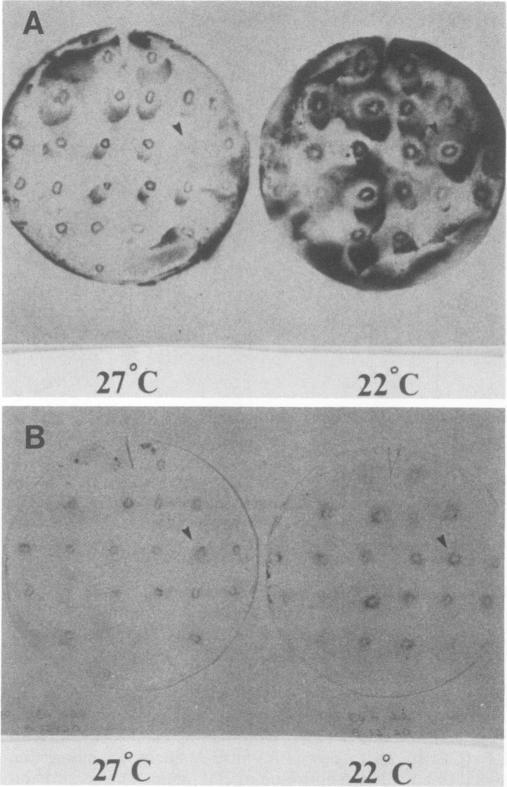
The assembly and processing of glycoprotein-linked oligosaccharides in Dictyostelium discoideum has been shown to generate a wide array of glycan structures which undergo dramatic developmental regulation. As late steps in processing of these oligosaccharides involve sulfation, a sulfate suicide selection procedure was developed to select for temperature-sensitive glycoprotein-processing mutants. Of 673 clones derived from the survivors of suicide selection, 99 were classified by replica-plating fluorography as temperature sensitive for sulfate transport or incorporation. Of these, 74 were unable to complete the developmental program to the fruiting body stage at the restrictive temperature, 29 being blocked in some aspect of aggregation and 45 being blocked at some postaggregation stage. Quantitative metabolic labeling experiments with representative clones showed that they incorporated wild-type levels of [35S]methionine but reduced levels of sulfate at the restrictive temperature. The specific incorporation patterns in the mutants suggest that distinct oligosaccharide-processing steps are involved in different developmental events.
盘基网柄菌中糖蛋白连接寡糖的组装和加工已被证明能产生多种聚糖结构,这些结构经历显著的发育调控。由于这些寡糖加工的后期步骤涉及硫酸化,因此开发了一种硫酸酯自杀选择程序来筛选温度敏感的糖蛋白加工突变体。在自杀选择幸存者衍生的673个克隆中,通过复制平板荧光自显影法将99个分类为对硫酸盐转运或掺入温度敏感。其中,74个在限制温度下无法完成发育程序至子实体阶段,29个在聚集的某些方面受阻,45个在聚集后阶段受阻。对代表性克隆进行的定量代谢标记实验表明,它们在限制温度下掺入野生型水平的[35S]甲硫氨酸,但硫酸盐水平降低。突变体中的特定掺入模式表明,不同的寡糖加工步骤参与了不同的发育事件。