Wolf Moritz, de Oliveira Ana Luiza, Taccardi Nicola, Maisel Sven, Heller Martina, Khan Antara Sharmin, Søgaard Alexander, Felfer Peter, Görling Andreas, Haumann Marco, Wasserscheid Peter
Friedrich-Alexander-Universität Erlangen-Nürnberg (FAU), Lehrstuhl für Chemische Reaktionstechnik (CRT), Egerlandstr. 3, 91058, Erlangen, Germany.
Forschungszentrum Jülich, Helmholtz Institute Erlangen-Nürnberg for Renewable Energy (IEK 11), Cauerstr. 1, 91058, Erlangen, Germany.
Commun Chem. 2023 Oct 18;6(1):224. doi: 10.1038/s42004-023-01018-w.
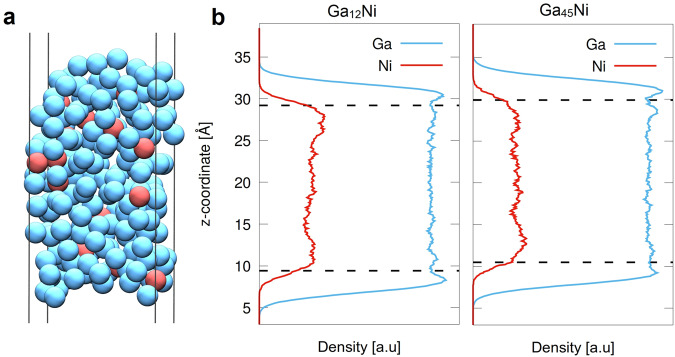
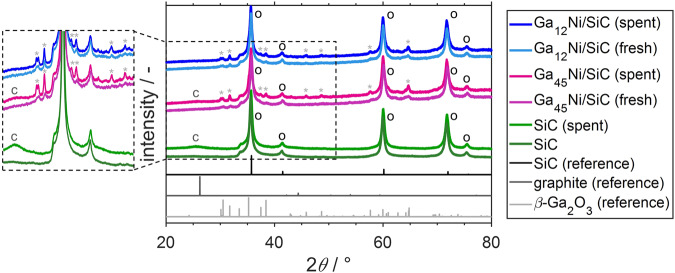
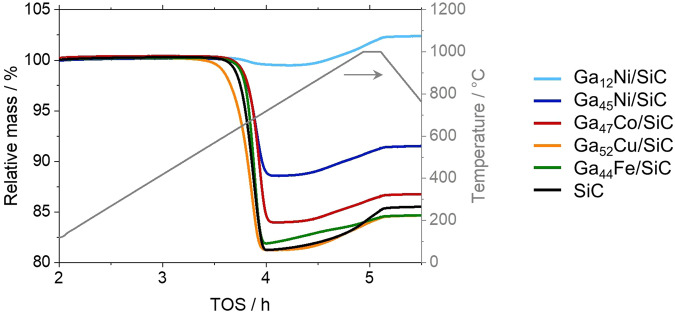
Gallium-rich supported catalytically active liquid metal solutions (SCALMS) were recently introduced as a new way towards heterogeneous single atom catalysis. SCALMS were demonstrated to exhibit a certain resistance against coking during the dehydrogenation of alkanes using Ga-rich alloys of noble metals. Here, the conceptual catalytic application of SCALMS in dry reforming of methane (DRM) is tested with non-noble metal (Co, Cu, Fe, Ni) atoms in the gallium-rich liquid alloy. This study introduces SCALMS to high-temperature applications and an oxidative reaction environment. Most catalysts were shown to undergo severe oxidation during DRM, while Ga-Ni SCALMS retained a certain level of activity. This observation is explained by a kinetically controlled redox process, namely oxidation to gallium oxide species and re-reduction via H activation over Ni. Consequentially, this redox process can be shifted to the metallic side when using increasing concentrations of Ni in Ga, which strongly suppresses coke formation. Density-functional theory (DFT) based ab initio molecular dynamics (AIMD) simulations were performed to confirm the increased availability of Ni at the liquid alloy-gas interface. However, leaching of gallium via the formation of volatile oxidic species during the hypothesised redox cycles was identified indicating a critical instability of Ga-Ni SCALMS for prolonged test durations.
富含镓的负载型催化活性液态金属溶液(SCALMS)最近被引入,作为一种实现多相单原子催化的新方法。使用富含镓的贵金属合金时,SCALMS在烷烃脱氢过程中表现出一定的抗结焦性能。在此,用富含镓的液态合金中的非贵金属(钴、铜、铁、镍)原子测试了SCALMS在甲烷干重整(DRM)中的概念性催化应用。本研究将SCALMS引入高温应用和氧化反应环境。大多数催化剂在DRM过程中被证明会发生严重氧化,而Ga-Ni SCALMS保留了一定水平的活性。这一观察结果通过动力学控制的氧化还原过程来解释,即氧化为氧化镓物种并通过镍上的氢活化进行再还原。因此,当在镓中使用浓度不断增加的镍时,这种氧化还原过程可以向金属一侧移动,从而强烈抑制焦炭形成。进行了基于密度泛函理论(DFT)的从头算分子动力学(AIMD)模拟,以确认镍在液态合金-气体界面处的可用性增加。然而,在假设的氧化还原循环过程中,通过形成挥发性氧化物种导致镓的浸出被确定,这表明Ga-Ni SCALMS在长时间测试中存在严重的不稳定性。