Ikenuma Hiroshi, Ogata Aya, Koyama Hiroko, Ji Bin, Ishii Hideki, Yamada Takashi, Abe Junichiro, Seki Chie, Nagai Yuji, Ichise Masanori, Minamimoto Takafumi, Higuchi Makoto, Zhang Ming-Rong, Kato Takashi, Ito Kengo, Suzuki Masaaki, Kimura Yasuyuki
Department of Clinical and Experimental Neuroimaging, Center for Development of Advanced Medicine for Dementia, National Center for Geriatrics and Gerontology (NCGG), 7-430 Morioka-Cho, Obu, Aichi, 474-8511, Japan.
Department of Pharmacy, Faculty of Pharmacy, Gifu University of Medical Science (GUMS), Kani, Japan.
EJNMMI Radiopharm Chem. 2023 Oct 18;8(1):31. doi: 10.1186/s41181-023-00217-z.
Receptor interacting protein kinase 1 (RIPK1) is a serine/threonine kinase, which regulates programmed cell death and inflammation. Recently, the involvement of RIPK1 in the pathophysiology of Alzheimer's disease (AD) has been reported; RIPK1 is involved in microglia's phenotypic transition to their dysfunctional states, and it is highly expressed in the neurons and microglia in the postmortem brains in AD patients. They prompt neurodegeneration leading to accumulations of pathological proteins in AD. Therefore, regulation of RIPK1 could be a potential therapeutic target for the treatment of AD, and in vivo imaging of RIPK1 may become a useful modality in studies of drug discovery and pathophysiology of AD. The purpose of this study was to develop a suitable radioligand for positron emission tomography (PET) imaging of RIPK1.
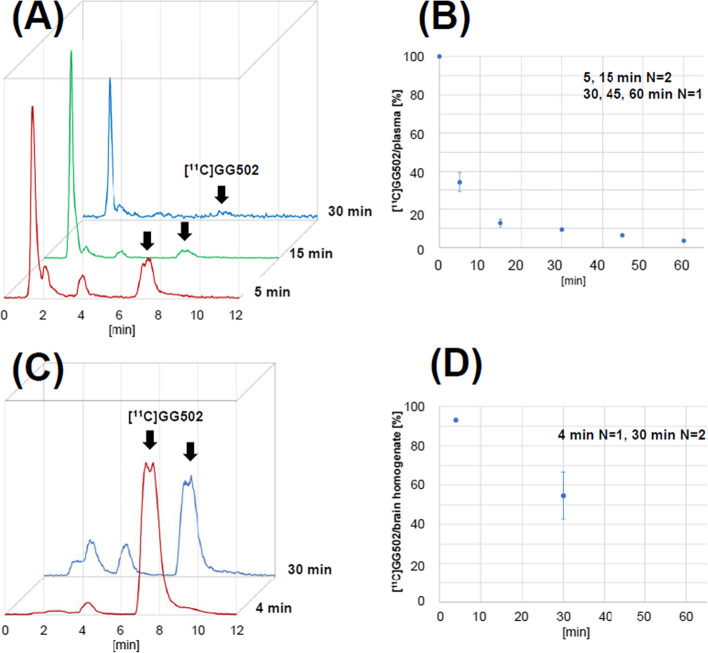
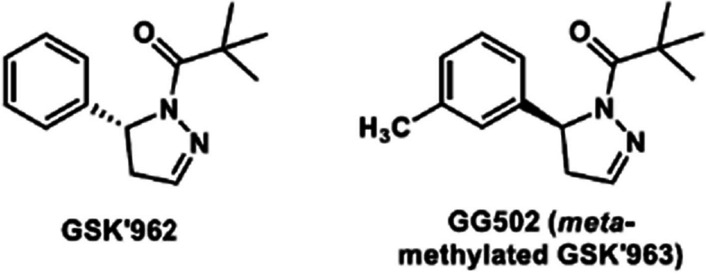
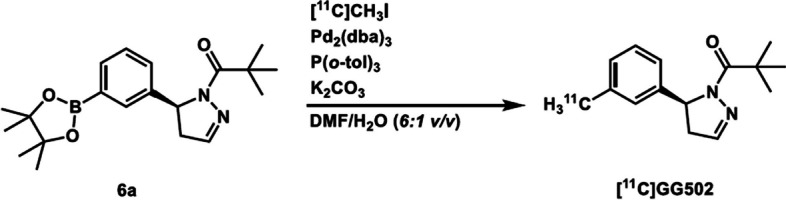
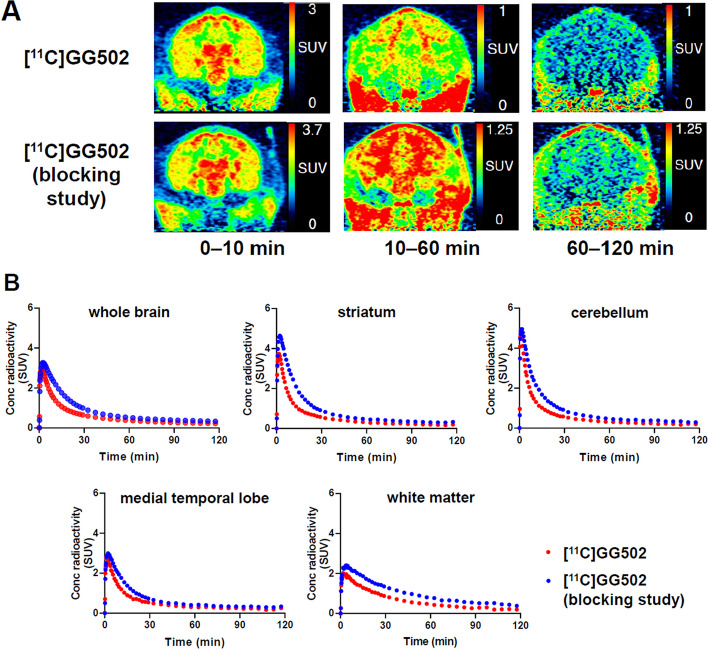
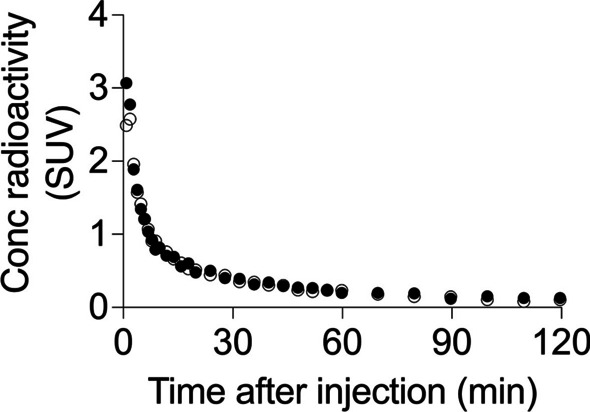
(S)-2,2-dimethyl-1-(5-phenyl-4,5-dihydro-1H-pyrazol-1-yl)propan-1-one (GSK'963) has a high affinity, selectivity for RIPK1, and favorable physiochemical properties based on its chemical structure. In this study, since C-labeling (half-life: 20.4 min) GSK'963 retaining its structure requiring the Grignard reaction of tert-butylmagnesium halides and [C]carbon dioxide was anticipated to give a low yield, we decided instead to C-label a GSK'963 analog ((S)-2,2-dimethyl-1-(5-(m-tolyl)-4,5-dihydro-1H-pyrazol-1-yl)propan-1-one, GG502), which has a high RIPK1 inhibitory activity equivalent to that of the original compound GSK'963. Thus, we successfully C-labeled GG502 using a Pd-mediated cross-coupling reaction in favorable yields (3.6 ± 1.9%) and radiochemical purities (> 96%), and molar activity (47-115 GBq/μmol). On autoradiography, radioactivity accumulation was observed for [C]GG502 and decreased by non-radioactive GG502 in the mouse spleen and human brain, indicating the possibility of specific binding of this ligand to RIPK1. On brain PET imaging in a rhesus monkey, [C]GG502 showed a good brain permeability (peak standardized uptake value (SUV) ~3.0), although there was no clear evidence of specific binding of [C]GG502. On brain PET imaging in acute inflammation model rats, [C]GG502 also showed a good brain permeability, and no significant increased uptake was observed in the lipopolysaccharide-treated side of striatum. On metabolite analysis in rats at 30 min after administration of [C]GG502, ~55% and ~10% of radioactivity was from unmetabolized [C]GG502 in the brain and the plasma, respectively.
We synthesized and evaluated a C-labeled PET ligand based on the methylated analog of GSK'963 for imaging of RIPK1 in the brain. Although in autoradiography of the resulting [C]GG502 indicated the possibility of specific binding, the actual PET imaging failed to detect any evidence of specific binding to RIPK1 despite its good brain permeability. Further development of radioligands with a higher binding affinity for RIPK1 in vivo and more stable metabolite profiles compared with the current compound may be required.
受体相互作用蛋白激酶1(RIPK1)是一种丝氨酸/苏氨酸激酶,可调节程序性细胞死亡和炎症。最近,有报道称RIPK1参与阿尔茨海默病(AD)的病理生理过程;RIPK1参与小胶质细胞向功能失调状态的表型转变,并且在AD患者死后大脑的神经元和小胶质细胞中高表达。它们促使神经退行性变,导致AD中病理性蛋白质的积累。因此,调节RIPK1可能是治疗AD的潜在治疗靶点,RIPK1的体内成像可能成为AD药物发现和病理生理学研究中的一种有用方式。本研究的目的是开发一种适合用于RIPK1正电子发射断层扫描(PET)成像的放射性配体。
(S)-2,2-二甲基-1-(5-苯基-4,5-二氢-1H-吡唑-1-基)丙-1-酮(GSK'963)具有高亲和力、对RIPK1的选择性以及基于其化学结构的良好理化性质。在本研究中,由于预计用碳-11标记(半衰期:20.4分钟)的GSK'963保留其结构需要叔丁基卤化镁与[碳-11]二氧化碳的格氏反应,产率会很低,所以我们决定改为对一种GSK'963类似物((S)-2,2-二甲基-1-(5-(间甲苯基)-4,5-二氢-1H-吡唑-1-基)丙-1-酮,GG502)进行碳-11标记,该类似物具有与原始化合物GSK'963相当的高RIPK1抑制活性。因此,我们使用钯介导的交叉偶联反应成功地对GG502进行了碳-11标记,产率良好(3.6±1.9%),放射化学纯度(>96%),摩尔活性(47 - 115 GBq/μmol)。在放射自显影中,在小鼠脾脏和人脑中观察到[碳-]GG502的放射性积累,并且未标记的GG502可使其降低,这表明该配体与RIPK1特异性结合的可能性。在恒河猴的脑PET成像中,[碳-11]GG502显示出良好的脑通透性(峰值标准化摄取值(SUV)~3.0),尽管没有明确证据表明[碳-11]GG502存在特异性结合。在急性炎症模型大鼠的脑PET成像中,[碳-11]GG502也显示出良好的脑通透性,并且在脂多糖处理侧的纹状体中未观察到明显的摄取增加。在给大鼠注射[碳-11]GG502后30分钟进行代谢物分析,脑中约55%和血浆中约10%的放射性来自未代谢的[碳-11]GG502。
我们合成并评估了一种基于GSK'963甲基化类似物用于脑内RIPK1成像的碳-标记PET配体。尽管所得[碳-11]GG502的放射自显影表明存在特异性结合的可能性,但实际的PET成像未能检测到与RIPK1特异性结合的任何证据,尽管其具有良好的脑通透性。可能需要进一步开发与当前化合物相比在体内对RIPK1具有更高结合亲和力且代谢物谱更稳定的放射性配体。