Jourdeuil Karyn, Neilson Karen M, Cousin Helene, Tavares Andre L P, Majumdar Himani D, Alfandari Dominique, Moody Sally A
Department of Anatomy and Cell Biology, George Washington University, School of Medicine and Health Sciences, Washington, DC, United States.
Department of Veterinary and Animal Sciences, University of Massachusetts, Amherst, MA, United States.
Front Cell Dev Biol. 2023 Oct 3;11:1274788. doi: 10.3389/fcell.2023.1274788. eCollection 2023.
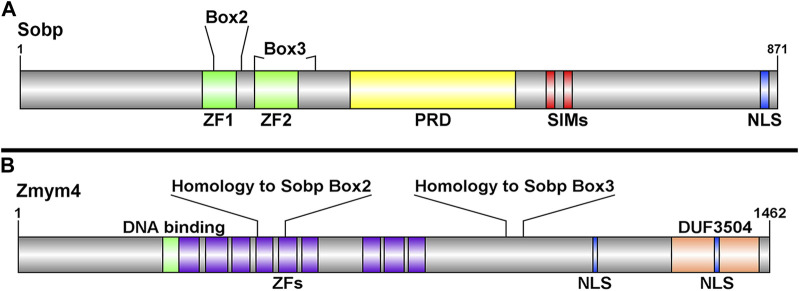
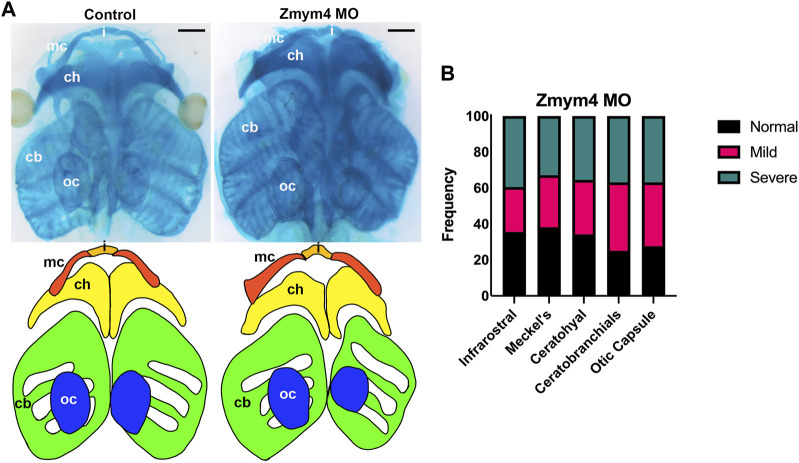
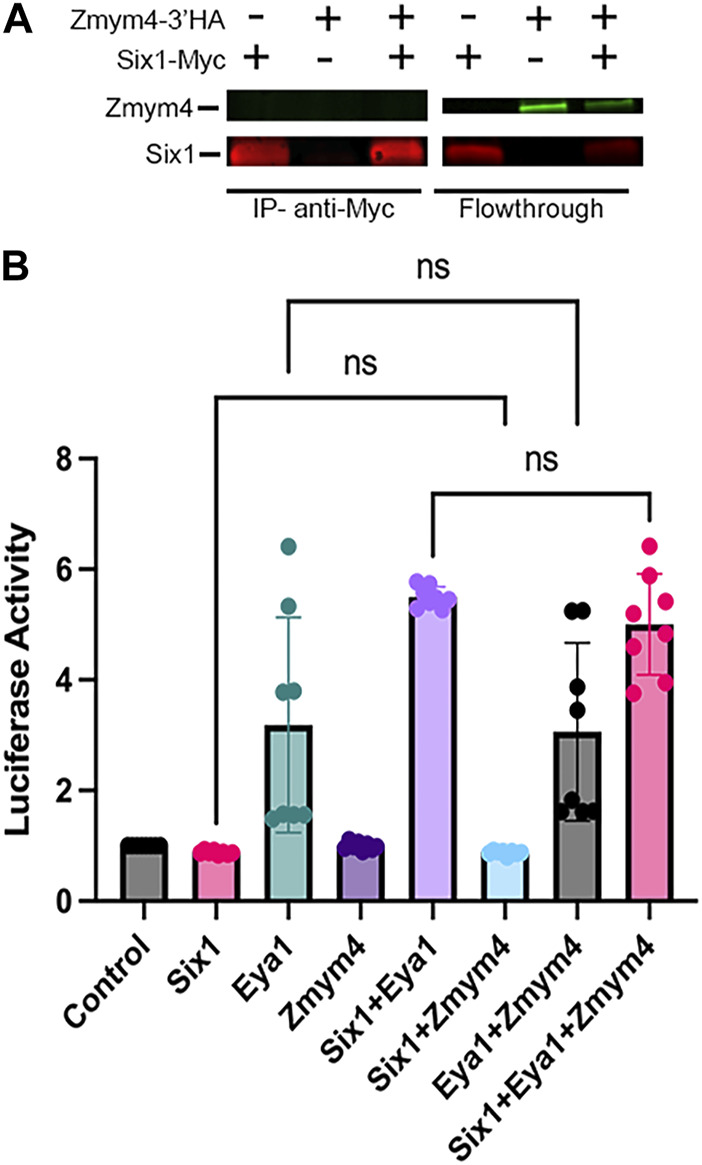
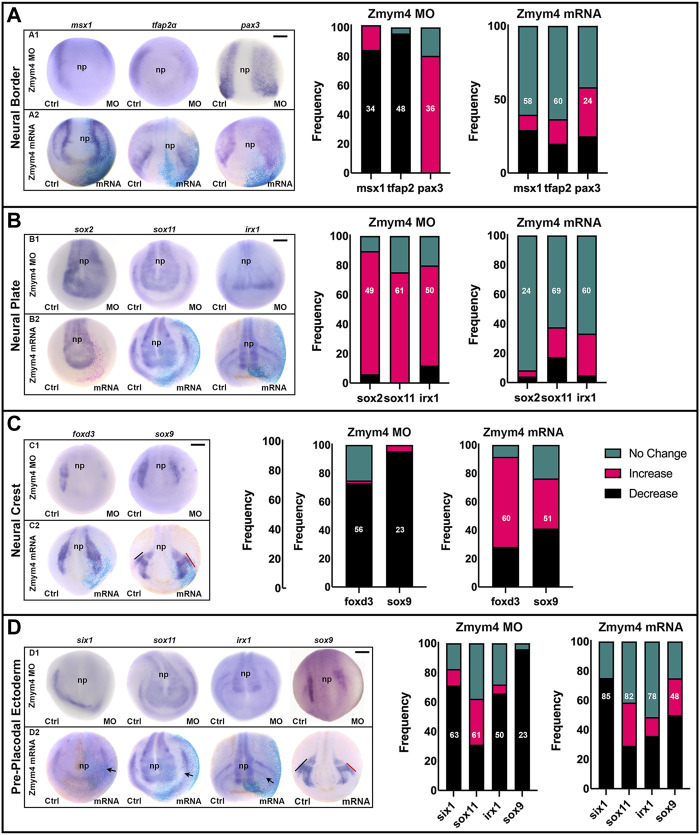
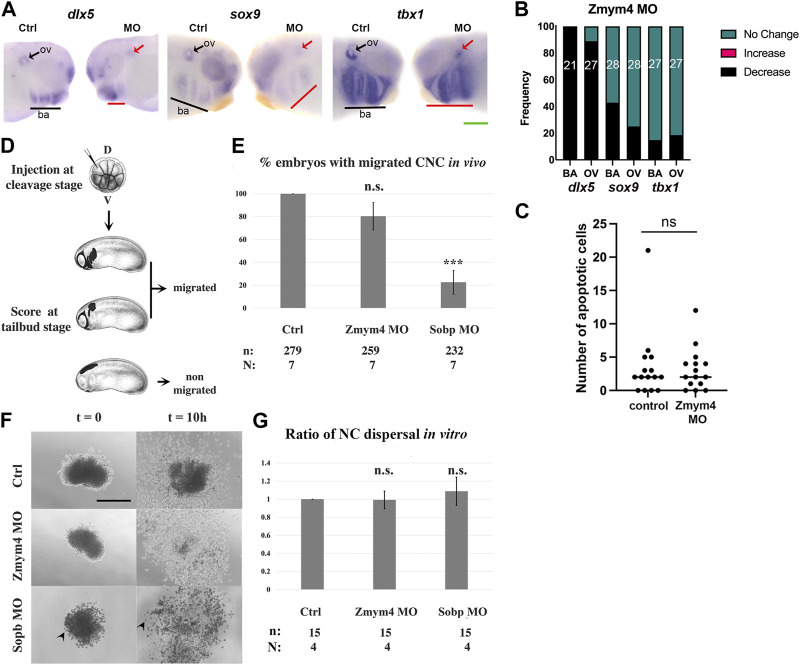
The Six1 transcription factor plays important roles in the development of cranial sensory organs, and point mutations underlie craniofacial birth defects. Because Six1's transcriptional activity can be modulated by interacting proteins, we previously screened for candidate interactors and identified zinc-finger MYM-containing protein 4 (Zmym4) by its inclusion of a few domains with a cofactor, Sine oculis binding protein (Sobp). Although Zmym4 has been implicated in regulating early brain development and certain cancers, its role in craniofacial development has not previously been described. We used co-immunoprecipitation and luciferase-reporter assays in cultured cells to test interactions between Zmym4 and Six1. We used knock-down and overexpression of Zmym4 in embryos to test for its effects on early ectodermal gene expression, neural crest migration and craniofacial cartilage formation. We found no evidence that Zmym4 physically or transcriptionally interacts with Six1 in cultured cells. Nonetheless, knockdown of endogenous Zmym4 in embryos resulted in altered early cranial gene expression, including those expressed in the neural border, neural plate, neural crest and preplacodal ectoderm. Experimentally increasing Zmym4 levels had minor effects on neural border or neural plate genes, but altered the expression of neural crest and preplacodal genes. At larval stages, genes expressed in the otic vesicle and branchial arches showed reduced expression in Zmym4 morphants. Although we did not detect defects in neural crest migration into the branchial arches, loss of Zmym4 resulted in aberrant morphology of several craniofacial cartilages. Although Zmym4 does not appear to function as a Six1 transcriptional cofactor, it plays an important role in regulating the expression of embryonic cranial genes in tissues critical for normal craniofacial development.
Six1转录因子在颅面部感觉器官的发育中起着重要作用,点突变是颅面出生缺陷的基础。由于Six1的转录活性可通过与相互作用蛋白相互作用来调节,我们之前筛选了候选相互作用蛋白,并通过其包含的几个与辅因子眼缺结合蛋白(Sobp)相关的结构域鉴定出含锌指MYM结构域蛋白4(Zmym4)。尽管Zmym4已被证明与早期脑发育和某些癌症的调节有关,但其在颅面发育中的作用此前尚未见报道。我们在培养细胞中使用了免疫共沉淀和荧光素酶报告基因检测来测试Zmym4与Six1之间的相互作用。我们在胚胎中敲低和过表达Zmym4,以测试其对早期外胚层基因表达、神经嵴迁移和颅面软骨形成的影响。我们没有发现证据表明Zmym4在培养细胞中与Six1发生物理或转录相互作用。尽管如此,在胚胎中敲低内源性Zmym4会导致早期颅面基因表达改变,包括那些在神经边界、神经板、神经嵴和前板外胚层中表达的基因。实验性增加Zmym4水平对神经边界或神经板基因影响较小,但改变了神经嵴和前板基因的表达。在幼虫阶段,在内耳泡和鳃弓中表达的基因在Zmym4 morphants中表达降低。虽然我们没有检测到神经嵴迁移到鳃弓中的缺陷,但Zmym4的缺失导致了几个颅面软骨的异常形态。虽然Zmym4似乎不充当Six1转录辅因子,但它在调节对正常颅面发育至关重要的组织中的胚胎颅面基因表达方面起着重要作用。