Institute of Epidemiology, Kiel University, Niemannsweg 11, 24105, Kiel, Germany.
Department of Hematology and Oncology, University Hospital Schleswig Holstein, Kiel, Germany.
Eur J Nutr. 2024 Mar;63(2):365-375. doi: 10.1007/s00394-023-03271-0. Epub 2023 Oct 19.
Dietary pattern scores reflecting a high intake of beneficial food groups were associated with reduced mortality risk. Data on associations of such dietary pattern scores in population-based samples from northern Germany are lacking. Therefore, we examined the association of three dietary pattern scores with all-cause mortality in a moderate-sized prospective sample from northern Germany.
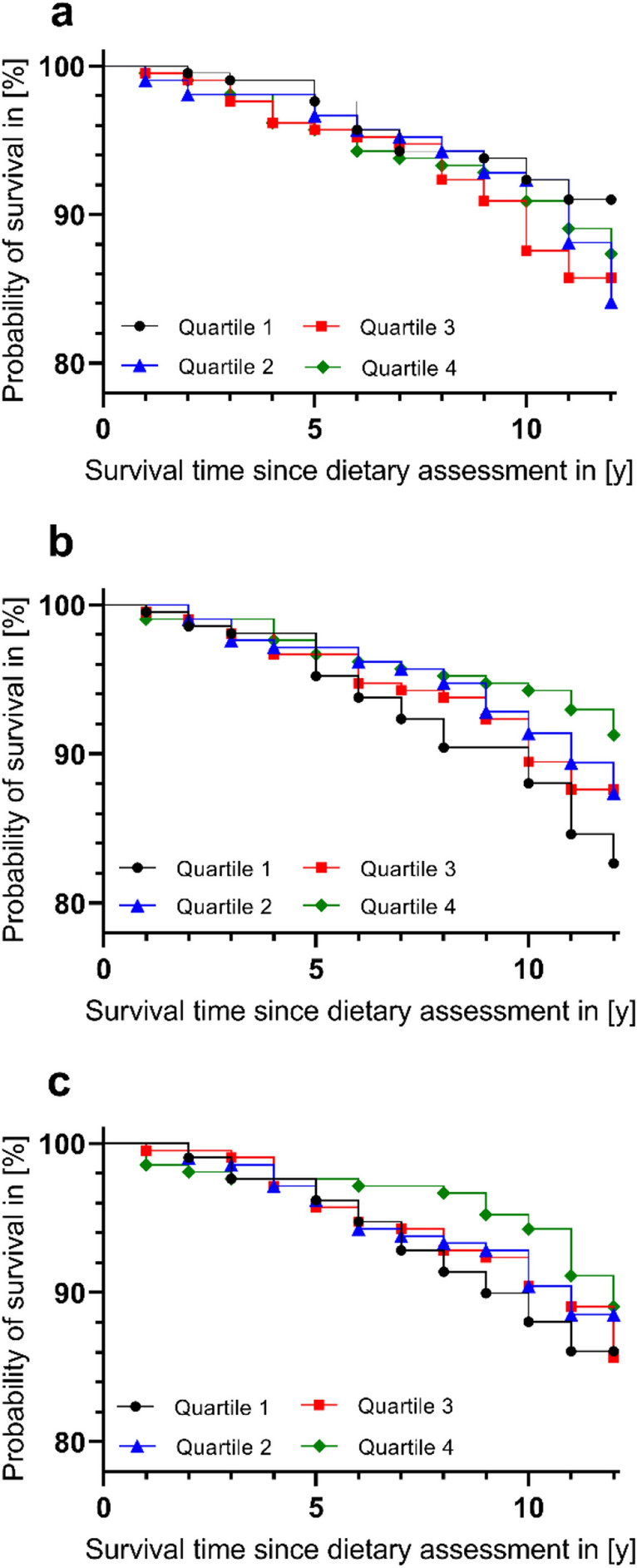
The study sample comprised 836 participants (43.8% females, median age 62.4 years). Based on a validated, self-administered Food Frequency Questionnaire, the dietary scores Dietary Approaches to Stop Hypertension (DASH), Modified Mediterranean Diet Score (MMDS), and Healthy Nordic Food Index (HNFI) were calculated. Cox proportional hazard regression models, adjusted for age, sex, body mass index, waist to hip ratio, education, smoking status, total energy intake, and physical activity, were used to separately relate DASH, MMDS, and HNFI to all-cause mortality.
During a median follow-up period of 11 years, 93 individuals died. While DASH and MMDS scores were not associated with all-cause mortality, greater adherence to HNFI was associated with lower mortality hazards (HR: 0.47 [95% CI 0.25-0.89] when comparing the highest score quartile to the lowest; HR: 0.79 [95% CI 0.64-0.98] for HNFI modeled as a 1-Standard Deviation increment). Among different HNFI components, higher intake of oats and cereals displayed the most conclusive association with all-cause mortality (HR: 0.59 [95% CI 0.38-0.91] when comparing high and low intake).
In an elderly general population sample from northern Germany, we observed greater adherence to HNFI to be associated with lower all-cause mortality.
反映有益食物组高摄入量的饮食模式评分与降低死亡风险相关。缺乏来自德国北部基于人群样本的此类饮食模式评分与死亡率之间关联的数据。因此,我们在德国北部一个中等规模的前瞻性样本中研究了三种饮食模式评分与全因死亡率的关系。
研究样本包括 836 名参与者(43.8%为女性,中位年龄为 62.4 岁)。基于经过验证的自我管理食物频率问卷,计算了饮食评分(DASH、改良地中海饮食评分和健康北欧食品指数)。使用 Cox 比例风险回归模型,调整年龄、性别、体重指数、腰臀比、教育程度、吸烟状况、总能量摄入和体力活动,分别将 DASH、MMDS 和 HNFI 与全因死亡率相关联。
在中位随访 11 年期间,有 93 人死亡。虽然 DASH 和 MMDS 评分与全因死亡率无关,但 HNFI 得分越高,死亡率越低(最高四分位数与最低四分位数相比的 HR:0.47 [95% CI 0.25-0.89];HNFI 作为 1 个标准差增量建模的 HR:0.79 [95% CI 0.64-0.98])。在不同的 HNFI 成分中,燕麦和谷物的摄入量与全因死亡率的相关性最强(高摄入量与低摄入量相比的 HR:0.59 [95% CI 0.38-0.91])。
在德国北部的老年人群样本中,我们观察到 HNFI 得分越高,全因死亡率越低。