Department of Obstetrics and Gynecology, Peking Union Medical College Hospital, Chinese Academy of Medical Sciences & Peking Union Medical College, National Clinical Research Center for Obstetric & Gynecologic Diseases, Beijing, China.
State Key Laboratory of Medical Molecular Biology, Department of Biochemistry and Molecular Biology, Institute of Basic Medical Sciences, Chinese Academy of Medical Sciences and Peking Union Medical College, Beijing, China.
J Gynecol Oncol. 2024 Jan;35(1):e8. doi: 10.3802/jgo.2024.35.e8. Epub 2023 Oct 12.
The TCGA molecular subtype of endometrial cancer (EC) is widely applied, among which the copy-number high (CNH) subtype has the poorest prognosis. However, the heterogeneity of this subtype remains elusive. In this study, we aimed to identify heterogeneous immune subtypes in CNH EC and explore their prognostic significance.
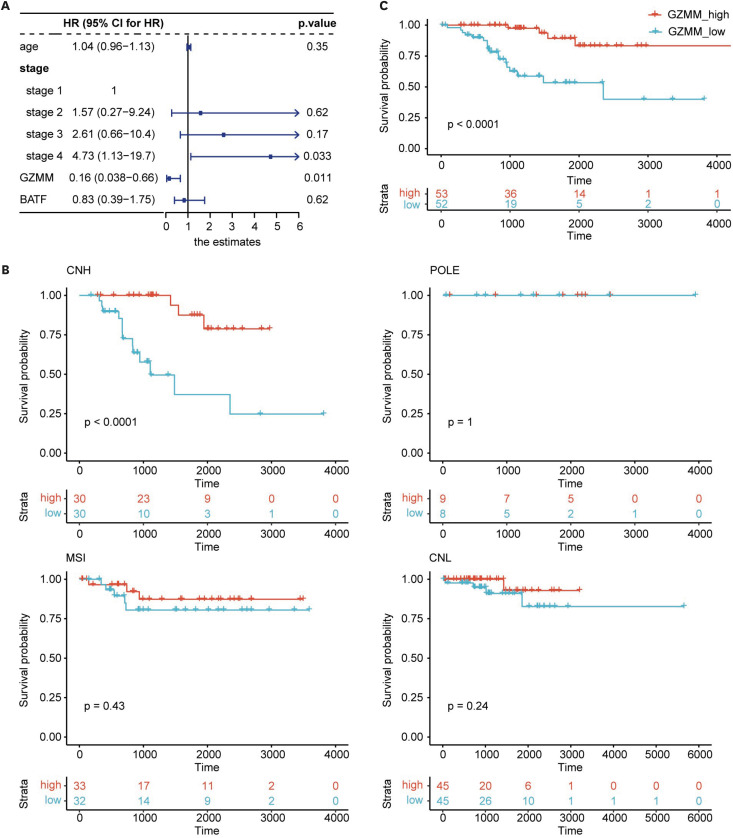
We collected 60 CNH EC cases in the TCGA database and performed unsupervised cluster analysis based on the enrichment scores of immune-related gene signatures to identify immune subtypes. We described their immune characteristics and prognoses and conducted differential gene analysis and lasso regression to identify a prognostic biomarker, GZMM. For experimental validation, we performed immunohistochemical staining of GZMM in 39 p53-positive EC surgical samples.
We defined two immune subtypes, immune-hot (IH) and immune-cold (IC), which differed in immune cell infiltration, cytokine and chemokine expression and prognosis. The IH subtype has significantly stronger immune activation than the IC subtype, showing a significant infiltration of immune effector cells and high expression of relevant chemokines, with better prognosis. Moreover, the immunohistochemical staining of GZMM in a cohort of 39 p53-positive EC surgical samples confirmed GZMM as a unique prognostic biomarker, with high expression in both tumor cells and lymphocytes predicting a better prognosis.
Our study revealed heterogeneous immune subtypes in CNH EC and identified GZMM as a prognostic biomarker. The stratified classification strategy combining molecular and immune subtypes provides valuable insights for future clinical practice.
TCGA 子宫内膜癌(EC)分子亚型被广泛应用,其中拷贝数高(CNH)亚型预后最差。然而,该亚型的异质性仍不清楚。本研究旨在鉴定 CNH EC 中的异质性免疫亚型,并探讨其预后意义。
我们从 TCGA 数据库中收集了 60 例 CNH EC 病例,并基于免疫相关基因特征的富集分数进行无监督聚类分析,以鉴定免疫亚型。我们描述了它们的免疫特征和预后,并进行了差异基因分析和套索回归,以鉴定预后生物标志物 GZMM。为了实验验证,我们对 39 例 p53 阳性 EC 手术样本进行了 GZMM 的免疫组织化学染色。
我们定义了两种免疫亚型,免疫热(IH)和免疫冷(IC),它们在免疫细胞浸润、细胞因子和趋化因子表达和预后方面存在差异。IH 亚型的免疫激活明显强于 IC 亚型,表现为免疫效应细胞的显著浸润和相关趋化因子的高表达,预后较好。此外,对 39 例 p53 阳性 EC 手术样本的 GZMM 免疫组织化学染色证实 GZMM 是一个独特的预后生物标志物,肿瘤细胞和淋巴细胞高表达均预示着较好的预后。
本研究揭示了 CNH EC 中的异质性免疫亚型,并鉴定了 GZMM 作为一个预后生物标志物。结合分子和免疫亚型的分层分类策略为未来的临床实践提供了有价值的见解。