Institute for Quantitative Biomedicine, Rutgers University, 174 Frelinghuysen Road, Piscataway, NJ, 08854, USA.
Department of Biochemistry & Microbiology, Rutgers University, 75 Lipman Drive, New Brunswick, NJ, 08901, USA.
Sci Rep. 2023 Oct 19;13(1):17825. doi: 10.1038/s41598-023-45200-5.
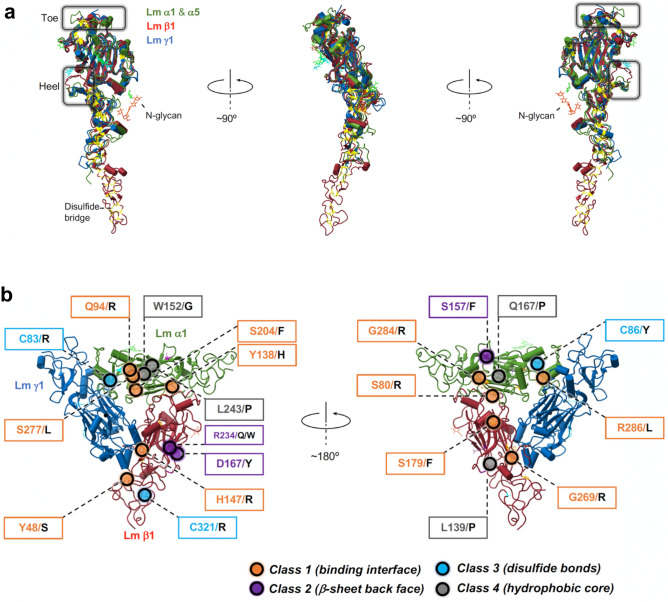
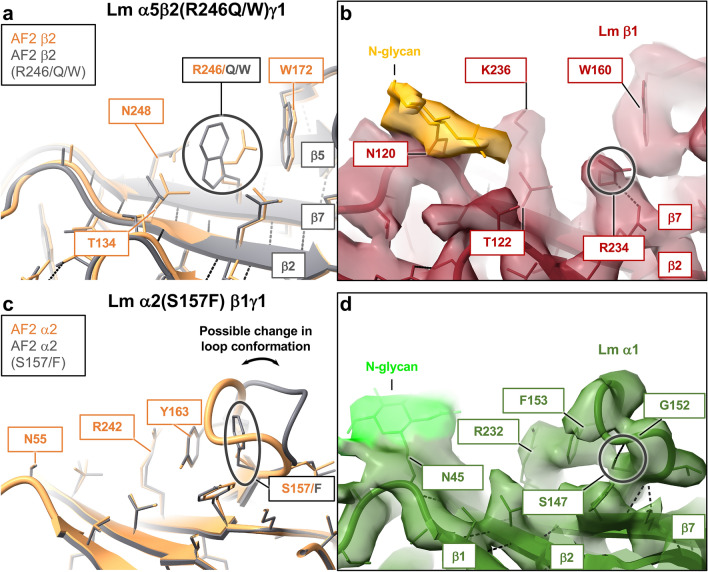
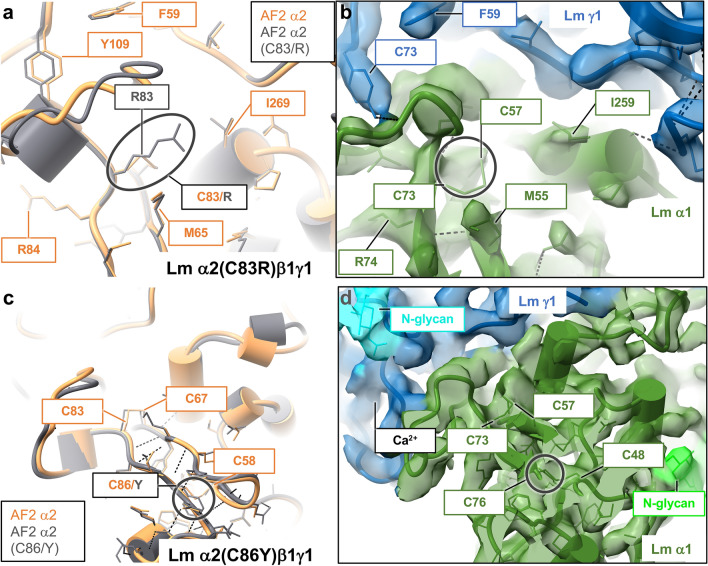
Laminins (Lm) are major components of basement membranes (BM), which polymerize to form a planar lattice on cell surface. Genetic alternations of Lm affect their oligomerization patterns and lead to failures in BM assembly manifesting in a group of human disorders collectively defined as Lm N-terminal domain lamininopathies (LN-lamininopathies). We have employed a recently determined cryo-EM structure of the Lm polymer node, the basic repeating unit of the Lm lattice, along with structure prediction and modeling to systematically analyze structures of twenty-three pathogenic Lm polymer nodes implicated in human disease. Our analysis provides the detailed mechanistic explanation how Lm mutations lead to failures in Lm polymerization underlining LN-lamininopathies. We propose the new categorization scheme of LN-lamininopathies based on the insight gained from the structural analysis. Our results can help to facilitate rational drug design aiming in the treatment of Lm deficiencies.
层粘连蛋白 (Lm) 是基底膜 (BM) 的主要成分,在细胞表面聚合形成平面晶格。Lm 的遗传改变会影响其寡聚化模式,并导致 BM 组装失败,从而表现为一组统称为 Lm N 端结构域层粘连蛋白病 (LN-层粘连蛋白病) 的人类疾病。我们采用了最近确定的 Lm 聚合物节点的冷冻电镜结构,即 Lm 晶格的基本重复单元,以及结构预测和建模,对涉及人类疾病的二十三个致病 Lm 聚合物节点的结构进行了系统分析。我们的分析提供了详细的机制解释,说明 Lm 突变如何导致 Lm 聚合失败,从而导致 LN-层粘连蛋白病。我们根据结构分析的结果提出了 LN-层粘连蛋白病的新分类方案。我们的研究结果有助于促进旨在治疗 Lm 缺乏症的合理药物设计。