Wang Zhi, Li Ying, He Xueru, Fu Yuhao, Li Yajing, Zhou Xin, Dong Zhanjun
Graduate School of Hebei Medical University, Shijiazhuang, China.
Department of Pharmacy, Hebei General Hospital, Shijiazhuang, China.
Front Pharmacol. 2023 Oct 4;14:1263975. doi: 10.3389/fphar.2023.1263975. eCollection 2023.
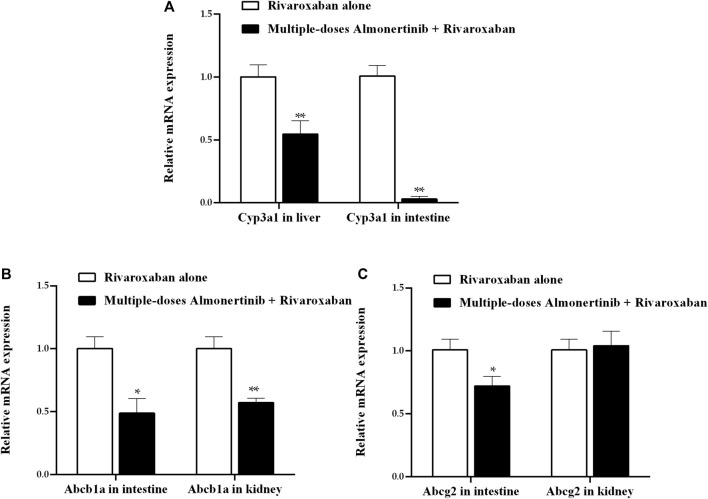
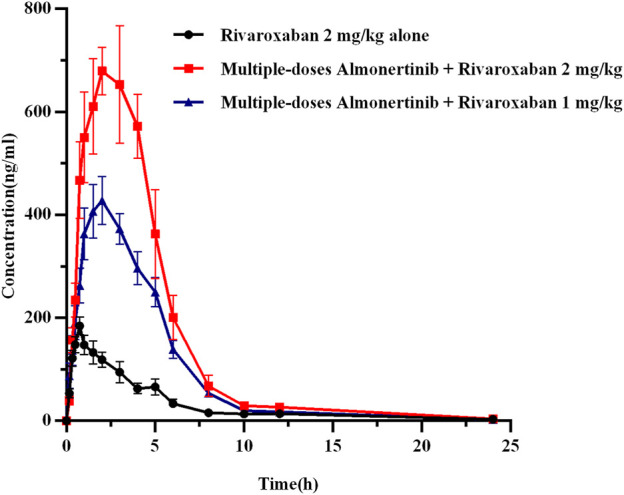
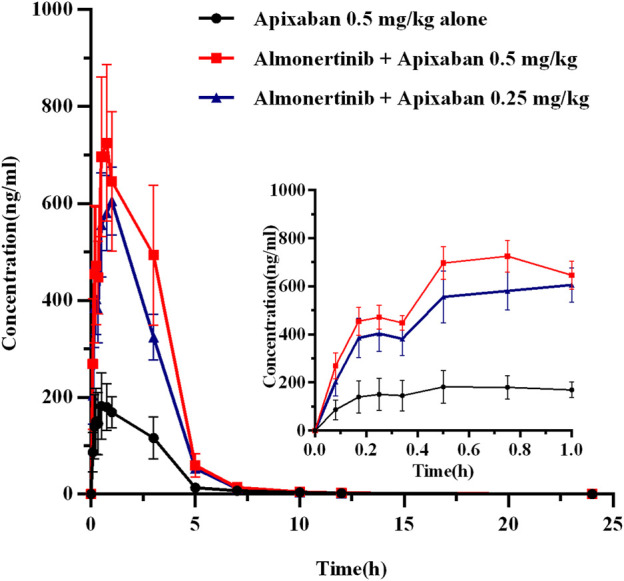
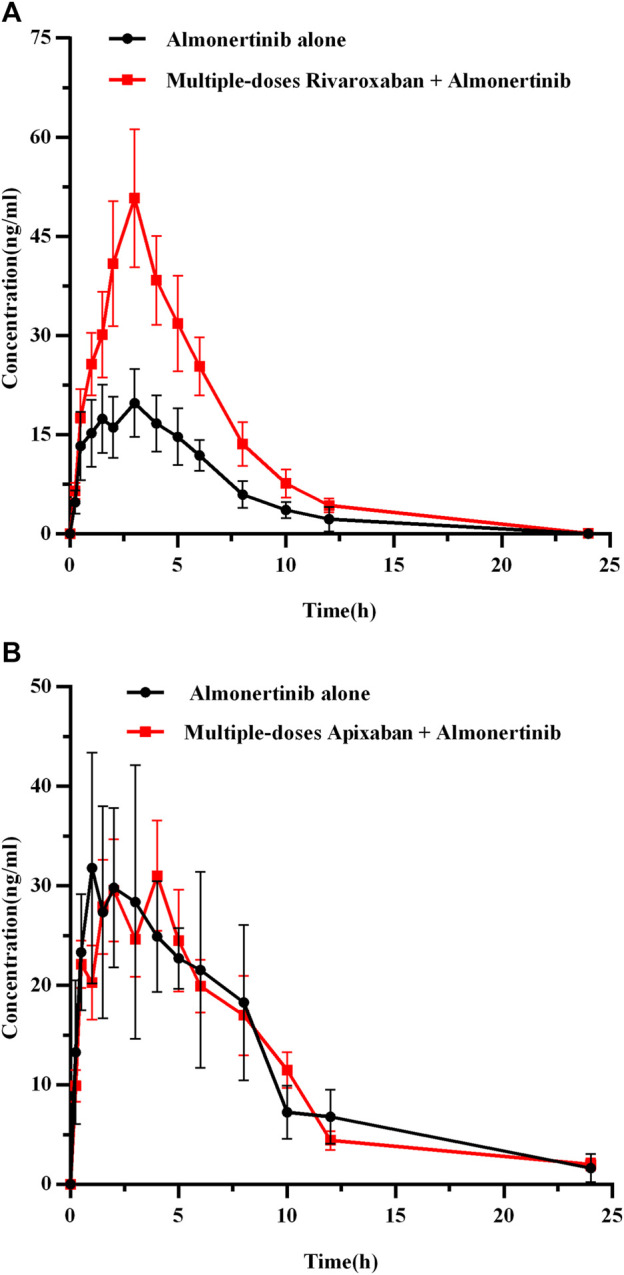
Almonertinib, a third-generation epidermal growth factor receptor tyrosine kinase inhibitor (EGFR-TKI), is commonly used as a first-line treatment for non-small cell lung cancer (NSCLC) patients with EGFR T790M mutations. Rivaroxaban and apixaban are a selective, direct factor Xa inhibitor used to treat venous thromboembolism (VTE), which is a frequent complication of NSCLC. Rivaroxaban and apixaban are substrates of CYP3A4, P-gp and BCRP, whereas almonertinib is an inhibitor of P-gp and BCRP. Rivaroxaban or apixaban are often prescribed together with almonertinib in NSCLC patients, but clear information on pharmacokinetic drug interaction is lacking. Therefore, this study aimed to unravel the extent of interactions between almonertinib-rivaroxaban and almonertinib apixaban in rats, and whether the pharmacokinetic interaction can be mitigated by rivaroxaban and apixaban dose adjustment. Rats were divided into ten groups ( = 6) that received rivaroxaban (2 mg/kg) (group 1), apixaban (0.5 mg/kg) (group 2), almonertinib (15 mg/kg) (group 3, group 4), almonertinib with rivaroxaban (2 mg/kg) (group 5), almonertinib with rivaroxaban (1 mg/kg) (group 6), almonertinib with apixaban (0.5 mg/kg) (group 7), almonertinib with apixaban (0.25 mg/kg) (group 8), rivaroxaban (2 mg/kg) with almonertinib (group 9), apixaban (0.5 mg/kg) with almonertinib (group 10). The concentrations of drugs were determined by an ultra-performance liquid chromatography tandem mass spectrometry (UPLC-MS/MS). The levels of messenger RNA were determined using quantitative real-time polymerase chain reaction (qRT-PCR). The results indicate that almonertinib increased the C and AUC of 2 mg/kg rivaroxaban by 3.30 and 3.60-fold, 1 mg/kg rivaroxaban by 1.28 and 1.90-fold. Almonertinib increased the C and AUC of 0.5 mg/kg apixaban by 2.69 and 2.87-fold, 0.25 mg/kg apixaban by 2.19 and 2.06-fold. In addition, rivaroxaban also increased systemic exposure to almonertinib. The results of qRT-PCR showed that almonertinib reduced the expression of Cyp3a1 in liver and intestine, and Abcb1a, Abcg2 in intestine and kidney. The pharmacokinetic results suggest that it is important to take special care of the interactions of these drugs in clinical applications.
阿美替尼是一种第三代表皮生长因子受体酪氨酸激酶抑制剂(EGFR-TKI),常用于治疗具有EGFR T790M突变的非小细胞肺癌(NSCLC)患者。利伐沙班和阿哌沙班是用于治疗静脉血栓栓塞(VTE)的选择性、直接Xa因子抑制剂,VTE是NSCLC的常见并发症。利伐沙班和阿哌沙班是CYP3A4、P-糖蛋白和乳腺癌耐药蛋白(BCRP)的底物,而阿美替尼是P-糖蛋白和BCRP的抑制剂。在NSCLC患者中,利伐沙班或阿哌沙班常与阿美替尼联合使用,但缺乏关于药代动力学药物相互作用的明确信息。因此,本研究旨在揭示阿美替尼-利伐沙班和阿美替尼-阿哌沙班在大鼠体内的相互作用程度,以及利伐沙班和阿哌沙班剂量调整是否可以减轻药代动力学相互作用。将大鼠分为十组(每组n = 6),分别接受利伐沙班(2 mg/kg)(第1组)、阿哌沙班(0.5 mg/kg)(第2组)、阿美替尼(15 mg/kg)(第3组、第4组)、阿美替尼与利伐沙班(2 mg/kg)(第5组)、阿美替尼与利伐沙班(1 mg/kg)(第6组)、阿美替尼与阿哌沙班(0.5 mg/kg)(第7组)、阿美替尼与阿哌沙班(0.25 mg/kg)(第8组)、利伐沙班(2 mg/kg)与阿美替尼(第9组)、阿哌沙班(0.5 mg/kg)与阿美替尼(第10组)。通过超高效液相色谱串联质谱法(UPLC-MS/MS)测定药物浓度。使用定量实时聚合酶链反应(qRT-PCR)测定信使核糖核酸水平。结果表明,阿美替尼使2 mg/kg利伐沙班的Cmax和AUC分别增加3.30倍和3.60倍,使1 mg/kg利伐沙班的Cmax和AUC分别增加1.28倍和1.90倍。阿美替尼使0.5 mg/kg阿哌沙班的Cmax和AUC分别增加2.69倍和2.87倍,使0.25 mg/kg阿哌沙班的Cmax和AUC分别增加2.19倍和2.06倍。此外,利伐沙班也增加了阿美替尼的全身暴露量。qRT-PCR结果显示,阿美替尼降低了肝脏和肠道中Cyp3a1以及肠道和肾脏中Abcb1a、Abcg2的表达。药代动力学结果表明,在临床应用中特别关注这些药物的相互作用很重要。