Department of School Health, Shenyang Center for Disease Control and Prevention, Shenyang, China.
Department of Nutrition and Food Hygiene, School of Public Health, Shenyang Medical College, Shenyang, China.
Medicine (Baltimore). 2023 Oct 20;102(42):e35536. doi: 10.1097/MD.0000000000035536.
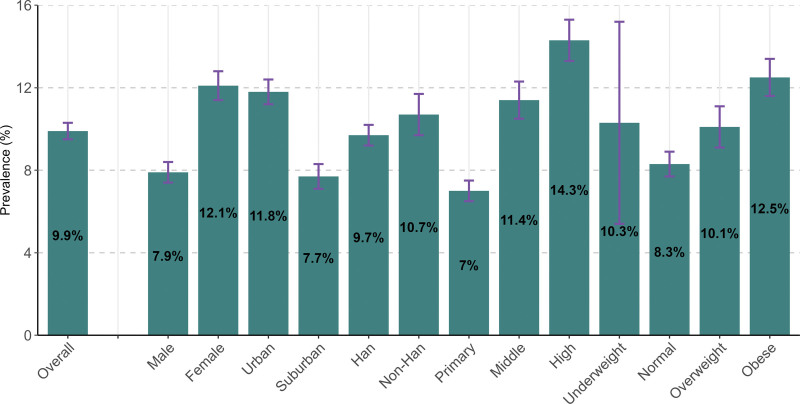
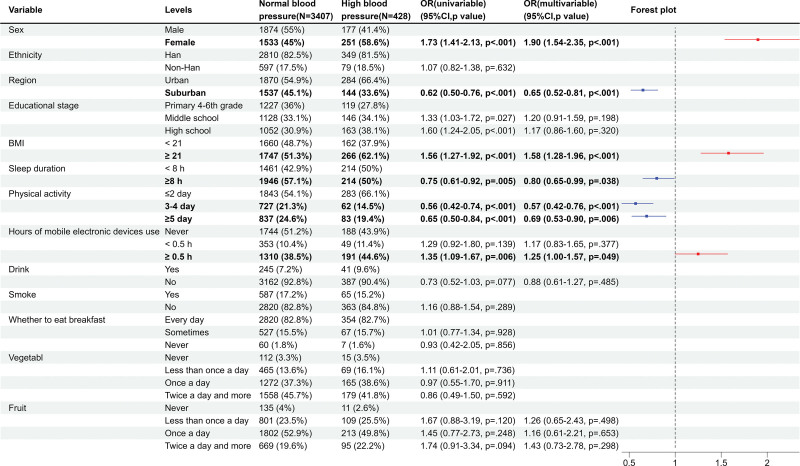
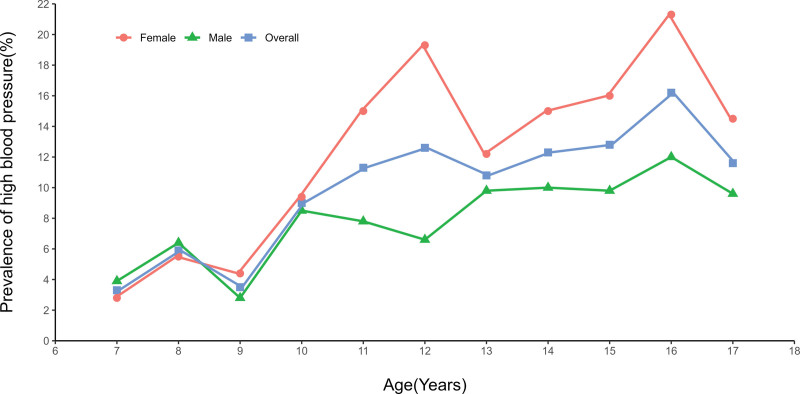
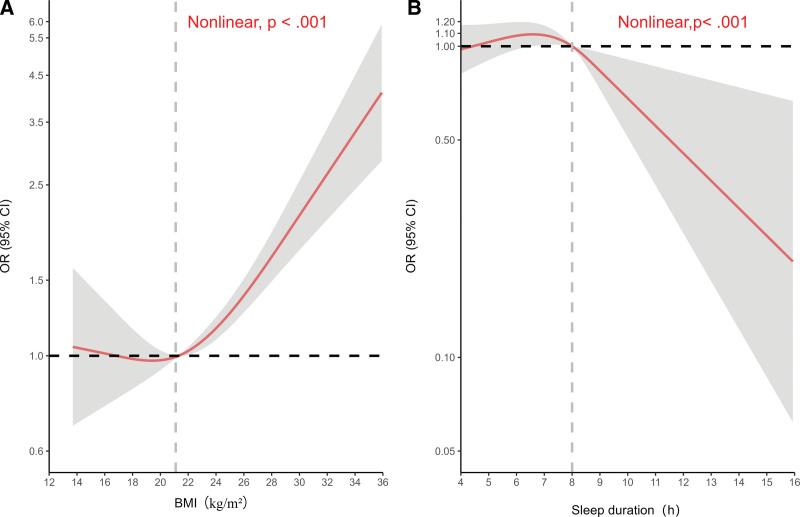
There is growing evidence that the prevalence of high blood pressure is increasing, and it may have serious consequences. However, research on the prevalence and influencing factors of high blood pressure among primary and secondary school students is still relatively scarce. This study aims to investigate the prevalence and influencing factors of high blood pressure among primary and secondary school students in Shenyang, in order to provide scientific evidence for the prevention and management of this disease. From April to May 2020, 4892 students aged 7 to 17 years were selected as the survey subjects, and on-site physical measurements and questionnaire surveys were conducted. The prevalence of high blood pressure was described. Restricted cubic spline was used to analyze the dose-response relationship between sleep duration, BMI and the risk of high blood pressure. Logistic regression was used to analyze the risk factors. Multiplicative and additive models were used to analyze the interaction between sleep duration and BMI. The results showed that the overall prevalence of high blood pressure among students aged 7 to 17 years in Shenyang was 9.9%, with a higher prevalence in females than males (12.1% vs 7.9%) and in urban areas than suburban areas (11.8% vs 7.7%). The prevalence was lowest in students with normal weight (8.3%) and highest in those who were obese (12.5%). The prevalence fluctuated to some extent among different age groups, but overall, it increased with age, with the lowest prevalence in primary school students (7.0%), 11.4% in mild school students, and the highest prevalence of 14.3% in high school students. Multivariable analysis showed that the risk of high blood pressure in female students was 1.90 times higher than that in male students (95% CI: 1.54-2.35), and the risk in suburban areas was 0.65 times lower than that in urban areas (95% CI: 0.52-0.81). Students with a BMI ≥ 21 kg/m2 had a 1.58 times higher risk than those with a BMI < 21 kg/m2(95% CI: 1.28-1.96), while those with a sleep time ≥ 8 hours had a 0.80 times lower risk than those with a sleep time < 8 hours (95% CI: 0.65-0.99). Exercise can significantly reduce the risk of high blood pressure, while using electronic devices for more than 0.5 hours significantly increases the risk of high blood pressure. BMI and sleep duration have no interaction effect on the risk of high blood pressure. To reduce the prevalence of high blood pressure, students should reduce the use of electronic devices, ensure adequate exercise, maintain a reasonable weight, and ensure sufficient sleep.
目前有越来越多的证据表明,高血压的患病率正在上升,它可能会产生严重的后果。然而,关于中小学生高血压的患病率和影响因素的研究仍然相对较少。本研究旨在调查沈阳市中小学生高血压的患病率和影响因素,为该疾病的预防和管理提供科学依据。2020 年 4 月至 5 月,选取沈阳市 7-17 岁学生 4892 名为调查对象,进行现场体格测量和问卷调查。描述高血压的患病率。采用限制性立方样条分析睡眠时间、BMI 与高血压发病风险的剂量-反应关系。采用 Logistic 回归分析高血压的危险因素。采用乘法和加法模型分析睡眠时间和 BMI 之间的交互作用。结果显示,沈阳市 7-17 岁学生高血压总患病率为 9.9%,女生高于男生(12.1%比 7.9%),城区高于郊区(11.8%比 7.7%)。其中,正常体重学生的患病率最低(8.3%),肥胖学生的患病率最高(12.5%)。不同年龄组之间患病率有一定波动,但总体上随年龄增长而升高,小学学生患病率最低(7.0%),初中生为 11.4%,高中生最高(14.3%)。多因素分析显示,女生高血压发病风险是男生的 1.90 倍(95%CI:1.54-2.35),郊区学生高血压发病风险是城区学生的 0.65 倍(95%CI:0.52-0.81)。BMI≥21kg/m2 的学生高血压发病风险是 BMI<21kg/m2 的学生的 1.58 倍(95%CI:1.28-1.96),睡眠时间≥8 小时的学生高血压发病风险是睡眠时间<8 小时的学生的 0.80 倍(95%CI:0.65-0.99)。运动可显著降低高血压发病风险,而每天使用电子设备>0.5 小时会显著增加高血压发病风险。BMI 和睡眠时间对高血压发病风险无交互作用。为降低高血压患病率,学生应减少电子设备使用,保证充足运动,维持合理体重,保证充足睡眠。