Caring Futures Institute, Flinders University, Adelaide, Australia.
Australian Centre for Health Services Innovation, Queensland University of Technology, Brisbane, Australia.
BMC Health Serv Res. 2023 Oct 20;23(1):1132. doi: 10.1186/s12913-023-10116-3.
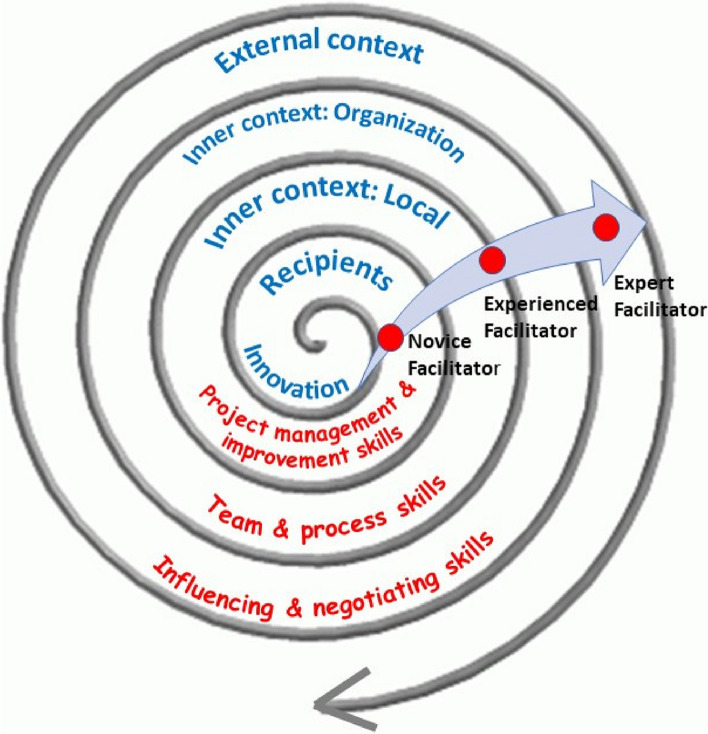
The Promoting Action on Research Implementation in Health Services (PARIHS) and integrated-PARIHS (i-PARIHS) frameworks position facilitation as an overarching strategy to enable implementation. In the revised i-PARIHS framework, facilitation is operationalised through a multi-level model with novice, experienced and expert facilitators working together in a network structure to build facilitation knowledge and skills along a continuum. To date, there has been limited evaluation of this facilitation model in practice, which is the aim of the study reported here.
A descriptive, qualitative longitudinal study was undertaken to track a team of four novice and two experienced facilitators involved in facilitating the implementation of an intervention known as 'Eat Walk Engage' to improve multidisciplinary team delivery of age-friendly care principles in hospital. Over an 18-month period, repeat interviews were conducted to explore the learning, development, and evolving roles of novice facilitators and the roles of the experienced facilitators in providing support and mentoring. Interview data were analysed using a descriptive qualitative approach and findings were interpreted in collaboration with the participating facilitators.
The findings demonstrated experiential learning in both the novice and experienced facilitator groups as they enacted their roles in practice. The novice facilitators progressively transitioned to becoming more experienced facilitators and the experienced facilitators became increasingly expert, in line with the i-PARIHS concept of a facilitation journey from novice to expert. Strategies to support this development included a staggered approach to learning, regular meetings between the experienced and novice facilitators, reflective writing and informal peer support and networking. However, the roles were not without challenge and these challenges changed over time, from a more specific focus on the demands of the facilitator role to concerns about embedding and sustaining improvements in practice.
Within a network of peers and a mentored relationship with more experienced facilitators, individuals who are new to an implementation facilitator role can transition along a continuum to become experienced facilitators. Building implementation facilitation capability in this way takes time and requires tailored support and mentorship using a mix of structured and flexible approaches incorporating opportunities for reflection to support individual and group learning.
促进卫生服务实施行动研究(PARIHS)和综合 PARIHS(i-PARIHS)框架将促进作为一种总体策略,以实现实施。在修订后的 i-PARIHS 框架中,促进通过一个多层次模型来运作,新手、经验丰富和专家促进者在网络结构中共同工作,沿着一个连续体建立促进知识和技能。迄今为止,该促进模式在实践中的评估有限,这是本报告所研究的目的。
进行了一项描述性的、纵向的定性研究,以跟踪一组四名新手和两名经验丰富的促进者,他们参与促进一项名为“Eat Walk Engage”的干预措施的实施,以改善医院多学科团队提供适合老年人护理原则的服务。在 18 个月的时间里,重复进行了访谈,以探索新手促进者的学习、发展和不断变化的角色,以及经验丰富的促进者在提供支持和指导方面的角色。使用描述性定性方法对访谈数据进行分析,并与参与的促进者合作解释研究结果。
研究结果表明,在新手和经验丰富的促进者群体中都存在经验学习,因为他们在实践中扮演了自己的角色。新手促进者逐渐过渡到更有经验的促进者,而经验丰富的促进者则越来越成为专家,这符合 i-PARIHS 促进者从新手到专家的促进之旅的概念。支持这种发展的策略包括分阶段学习、经验丰富的促进者和新手促进者之间的定期会议、反思性写作以及非正式的同行支持和网络。然而,这些角色并非没有挑战,而且这些挑战随着时间的推移而变化,从更具体地关注促进者角色的需求到关注在实践中嵌入和维持改进。
在同行网络和与经验丰富的促进者的指导关系中,新的实施促进者角色可以沿着一个连续体过渡到成为有经验的促进者。以这种方式建立实施促进能力需要时间,并需要使用结构化和灵活的方法相结合的定制支持和指导,包括提供反思的机会,以支持个人和小组学习。