Department of Life Sciences, Aberystwyth University, Aberystwyth, SY23 3DA, UK.
Wales Veterinary Science Centre, Y Buarth, Aberystwyth, SY23 1ND, Ceredigion, UK.
Sci Rep. 2023 Oct 21;13(1):18016. doi: 10.1038/s41598-023-44822-z.
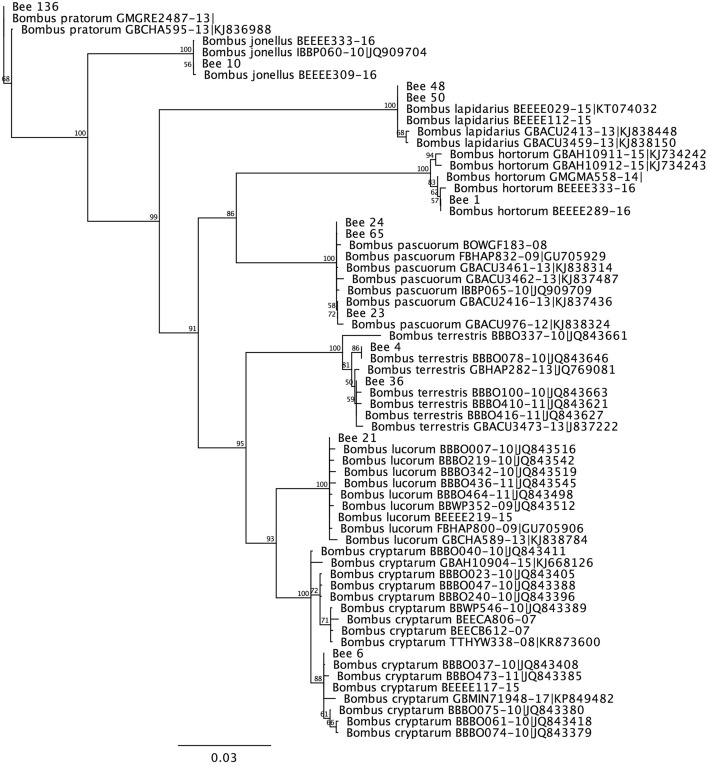
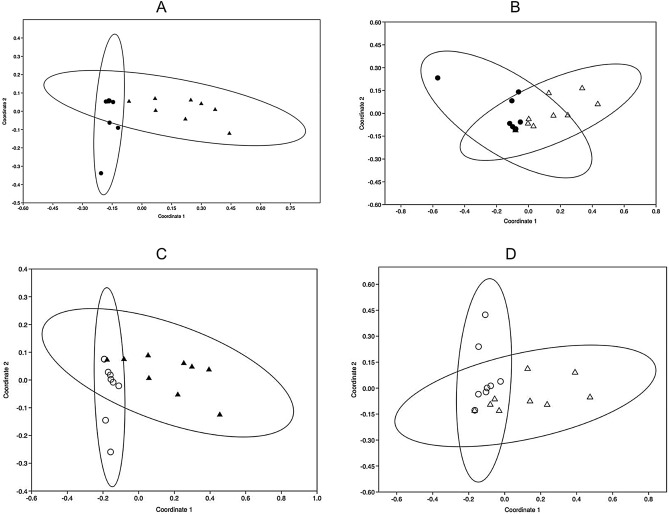
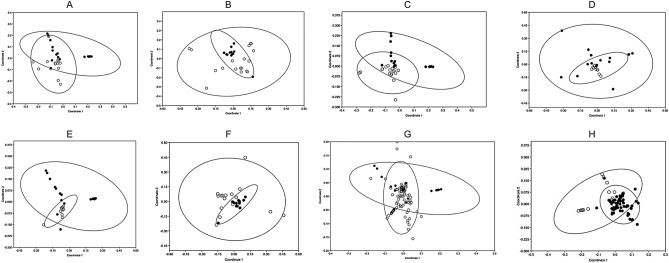
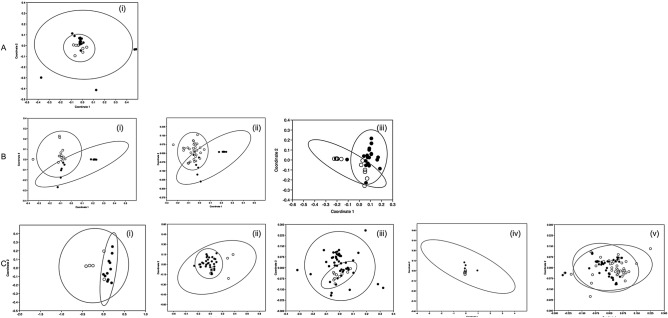
Predicting ecological impact of declining bumblebee (Bombus) populations requires better understanding of interactions between pollinator partitioning of floral resources and plant partitioning of pollinator resources. Here, we combine Cytochrome Oxidase 1 (CO1) barcoding for bumblebee identification and rbcL metabarcoding of pollen carried by bees in three species-rich UK pastures. CO1 barcoding assigned 272 bees to eight species, with 33 individuals belonging to the cryptic Bombus lucorum complex (16 B. lucorum and 17 B. cryptarum). Seasonal bias in capture rates varied by species, with B. pratorum found exclusively in June/July and B. pascuorum more abundant in August. Pollen metabarcoding coupled with PERMANOVA and NMDS analyses revealed all bees carried several local pollen species and evidence of pollen resource partitioning between some species pairings, with Bombus pratorum carrying the most divergent pollen load. There was no evidence of resource partitioning between the two cryptic species present, but significantly divergent capture rates concorded with previous suggestions of separation on the basis of foraging behaviour being shaped by local/temporal differences in climatic conditions. Considering the bee carriage profile of pollen species revealed no significant difference between the nine most widely carried plant species. However, there was a sharp, tipping point change in community pollen carriage across all three sites that occurred during the transition between late July and early August. This transition resulted in a strong divergence in community pollen carriage between the two seasonal periods in both years. We conclude that the combined use of pollen and bee barcoding offers several benefits for further study of plant-pollinator interactions at the landscape scale.
预测蜂群(Bombus)数量下降对生态的影响,需要更好地理解传粉者对花卉资源的分区和植物对传粉者资源的分区之间的相互作用。在这里,我们结合了用于鉴定熊蜂的细胞色素氧化酶 1(CO1)条形码和蜜蜂携带的花粉的 rbcL 代谢条形码,对英国三个物种丰富的牧场上的三种物种进行了研究。CO1 条形码将 272 只蜜蜂分配到了 8 个物种,其中 33 只属于隐密的熊蜂属(16 只熊蜂 lucorum 和 17 只熊蜂 cryptarum)。捕获率的季节性偏差因物种而异,B. pratorum 仅在 6/7 月发现,B. pascuorum 在 8 月更为丰富。花粉代谢条形码与 PERMANOVA 和 NMDS 分析相结合,显示所有的蜜蜂都携带了几种本地花粉物种,并且存在一些物种对之间的花粉资源分区的证据,其中 B. pratorum 携带的花粉负荷最具差异。在两种隐密种之间没有发现资源分区的证据,但明显不同的捕获率与基于觅食行为的分离相一致,这些行为是由局部/时间上气候条件的差异所塑造的。考虑到花粉物种的蜜蜂携带情况,在所研究的 9 种最广泛携带的植物物种之间没有发现显著差异。然而,在 7 月底和 8 月初之间的过渡期间,所有三个地点的群落花粉携带情况都发生了急剧的转折点变化。这种转变导致了两年中两个季节期间群落花粉携带情况的强烈分歧。我们得出结论,花粉和蜜蜂条形码的联合使用为进一步研究景观尺度上的植物-传粉者相互作用提供了一些好处。