Yapici Burak, Sahin Ozlem Gokdogan
Chemical Engineering Department, Konya Technical University, 42250 Konya, Turkey.
ACS Omega. 2023 Oct 2;8(41):38577-38586. doi: 10.1021/acsomega.3c05531. eCollection 2023 Oct 17.
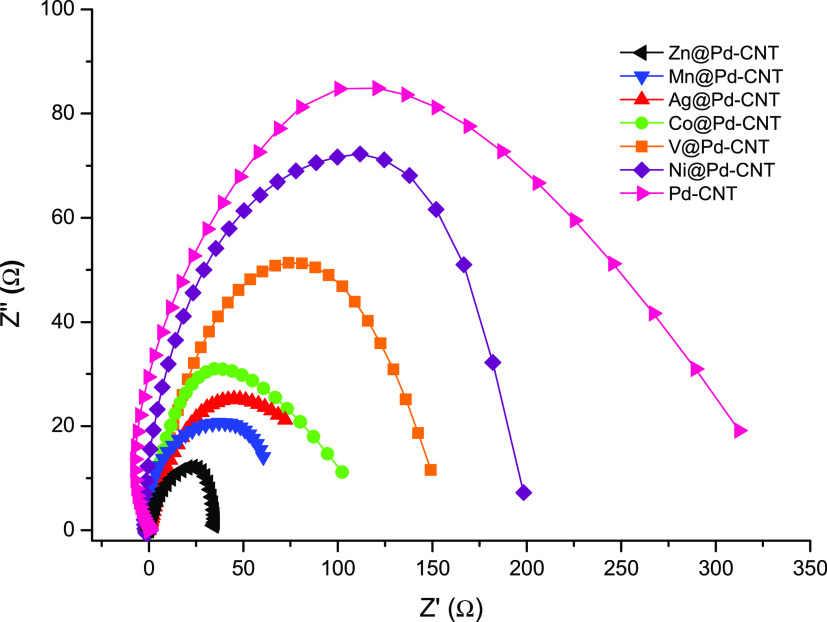
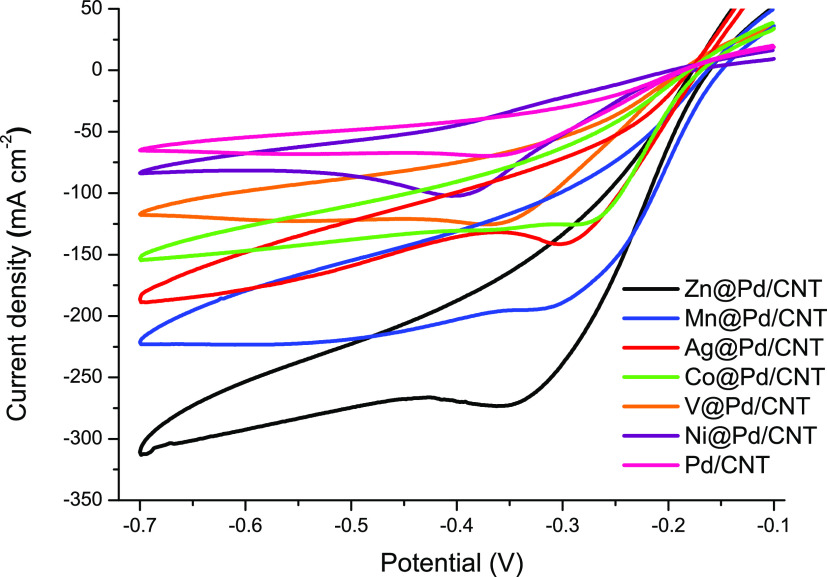
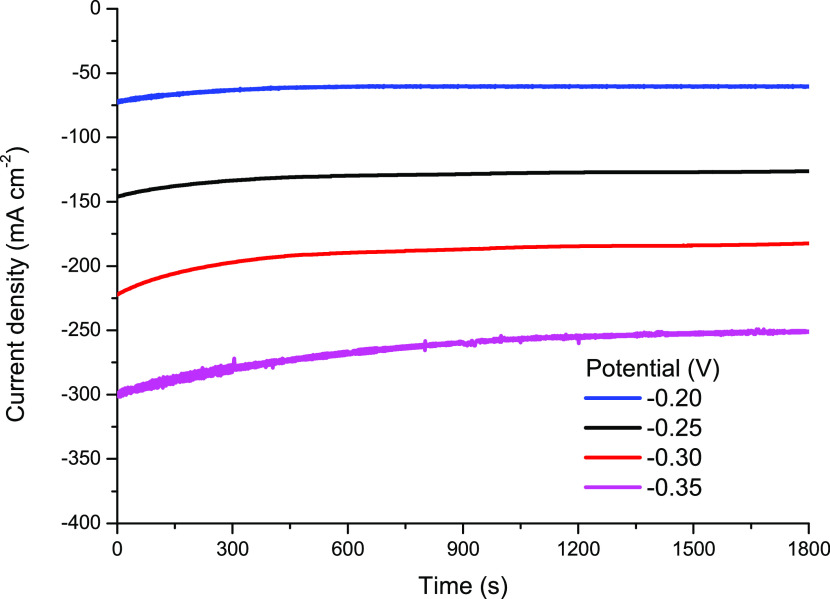
M@Pd/CNT (M: Zn, Mn, Ag, Co, V, Ni) core-shell and Pd/CNT nanoparticles were prepared by sodium borohydride reduction and explored as cathode catalysts for the hydrogen peroxide reduction reaction. Electrochemical and physical characterization techniques are applied to explore the characteristics of the produced electrocatalysts. The cyclic voltammetry (CV) experiments show that Zn@Pd/CNT-modified electrodes have a current density of 273.2 mA cm, which is 3.95 times higher than that of Pd/CNT. According to the chronoamperometric curves, Zn@Pd/CNT has the highest steady-state current density for the HO electro-reduction process among the synthesized electrocatalysts. Moreover, electrochemical impedance spectroscopy (EIS) spectra confirmed the previous electrochemical results due to the lowest charge transfer resistance (35 Ω) with respect to other electrocatalysts.
通过硼氢化钠还原法制备了M@Pd/CNT(M:锌、锰、银、钴、钒、镍)核壳结构和Pd/CNT纳米颗粒,并将其作为过氧化氢还原反应的阴极催化剂进行了探索。应用电化学和物理表征技术来探究所制备的电催化剂的特性。循环伏安法(CV)实验表明,Zn@Pd/CNT修饰电极的电流密度为273.2 mA/cm²,比Pd/CNT高3.95倍。根据计时电流曲线,在合成的电催化剂中,Zn@Pd/CNT在HO电还原过程中具有最高的稳态电流密度。此外,电化学阻抗谱(EIS)光谱证实了先前的电化学结果,因为相对于其他电催化剂,其电荷转移电阻最低(35Ω)。