Shiraishi Takeshi, Midorikawa Kensuke, Miyahara So, Waseda Ryuichi, Sato Toshihiko
Center of Organ Transplant Medicine (Lung Transplant Unit), Fukuoka University Hospital, Fukuoka, Japan.
Department of General Thoracic, Breast and Pediatric Surgery, Fukuoka University School of Medicine, Fukuoka, Japan.
J Thorac Dis. 2023 Sep 28;15(9):5204-5212. doi: 10.21037/jtd-22-1861. Epub 2023 Aug 17.
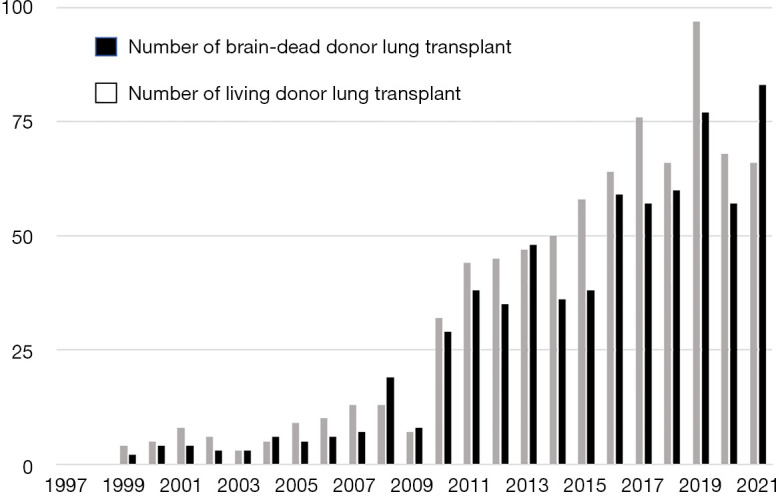
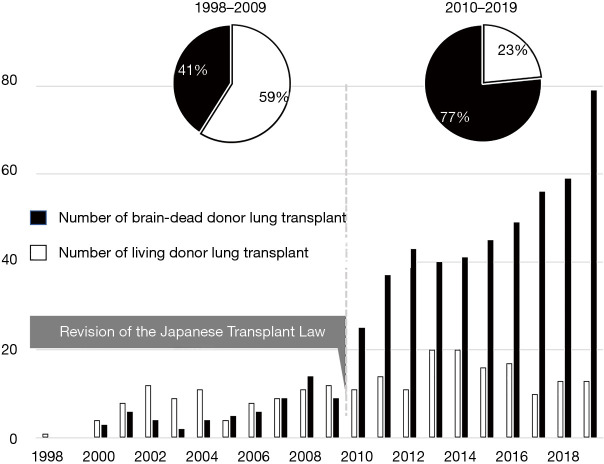
Japan is a unique country in terms of organ transplantation. Despite the impressive progress in transplant medicine achieved during the late 20th century in many Western countries, Japan was unable to implement a program for organ transplants from brain-dead donors due to persistent public distrust regarding the ethical understanding of "brain death as human death". In 1997, the Japanese Organ Transplant Law was enacted, and organ transplantation from brain-dead donors was finally legalized. However, this law was strongly opposed by religious leaders, philosophers, politicians, and even medical personnel who did not accept the idea that brain death is human death, so transplant physicians had to start performing transplants in the face of strong social resistance. The Japanese National Lung Transplant System was established based on the following three philosophies: (I) an institutional certification system based on strict standards; (II) a rigorous central monitoring system for transplant results; and (III) a third-party review system to determine eligibility for patient registration. The purpose of these policies was to avoid ethical issues at lung transplant institutes, and to achieve high-quality transplant results. The actual progress of Japanese lung transplantation has been quite unusual compared to other countries. The number of brain-dead organ donations was extremely limited at first, so more than 60% of lung transplants were performed as living-donor transplants during the first 9 years [1998-2006]. The number of brain-dead donations subsequently increased, particularly after the revision of the Organ Transplant Law in 2010 such that the majority of lung transplants are now performed as brain-dead transplantations. Regarding the results of lung transplants, the most recent national registry report indicated that a total of 668 lung transplants including 447 from brain-dead donors and 221 from living donors, had been performed as of 2018. The 5- and 10-year survival rates for brain-dead donor lung transplantation were 71.9% and 57.8%, respectively, with no significant difference between the living-donor and brain-dead-donor groups. These results are comparable with the outcome of preceding programs in the US and European countries.
在器官移植方面,日本是一个独特的国家。尽管20世纪后期许多西方国家在移植医学上取得了令人瞩目的进展,但由于公众对“脑死亡即人死亡”的伦理理解一直存在不信任,日本未能实施脑死亡供体器官移植计划。1997年,日本颁布了《器官移植法》,脑死亡供体器官移植终于合法化。然而,该法律遭到了宗教领袖、哲学家、政治家甚至不接受脑死亡即人死亡这一观念的医务人员的强烈反对,因此移植医生不得不在强大的社会阻力下开始进行移植手术。日本国家肺移植系统基于以下三种理念建立:(I)基于严格标准的机构认证系统;(II)对移植结果进行严格的中央监测系统;(III)确定患者登记资格的第三方审查系统。这些政策的目的是避免肺移植机构出现伦理问题,并取得高质量的移植结果。与其他国家相比,日本肺移植的实际进展相当不同寻常。起初,脑死亡器官捐赠数量极其有限,因此在最初的9年里(1998 - 2006年),超过60%的肺移植是活体供体移植。随后脑死亡捐赠数量有所增加,特别是在2010年《器官移植法》修订后,现在大多数肺移植是脑死亡移植。关于肺移植的结果,最新的国家登记报告显示,截至2018年,共进行了668例肺移植,其中447例来自脑死亡供体,221例来自活体供体。脑死亡供体肺移植的5年和10年生存率分别为71.9%和57.8%,活体供体组和脑死亡供体组之间无显著差异。这些结果与美国和欧洲国家之前项目的结果相当。