Mallya Deepak Surendhra, Yang Guoliang, Lei Weiwei, Muthukumaran Shobha, Baskaran Kanagaratnam
School of Engineering, Deakin University, Waurn Ponds, Geelong, VIC, 3216, Australia.
Institute of Frontier Materials, Deakin University, Waurn Ponds, Geelong, VIC, 3220, Australia.
Discov Nano. 2023 Oct 23;18(1):131. doi: 10.1186/s11671-023-03909-2.
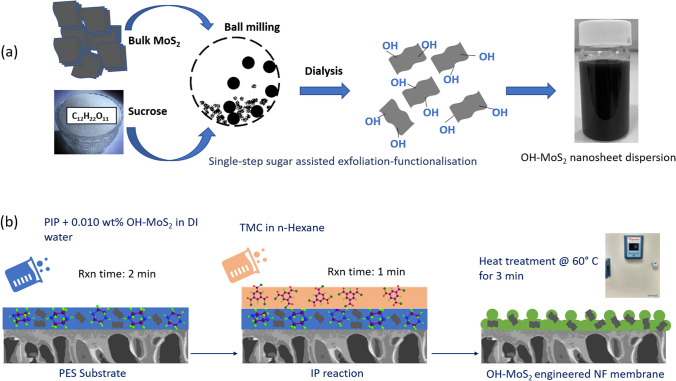
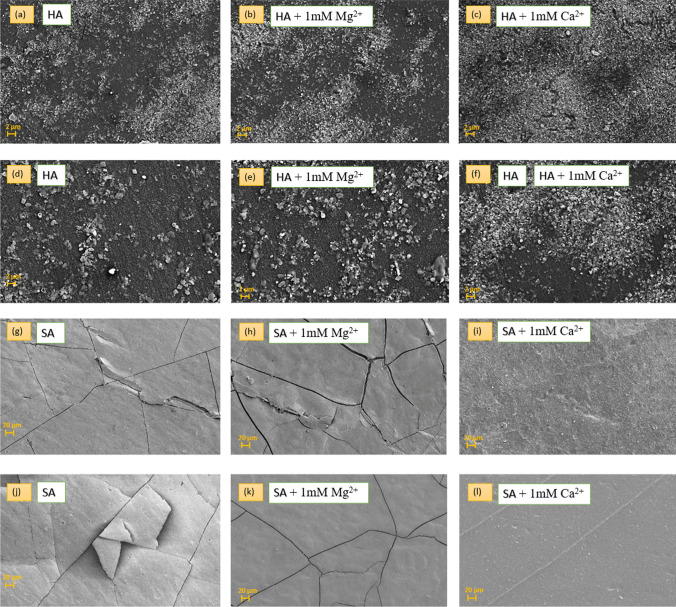
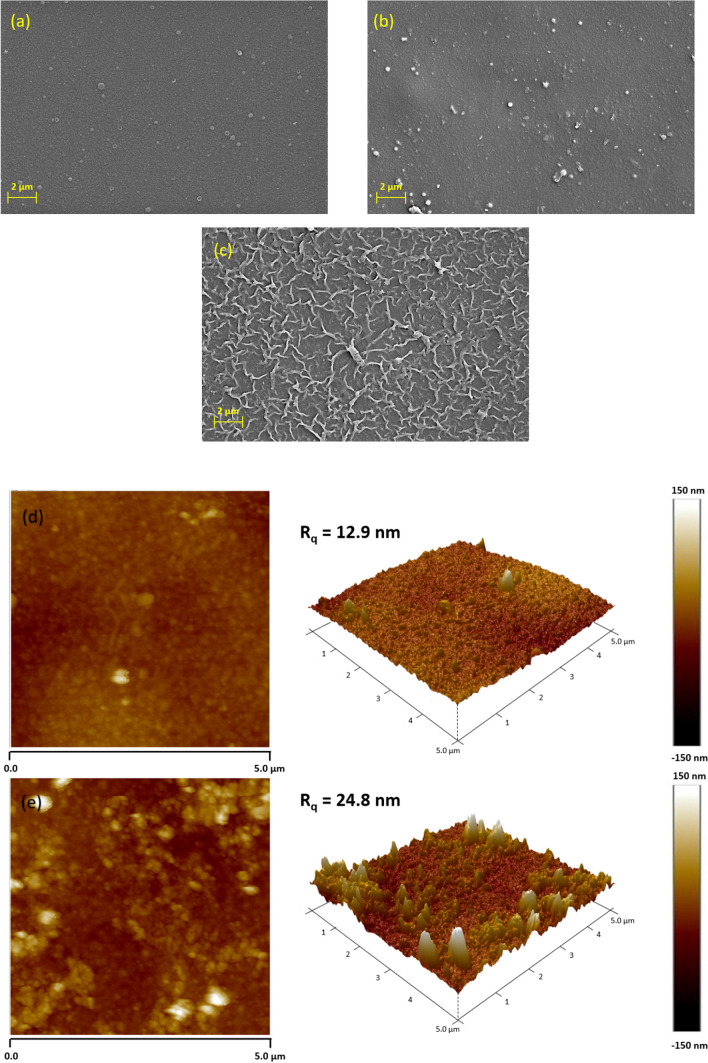
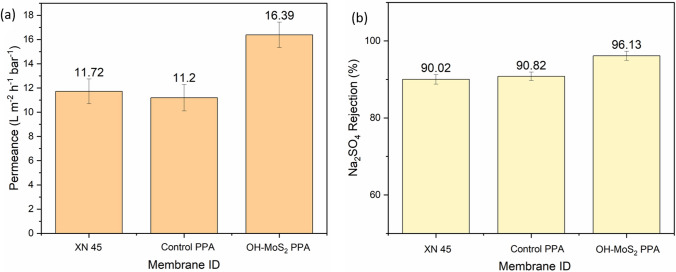
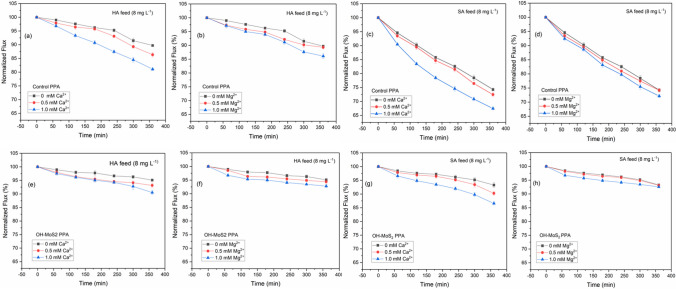
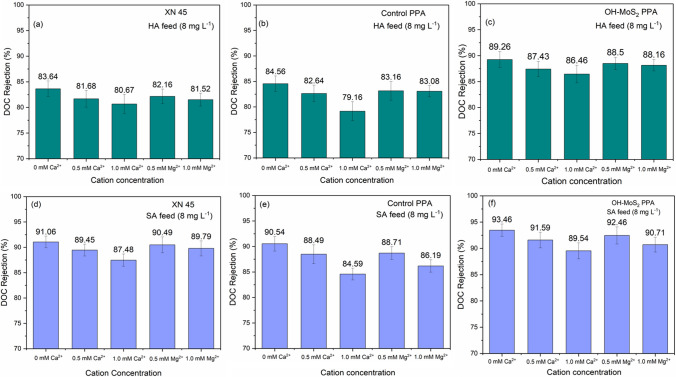
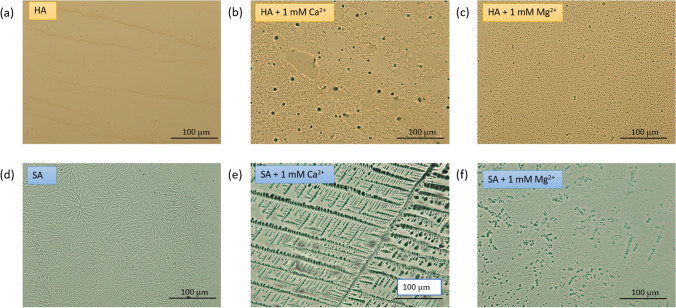
Natural organic matter (NOM) present in surface water causes severe organic fouling of nanofiltration (NF) membranes employed for the production of potable water. Calcium (Ca) and magnesium (Mg) are alkaline earth metals present in natural surface water and severely exacerbate organic fouling owing to their ability to cause charge neutralization, complexation, and bridging of NOM and the membrane surface. Hence, it is of practical significance to engineer membranes with properties suitable for addressing organic fouling in the presence of these cations. This study employed OH-functionalized molybdenum disulphide (OH-MoS) nanosheets as nanofillers via the interfacial polymerization reaction to engineer NF membranes for enhanced removal of NOM and fouling mitigation performance. At an optimized concentration of 0.010 wt.% of OH-MoS nanosheet, the membrane was endowed with higher hydrophilicity, negative charge and rougher membrane morphology which enhanced the pure water permeance by 46.33% from 11.2 to 16.39 L m h bar while bridging the trade-off between permeance and salt selectivity. The fouling performance was evaluated using humic acid (HA) and sodium alginate (SA), which represent the hydrophobic and hydrophilic components of NOM in the presence of 0, 0.5, and 1 mM Ca and Mg, respectively, and the performance was benchmarked with control and commercial membranes. The modified membrane exhibited normalized fluxes of 95.09% and 93.26% for HA and SA, respectively, at the end of the 6 h filtration experiments, compared to the control membrane at 89.71% and 74.25%, respectively. This study also revealed that Ca has a more detrimental effect than Mg on organic fouling and NOM removal. The engineered membrane outperformed the commercial and the pristine membranes during fouling tests in the presence of 1 mM Ca and Mg in the feed solution. In summary, this study has shown that incorporating OH-MoS nanosheets into membranes is a promising strategy for producing potable water from alternative water sources with high salt and NOM contents.
地表水中存在的天然有机物(NOM)会导致用于生产饮用水的纳滤(NF)膜严重有机污染。钙(Ca)和镁(Mg)是天然地表水中存在的碱土金属,由于它们能够引起电荷中和、络合以及NOM与膜表面的桥联作用,会严重加剧有机污染。因此,设计具有适合解决这些阳离子存在时有机污染性能的膜具有实际意义。本研究通过界面聚合反应,采用羟基功能化二硫化钼(OH-MoS₂)纳米片作为纳米填料来制备纳滤膜,以提高NOM的去除率和减轻污染性能。在OH-MoS₂纳米片的最佳浓度为0.010 wt.%时,该膜具有更高的亲水性、负电荷和更粗糙的膜形态,纯水通量从11.2 L m⁻² h⁻¹ bar提高了46.33%至16.39 L m⁻² h⁻¹ bar,同时弥合了通量与盐选择性之间的权衡。使用腐殖酸(HA)和海藻酸钠(SA)评估污染性能,它们分别代表在0、0.5和1 mM Ca和Mg存在下NOM的疏水和亲水成分,并以对照膜和商业膜作为性能基准。在6小时过滤实验结束时,改性膜对HA和SA的归一化通量分别为95.09%和93.26%,而对照膜分别为89.71%和74.25%。本研究还表明,Ca对有机污染和NOM去除的不利影响比Mg更大。在进料溶液中存在1 mM Ca和Mg的情况下,工程膜在污染测试中表现优于商业膜和原始膜。总之,本研究表明将OH-MoS₂纳米片掺入膜中是一种从高盐和NOM含量的替代水源生产饮用水的有前景的策略。