Department of Medical Oncology, National Cancer Center, National Clinical Research Center for Cancer/Cancer Hospital & Shenzhen Hospital, Chinese Academy of Medical Sciences and Peking Union Medical College, Guangdong, Shenzhen, 518116, China.
Department of Nutrition, Shenzhen Hospital, National Cancer Center, National Clinical Research Center for Cancer/Cancer Hospital, Chinese Academy of Medical Sciences and Peking Union Medical College, Guangdong, Shenzhen, 518116, China.
BMC Cancer. 2023 Oct 23;23(1):1023. doi: 10.1186/s12885-023-11512-y.
ICIs have become the standard treatment for advanced NSCLC patients. Currently, PD-L1 is the most widely useful biomarker to predict ICI efficacy, but the sensitivity and specificity are limited. Therefore, the useful predictive biomarkers of ICI efficacy is urgently needed. BMI is an internationally used measure of body health. Obesity may affect ICI efficacy by changing T cell functions. This meta-analysis aimed to clarify the relationship between BMI and survival outcomes of NSCLC patients treated with ICIs.
A systematic review was conducted to identify studies that assessed the association between BMI and survival outcomes in patients treated with ICIs. OS was the primary endpoint, and PFS was the secondary endpoint. Random-effect models or fixed-effect models were utilized to combine study effects according to the Cochran Q and I tests.
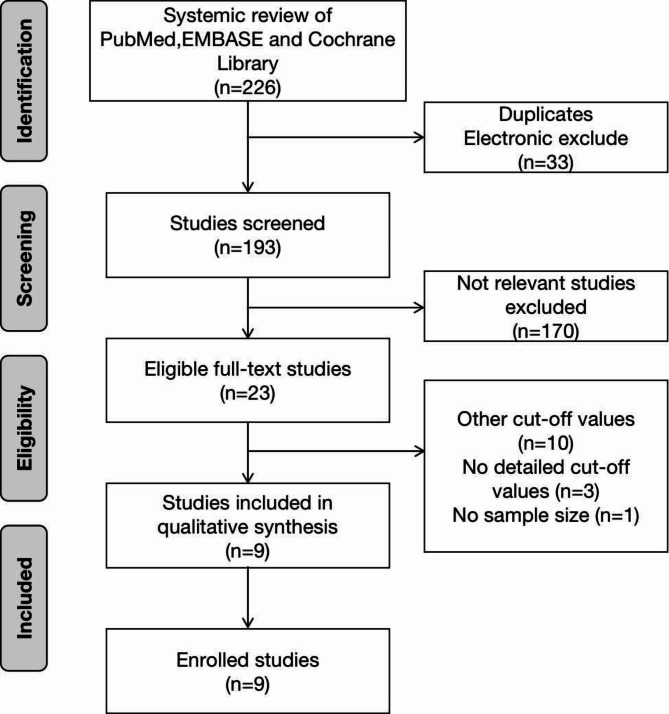
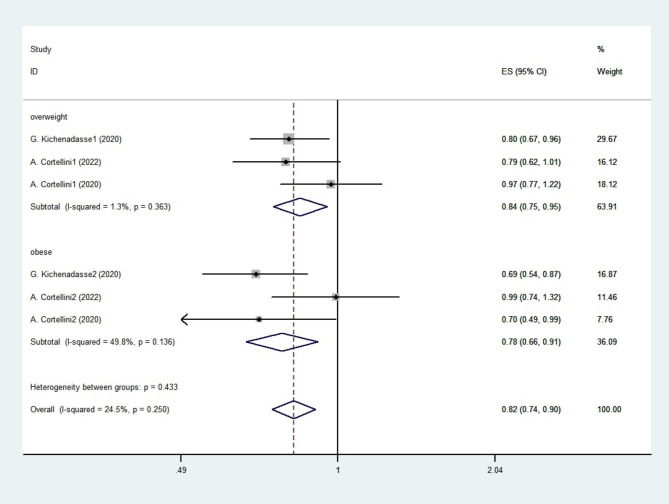
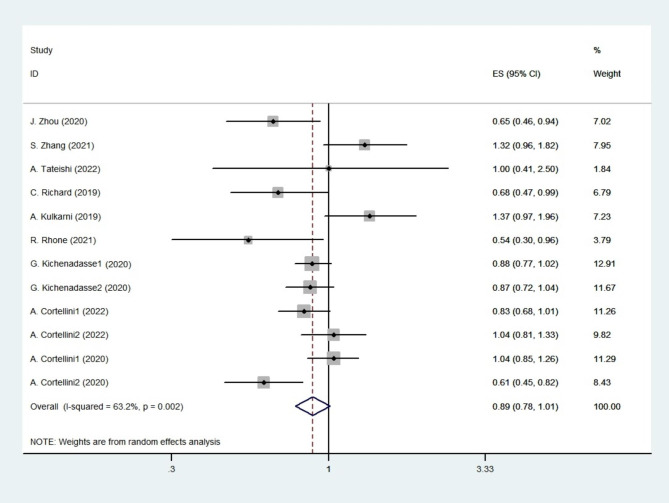
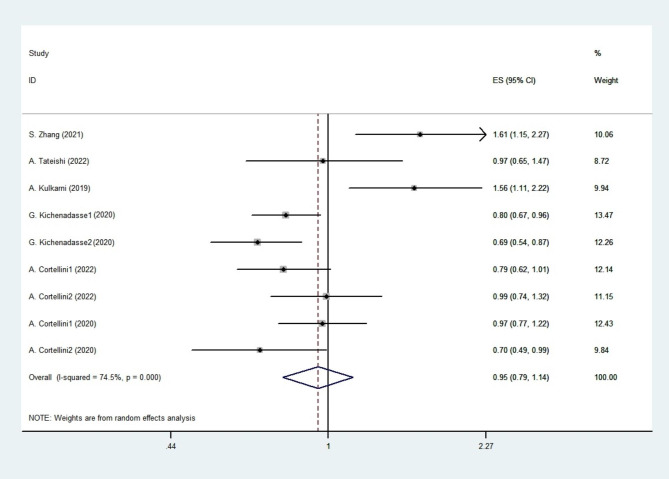
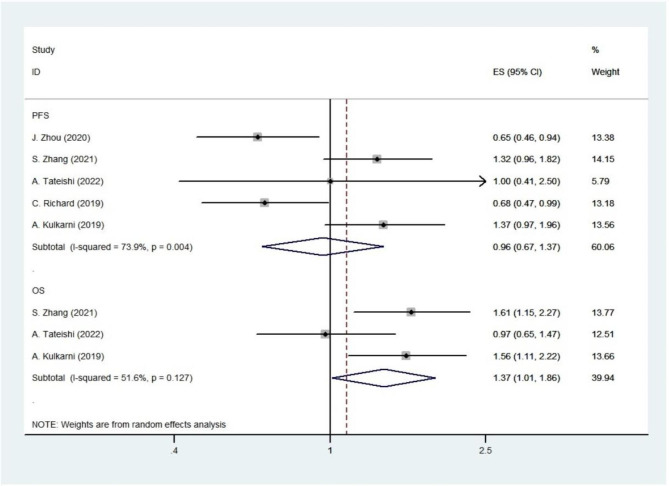
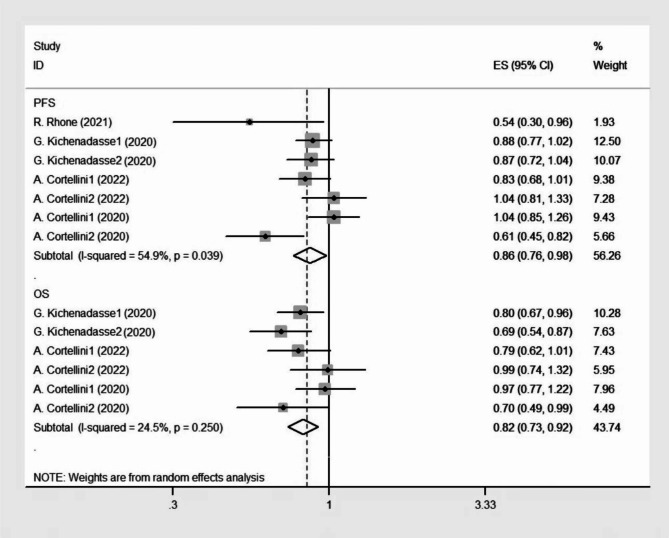
Nine studies, including 4602 NSCLC patients treated with ICIs, that met the inclusion criteria were selected for this meta-analysis. There was no significant difference in PFS (HR 0.885; 95% CI 0.777-1.009, p = 0.068) or OS (HR 0.947; 95% CI 0.789-1.137, p = 0.560) between the low BMI group and the high BMI group. However, in the subgroup analysis, compared with normal-weight patients, overweight and obese patients achieved prolonged PFS (HR 0.862; 95% CI 0.760-0.978, p = 0.021) and OS (HR 0.818; 95% CI 0.741-0.902, p<0.0001).
Overweight and obese NSCLC patients tend to achieve prolonged survival time with ICI regimens. Further prospective studies are needed to strengthen the association between ICI outcomes and BMI levels.
ICI 已成为晚期 NSCLC 患者的标准治疗方法。目前,PD-L1 是预测 ICI 疗效最广泛应用的生物标志物,但敏感性和特异性有限。因此,迫切需要有用的 ICI 疗效预测生物标志物。BMI 是国际上用于衡量身体健康的指标。肥胖可能通过改变 T 细胞功能来影响 ICI 的疗效。本荟萃分析旨在阐明 BMI 与接受 ICI 治疗的 NSCLC 患者生存结局之间的关系。
进行了系统评价,以确定评估 BMI 与接受 ICI 治疗的患者生存结局之间关系的研究。OS 是主要终点,PFS 是次要终点。根据 Cochran Q 和 I 检验,采用随机效应模型或固定效应模型合并研究效应。
纳入了 9 项研究,共 4602 例接受 ICI 治疗的 NSCLC 患者,符合纳入标准,进行了荟萃分析。低 BMI 组与高 BMI 组之间的 PFS(HR 0.885;95%CI 0.777-1.009,p=0.068)或 OS(HR 0.947;95%CI 0.789-1.137,p=0.560)差异无统计学意义。然而,在亚组分析中,与体重正常的患者相比,超重和肥胖患者的 PFS(HR 0.862;95%CI 0.760-0.978,p=0.021)和 OS(HR 0.818;95%CI 0.741-0.902,p<0.0001)更长。
超重和肥胖的 NSCLC 患者接受 ICI 方案治疗时,生存时间可能延长。需要进一步的前瞻性研究来加强 ICI 疗效与 BMI 水平之间的关联。