Endocrinology and Metabolism Research Center, Endocrinology and Metabolism Clinical Sciences Institute, Tehran University of Medical Sciences, Tehran, Iran.
Non-communicable Diseases Research Center, Alborz University of Medical Sciences, Karaj, Iran.
BMC Endocr Disord. 2023 Oct 24;23(1):235. doi: 10.1186/s12902-023-01490-4.
The global prevalence of childhood obesity has exhibited a troubling surge in recent years. Due to the raised questions regarding its potential correlation with infertility in adulthood, this systematic review has been undertaken to explore the relationships between childhood obesity, and infertility later in life.
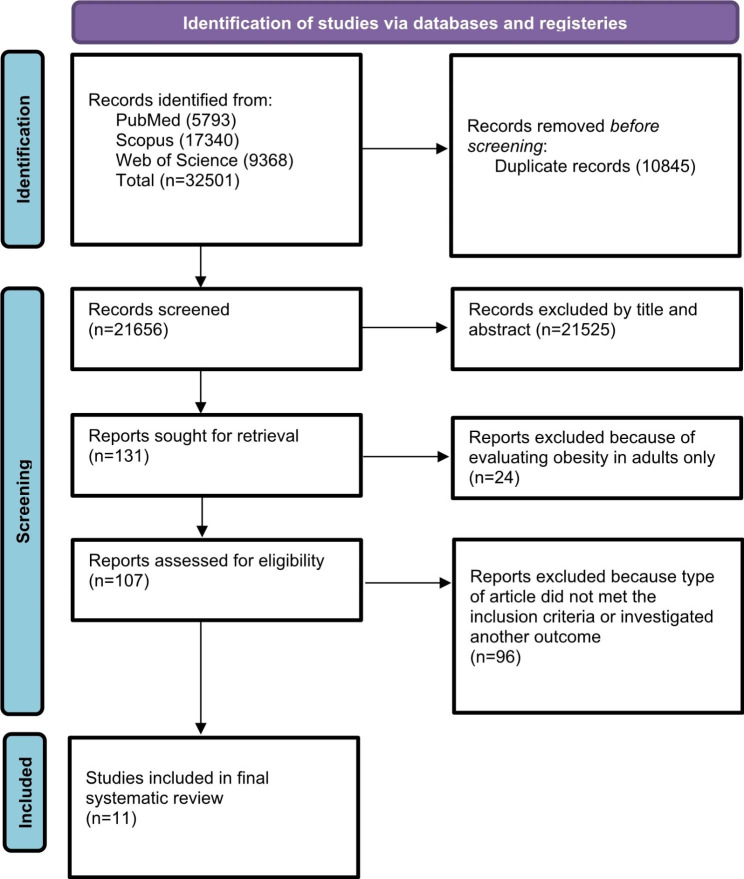
A comprehensive search was performed in three international databases (PubMed, Web of Science, and Scopus). All cohort (retrospective or prospective), case-cohort, and nested case-control studies until April 2022 which assessed the association of obesity in children and adolescents with male and female infertility indicators in later life were included. The quality of the included studies was assessed by Newcastle-Ottawa quality assessment checklists.
Out of the initial 32,501 documents, eleven eligible studies with a total sample size of 498,980 participants were included. Five studies focused on the number of offspring and indicated that obesity, especially in adolescence had an association with later life lower number of children, nulliparity, and childlessness in both men and women. Concerning conceiving problems, two studies showed that obesity before age 12 increased the risk of female fertility problems in the future. Two studies reported that obesity in early life raised the risk of impaired female reproductive system such as menstrual or ovulatory problems. As well as females, a study discovered that obesity in men during their 20s was linked to an elevated risk of low sperm motility and poor sperm morphology. Another study has reported men with higher pre-pubertal BMI had lower sex hormone-binding globulin; however, the same association was not seen between childhood BMI and semen quality.
The evidence suggests a positive association between childhood obesity with infertility indicators in later life. Childhood weight reduction strategies are suggested to be implemented in societies in order to reduce infertility rates in later life.
近年来,全球儿童肥胖症的患病率呈令人担忧的上升趋势。由于人们对其与成年后不孕之间潜在关联提出了质疑,因此进行了这项系统评价,以探讨儿童肥胖与成年后不孕之间的关系。
在三个国际数据库(PubMed、Web of Science 和 Scopus)中进行了全面检索。纳入了截至 2022 年 4 月评估儿童和青少年肥胖与成年后男性和女性不孕指标之间关联的所有队列(回顾性或前瞻性)、病例对照和巢式病例对照研究。使用纽卡斯尔-渥太华质量评估清单评估纳入研究的质量。
在最初的 32501 篇文献中,有 11 项符合条件的研究,共纳入 498980 名参与者。其中 5 项研究集中于后代数量,表明肥胖,尤其是青春期肥胖与成年后生育能力下降、男性和女性的不孕、不育和无子女有关。关于受孕问题,两项研究表明,12 岁前肥胖会增加女性未来生育问题的风险。两项研究报告称,生命早期肥胖会增加女性生殖系统受损的风险,如月经或排卵问题。与女性一样,一项研究发现,男性在 20 多岁时肥胖会导致精子活力下降和精子形态不佳的风险增加。另一项研究报告称,青春期前 BMI 较高的男性血清性激素结合球蛋白较低;然而,儿童 BMI 与精液质量之间没有相同的关联。
有证据表明儿童肥胖与成年后不孕指标之间存在正相关。建议在社会中实施儿童减肥策略,以降低成年后不孕率。