Rheumatology and Rare Disease Research Center, The Wohl Institute for Translational Medicine, Hadassah-Hebrew University Medical Center and School of Medicine, Jerusalem, Israel.
Department of Molecular Cell Biology, Weizmann Institute of Science, Rehovot, Israel.
J Neuroinflammation. 2023 Oct 24;20(1):245. doi: 10.1186/s12974-023-02920-9.
Homozygous CD59-deficient patients manifest with recurrent peripheral neuropathy resembling Guillain-Barré syndrome (GBS), hemolytic anemia and recurrent strokes. Variable mutations in CD59 leading to loss of function have been described and, overall, 17/18 of patients with any mutation presented with recurrent GBS. Here we determine the localization and possible role of membrane-bound complement regulators, including CD59, in the peripheral nervous systems (PNS) of mice and humans.
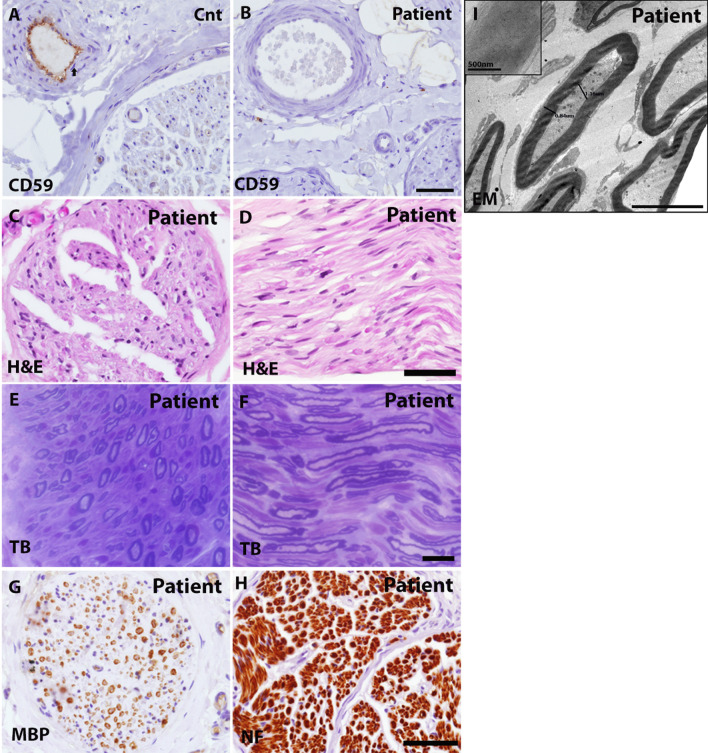
We examined the localization of membrane-bound complement regulators in the peripheral nerves of healthy humans and a CD59-deficient patient, as well as in wild-type (WT) and CD59a-deficient mice. Cross sections of teased sciatic nerves and myelinating dorsal root ganglia (DRG) neuron/Schwann cell cultures were examined by confocal and electron microscopy.
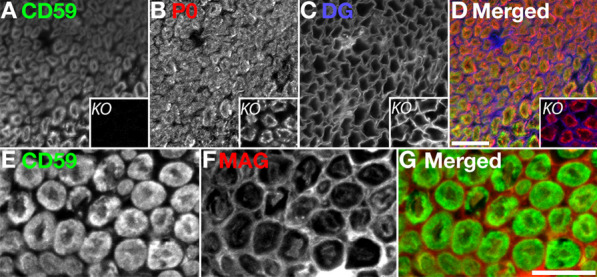
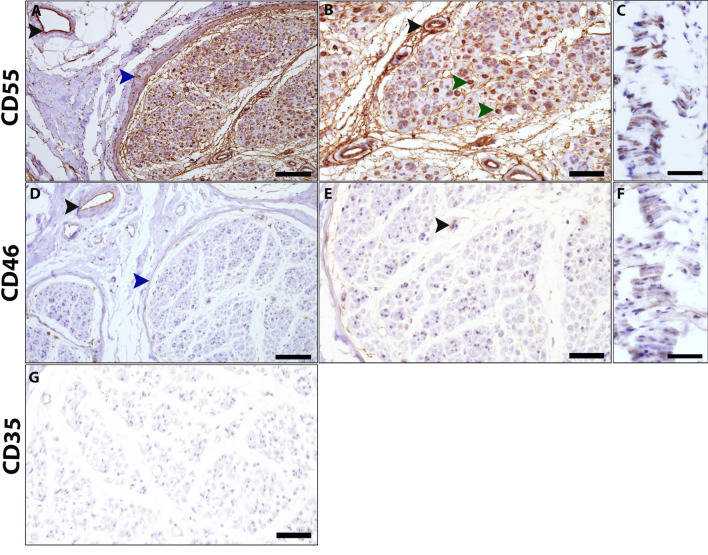
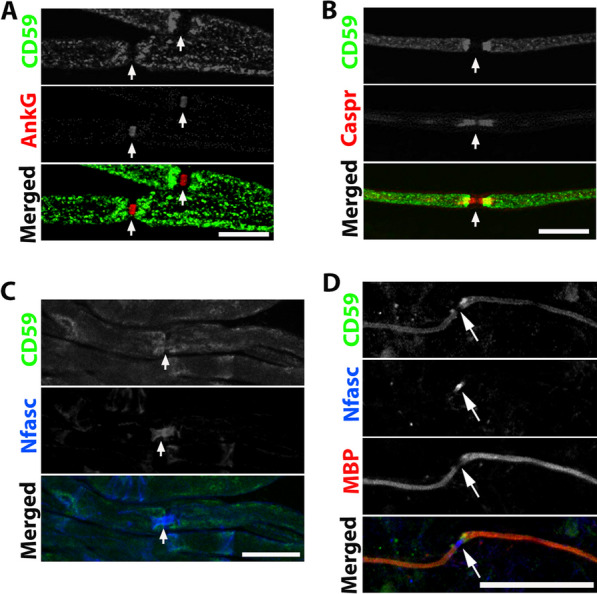
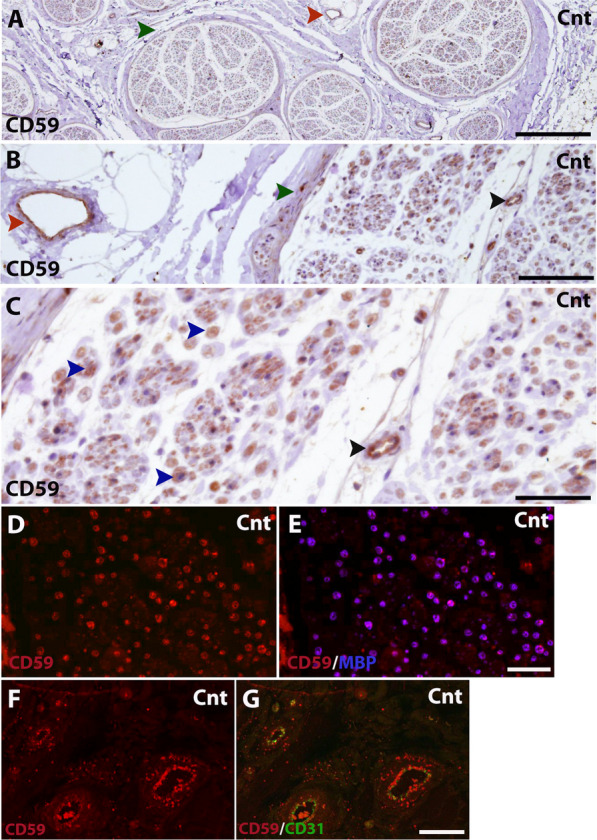
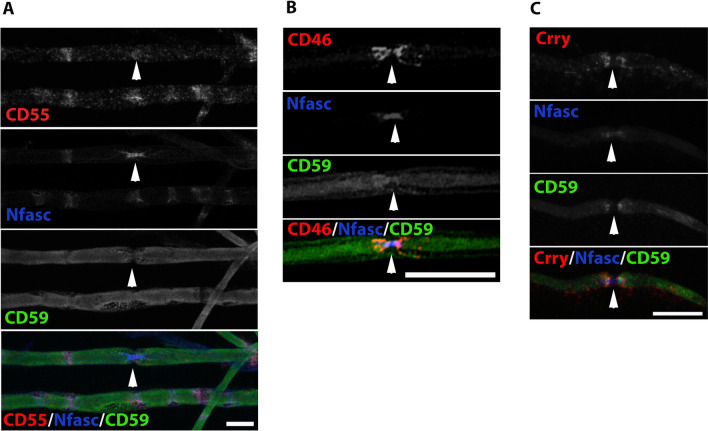
We demonstrate that CD59a-deficient mice display normal peripheral nerve morphology but develop myelin abnormalities in older age. They normally express myelin protein zero (P0), ankyrin G (AnkG), Caspr, dystroglycan, and neurofascin. Immunolabeling of WT nerves using antibodies to CD59 and myelin basic protein (MBP), P0, and AnkG revealed that CD59 was localized along the internode but was absent from the nodes of Ranvier. CD59 was also detected in blood vessels within the nerve. Finally, we show that the nodes of Ranvier lack other complement-membrane regulatory proteins, including CD46, CD55, CD35, and CR1-related gene-y (Crry), rendering this area highly exposed to complement attack.
The Nodes of Ranvier lack CD59 and are hence not protected from complement terminal attack. The myelin unit in human PNS is protected by CD59 and CD55, but not by CD46 or CD35. This renders the nodes and myelin in the PNS vulnerable to complement attack and demyelination in autoinflammatory Guillain-Barré syndrome, as seen in CD59 deficiency.
纯合 CD59 缺陷患者表现为类似于吉兰-巴雷综合征(GBS)的复发性周围神经病、溶血性贫血和复发性中风。已经描述了导致功能丧失的 CD59 可变突变,并且,所有突变患者中有 17/18 例出现复发性 GBS。在这里,我们确定了膜结合补体调节剂,包括 CD59,在小鼠和人类周围神经系统(PNS)中的定位和可能作用。
我们检查了健康人外周神经和 CD59 缺陷患者以及 CD59a 缺陷小鼠的膜结合补体调节剂的定位。通过共聚焦和电子显微镜检查 teased 坐骨神经和髓鞘形成背根神经节(DRG)神经元/施万细胞培养物的横截面。
我们证明 CD59a 缺陷小鼠表现出正常的周围神经形态,但在老年时会出现髓鞘异常。它们正常表达髓鞘蛋白零(P0)、ankyrin G(AnkG)、Caspr、dystroglycan 和 neurofascin。用针对 CD59 和髓鞘碱性蛋白(MBP)、P0 和 AnkG 的抗体对 WT 神经进行免疫标记,显示 CD59 定位于节间段,但不在郎飞结。CD59 也在神经内的血管中被检测到。最后,我们表明郎飞结缺乏其他补体-膜调节蛋白,包括 CD46、CD55、CD35 和 CR1 相关基因-y(Crry),使该区域极易受到补体攻击。
郎飞结缺乏 CD59,因此不受补体终末攻击的保护。人 PNS 的髓鞘单位受 CD59 和 CD55 保护,但不受 CD46 或 CD35 保护。这使得 PNS 的郎飞结和髓鞘容易受到补体攻击和自身炎症性吉兰-巴雷综合征中的脱髓鞘,如 CD59 缺陷所见。