Mangia Lucas Resende Lucinda, Amadeu Nicole Tássia, da Silva Oliveira Maurício, Patzer Lucas Santin, Somensi Eduardo de Souza, Hamerschmidt Rogério
Department of Otolaryngology and Head and Neck Surgery, Complexo Hospital de Clínicas - Universidade Federal Do Paraná (CHC-UFPR), Curitiba, Brazil.
Complexo Hospital de Clínicas - Universidade Federal Do Paraná (CHC-UFPR), Curso de Medicina, Curitiba, Brazil.
J Otol. 2023 Oct;18(4):214-219. doi: 10.1016/j.joto.2023.09.003. Epub 2023 Sep 9.
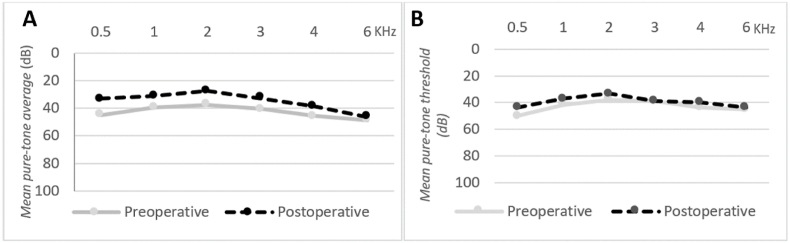
Several technical variations of tympanoplasty have been reported, usually involving the type of graft and/or instruments used. Few studies have focused on the outcome of type-1 tympanoplasty specifically in teaching scenarios. We aimed to describe the results of type-1 tympanoplasty performed by residents, and to investigate potential predictive factors of surgical success. To do so, we did a retrospective analysis of medical records of patients who underwent type-1 tympanoplasty in a tertiary university hospital. We evaluated the tympanic membrane closure and audiometric outcomes during the first year of follow-up, and compared the results according to some clinical and surgical factors. 130 operated ears were included in the study. The closure rate reached 84.12% after one month and 72.72% after twelve months of surgery. The mean air-bone gap was 22.98 dB preoperatively, and reached 10.55 dB after surgery. Perforation closure rates were 85% and 57.14% for those operated by endoscopic and microscopic-assisted approaches, respectively (p = 0.004). The use of cartilage grafts and time without otorrhea of more than three months prior to surgery were also predictors of surgical success (p = 0.002 and 0.041, respectively). Gender, age, perforation size, contralateral disease, operated side, reoperation, and degree of hearing loss did not significantly interfere with outcomes. Tympanoplasty showed good overall results when performed by residents, although inferior to those reported by experienced surgeons. The use of the endoscope, cartilage grafting, and longer preoperative time without otorrhea were predictors of surgical success in this scenario.
IIB.
已报道了鼓室成形术的几种技术变体,通常涉及所使用的移植物类型和/或器械。很少有研究专门关注教学场景下I型鼓室成形术的结果。我们旨在描述住院医师进行I型鼓室成形术的结果,并调查手术成功的潜在预测因素。为此,我们对在一所三级大学医院接受I型鼓室成形术的患者的病历进行了回顾性分析。我们评估了随访第一年期间的鼓膜闭合情况和听力测定结果,并根据一些临床和手术因素比较了结果。该研究纳入了130只接受手术的耳朵。术后1个月时闭合率达到84.12%,术后12个月时为72.72%。术前平均气骨导差为22.98 dB,术后达到10.55 dB。在内镜辅助和显微镜辅助手术中,穿孔闭合率分别为85%和57.14%(p = 0.004)。使用软骨移植物以及术前无耳漏超过3个月也是手术成功的预测因素(分别为p = 0.002和0.041)。性别、年龄、穿孔大小、对侧疾病、手术侧、再次手术以及听力损失程度对结果无显著影响。住院医师进行鼓室成形术时总体效果良好,尽管不如经验丰富的外科医生所报告的结果。在这种情况下,使用内镜、软骨移植以及术前无耳漏时间较长是手术成功的预测因素。
IIB。