Sommariva R, Alam M S, Crilley L R, Rooney D J, Bloss W J, Fomba K W, Andersen S T, Carpenter L J
School of Geography, Earth and Environmental Science, University of Birmingham, Birmingham B15 2TT, U.K.
Atmospheric Chemistry Department, Leibniz Institute for Tropospheric Research, Leipzig 04318, Germany.
J Phys Chem A. 2023 Nov 9;127(44):9302-9310. doi: 10.1021/acs.jpca.3c03853. Epub 2023 Oct 25.
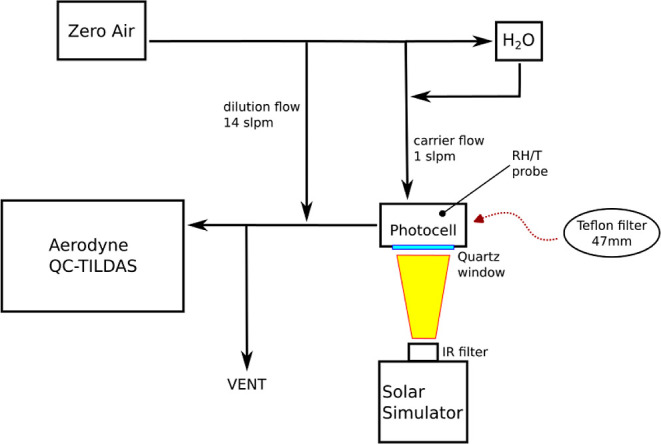
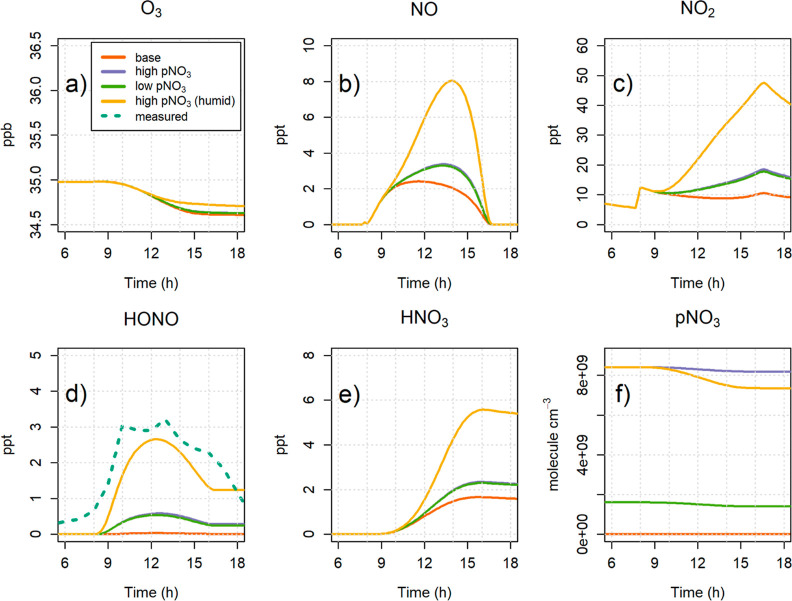
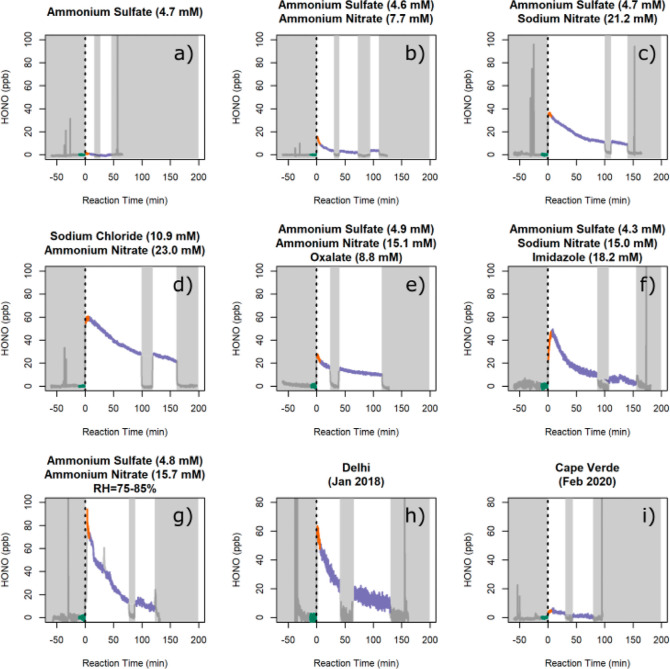
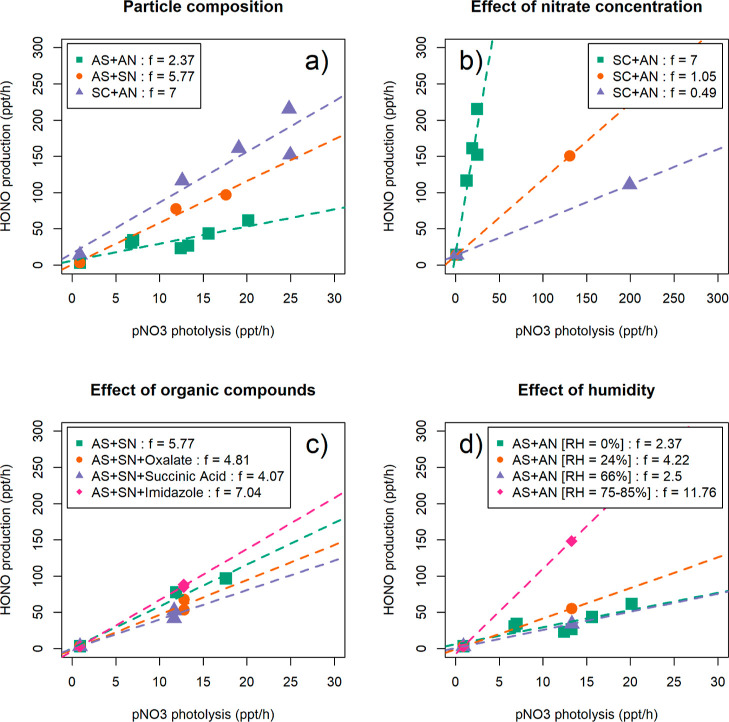
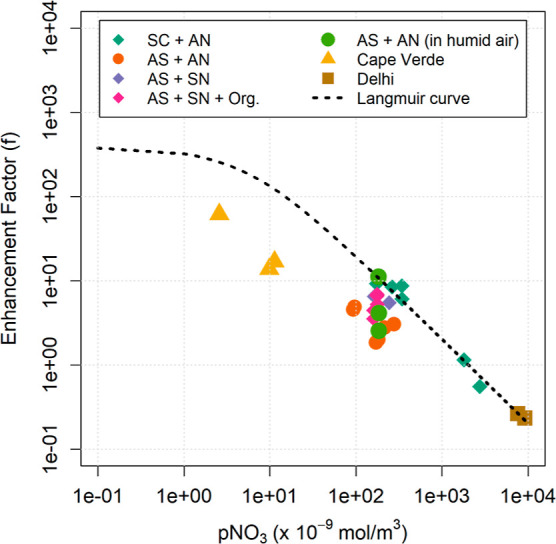
Enhanced photolysis of particulate nitrate (pNO) to form photolabile species, such as gas-phase nitrous acid (HONO), has been proposed as a potential mechanism to recycle nitrogen oxides (NO) in the remote boundary layer ("renoxification"). This article presents a series of laboratory experiments aimed at investigating the parameters that control the photolysis of pNO and the efficiency of HONO production. Filters on which artificial or ambient particles had been sampled were exposed to the light of a solar simulator, and the formation of HONO was monitored under controlled laboratory conditions. The results indicate that the photolysis of pNO is enhanced, compared to the photolysis of gas-phase HNO, at low pNO levels, with the enhancement factor reducing at higher pNO levels. The presence of cations (Na) and halides (Cl) and photosensitive organic compounds (imidazole) also enhance pNO photolysis, but other organic compounds such as oxalate and succinic acid have the opposite effect. The precise role of humidity in pNO photolysis remains unclear. While the efficiency of photolysis is enhanced in deliquescent particles compared to dry particles, some of the experimental results suggest that this may not be the case for supersaturated particles. These experiments suggest that both the composition and the humidity of particles control the enhancement of particulate nitrate photolysis, potentially explaining the variability in results among previous laboratory and field studies. HONO observations in the remote marine boundary layer can be explained by a simple box-model that includes the photolysis of pNO, in line with the results presented here, although more experimental work is needed in order to derive a comprehensive parametrization of this process.
有人提出,增强颗粒态硝酸盐(pNO)的光解以形成光不稳定物种,如气相亚硝酸(HONO),是偏远边界层中氮氧化物(NO)循环利用的一种潜在机制(“再氧化”)。本文介绍了一系列实验室实验,旨在研究控制pNO光解的参数以及HONO生成效率。将采集了人工或环境颗粒物的滤膜暴露在太阳模拟器的光线下,并在受控实验室条件下监测HONO的形成。结果表明,在低pNO水平下,与气相HNO的光解相比,pNO的光解增强,而在较高pNO水平下增强因子降低。阳离子(Na)、卤化物(Cl)和光敏有机化合物(咪唑)的存在也会增强pNO光解,但草酸盐和琥珀酸等其他有机化合物则有相反的作用。湿度在pNO光解中的确切作用仍不清楚。虽然与干燥颗粒相比,潮解颗粒中的光解效率有所提高,但一些实验结果表明,对于过饱和颗粒可能并非如此。这些实验表明,颗粒的组成和湿度都控制着颗粒态硝酸盐光解的增强,这可能解释了以往实验室和现场研究结果的差异。尽管为了得出该过程的综合参数化还需要更多的实验工作,但偏远海洋边界层中的HONO观测结果可以用一个简单的箱式模型来解释,该模型包括pNO的光解,与本文给出的结果一致。