Department of Laboratory Medicine, Gene Diagnosis Research Center, The First Affiliated Hospital, Fujian Medical University, Fuzhou, China; Clinical Laboratory Diagnostics, The First Clinical College, Fujian Medical University, Fuzhou, China.
Department of Laboratory Medicine, Gene Diagnosis Research Center, The First Affiliated Hospital, Fujian Medical University, Fuzhou, China; Fujian Key Laboratory of Laboratory Medicine, The First Affiliated Hospital, Fujian Medical University, Fuzhou, China; Fujian Clinical Research Center for Clinical Immunology Laboratory Test, The First Affiliated Hospital, Fujian Medical University, Fuzhou, China; Department of Laboratory Medicine, National Reginal Medical Center, Binhai Campus of the First Affiliated Hospital, Fujian Medical University, Fuzhou, China.
Cell Mol Gastroenterol Hepatol. 2024;17(2):219-235. doi: 10.1016/j.jcmgh.2023.10.003. Epub 2023 Oct 23.
BACKGROUND & AIMS: Functional cure is achieved by a limited number of patients with chronic hepatitis B (CHB) after nucleotide analogue(s) and interferon treatment. It is urgent to develop therapies that can help a larger proportion of patients achieve functional cure. The present study was designed to explore the anti-hepatitis B virus (HBV) potency of interleukin-6 family cytokines and to characterize the underlying mechanisms of the cytokine displaying the highest anti-HBV potency.
HBV-infected cells were used to screened the anti-HBV potency of interleukin-6 family cytokines. The concentration of oncostatin M (OSM) in patients with chronic HBV infection was examined by enzyme-linked immunosorbent assay. The underlying mechanism of OSM anti-HBV was explored through RNA-seq. C57BL/6 mice injected with rAAV8-1.3HBV were used to explore the suppression effect of OSM on HBV in vivo.
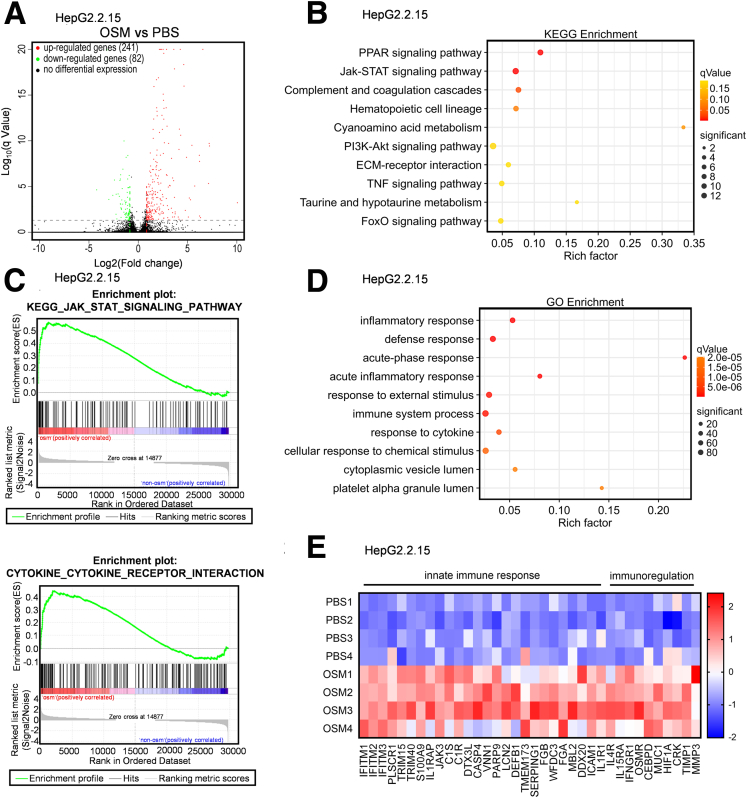
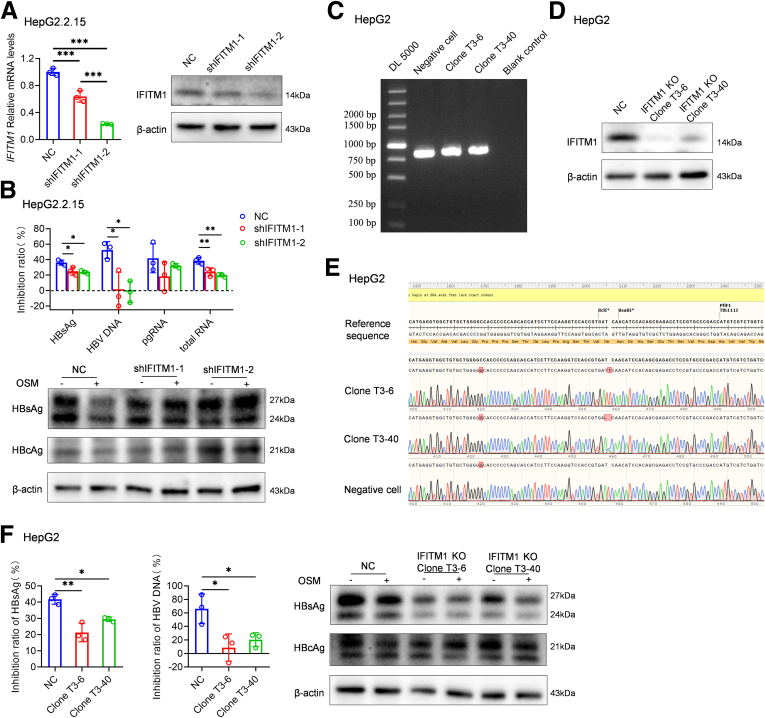
OSM is the most effective of the interleukin-6 family cytokines for suppression of HBV replication (percentage of average inhibition: hepatitis B surface antigen, 34.44%; hepatitis B e antigen, 32.52%; HBV DNA, 61.57%). Hepatitis B e antigen-positive CHB patients with high OSM levels had lower hepatitis B surface antigen and hepatitis B e antigen than those with low levels. OSM activated JAK-STAT signaling pathway promoting the formation of STAT1-IRF9 transcription factor complex. Following this, OSM increased the expression of various genes with known functions in innate and adaptive immunity, which was higher expression in patients with CHB in immune clearance phase than in immune tolerance phase (data from GEO: GSE65359). Interferon-induced transmembrane protein 1, one of the most differentially expressed genes, was identified as an HBV restriction factor involved in OSM-mediated anti-HBV effect. In vivo, we also found OSM significantly inhibited HBV replication and induced expression of antiviral effector interferon-induced transmembrane protein 1.
Our study shows that OSM remodels the immune response against HBV and exerts potent anti-HBV activity, supporting its further development as a potential therapy for treating CHB.
少数慢性乙型肝炎(CHB)患者在接受核苷酸类似物和干扰素治疗后可实现功能性治愈。因此,迫切需要开发能够帮助更多患者实现功能性治愈的治疗方法。本研究旨在探索白细胞介素 6 家族细胞因子抗乙型肝炎病毒(HBV)的效力,并阐明显示出最高抗 HBV 效力的细胞因子的潜在机制。
使用 HBV 感染的细胞筛选白细胞介素 6 家族细胞因子的抗 HBV 效力。通过酶联免疫吸附试验检测慢性 HBV 感染患者的抑瘤素 M(OSM)浓度。通过 RNA 测序探索 OSM 抗 HBV 的潜在机制。使用 rAAV8-1.3HBV 注射的 C57BL/6 小鼠探索 OSM 在体内对 HBV 的抑制作用。
OSM 是抑制 HBV 复制最有效的白细胞介素 6 家族细胞因子(平均抑制率:乙型肝炎表面抗原,34.44%;乙型肝炎 e 抗原,32.52%;HBV DNA,61.57%)。HBV e 抗原阳性 CHB 患者中 OSM 水平较高者的乙型肝炎表面抗原和乙型肝炎 e 抗原水平低于水平较低者。OSM 激活 JAK-STAT 信号通路,促进 STAT1-IRF9 转录因子复合物的形成。随后,OSM 增加了各种具有先天和适应性免疫已知功能的基因的表达,在免疫清除期 CHB 患者中的表达高于免疫耐受期(来自 GEO 的数据:GSE65359)。干扰素诱导跨膜蛋白 1 是表达差异最大的基因之一,被鉴定为参与 OSM 介导的抗 HBV 作用的 HBV 限制因子。在体内,我们还发现 OSM 可显著抑制 HBV 复制并诱导抗病毒效应干扰素诱导跨膜蛋白 1 的表达。
我们的研究表明,OSM 重塑了针对 HBV 的免疫反应,并发挥出强大的抗 HBV 活性,支持其进一步开发作为治疗 CHB 的潜在疗法。