
类风湿关节炎患者在真实环境中 2 年内糖皮质激素的变化轨迹。
Glucocorticoid trajectories over 2 years in patients with rheumatoid arthritis in a real-life setting.
机构信息
Rheumatology, University Hospital Centre Clermont-Ferrand, Clermont-Ferrand, France.
Biostatistic Units, University Hospital Centre Clermont-Ferrand, Clermont-Ferrand, France.
出版信息
RMD Open. 2023 Oct;9(4). doi: 10.1136/rmdopen-2023-003366.
OBJECTIVES
To analyse glucocorticoid (GC) use and trajectories in a real-life cohort of rheumatoid arthritis (RA).
METHODS
Patients with RA included in the longitudinal RCVRIC cohort for initiating or changing biological disease-modifying antirheumatic drugs, were compared for the use of GCs at baseline. Among the GC users, the GC dose was analysed over 2 years of follow-up by group-based trajectory models. Characteristics and outcomes were compared between the trajectories.
RESULTS
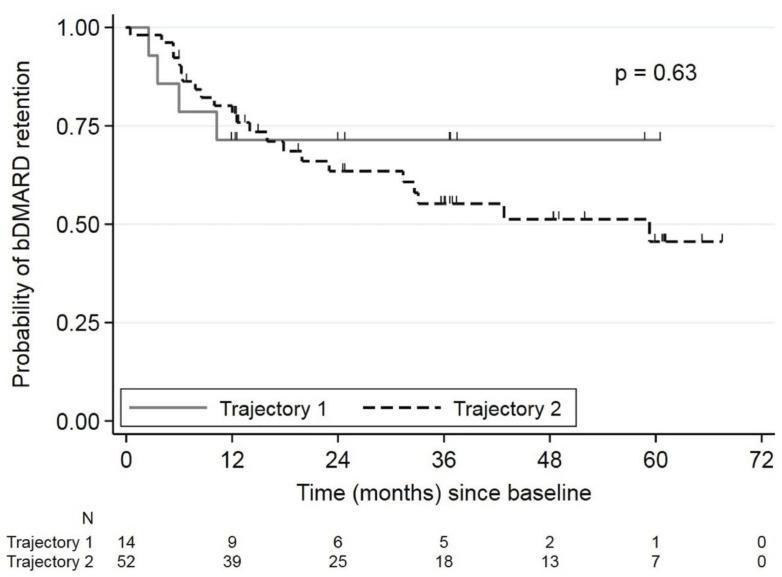
Among the 184 patients (RA duration 4.2 years (1.3; 12.6), Disease Activity Scores (DAS)28-C reactive protein (CRP) 4.24±2.14), 81 (44%) were on GCs. The GC users were significantly older, had higher CRP and Health Assessment Questionnaire (HAQ), more hypertension and lower lumbar T-score, but similar activity and erosive scores. Among the GC users, two trajectories were identified: trajectory 1 (n=20, 25%) with GC discontinuation in the first year and trajectory 2 (n=61, 75%) with maintenance of low-dose GCs at 2 years. Trajectory 2 was significantly associated with higher HAQ, a longer GC duration and a less frequent methotrexate association. After adjustment for HAQ, GC duration and MTX use, good EULAR responses were less frequent at 6 months and 1 year in the GC maintenance trajectory (38.3% vs 81.3%, p=0.03; 42.0% vs 82.4%, p=0.02). Diabetes, fractures and increased body mass index were noted in trajectory 2.
CONCLUSION
GCs were used in almost half of patients with established RA in real-world practice. For the majority of GC users, a long-term low dose of GCs is maintained over 2 years. These results highlight the difficulties with stopping GCs, the lack of consensus for the efficacy-safety balance of GCs, and the need to individualise the best GC tapering.
目的
分析真实队列中类风湿关节炎(RA)患者糖皮质激素(GC)的使用和轨迹。
方法
比较纳入纵向 RCVRIC 队列的开始或改变生物疾病修饰抗风湿药物治疗的 RA 患者在基线时 GC 的使用情况。在 GC 使用者中,通过基于群组的轨迹模型分析 2 年随访期间的 GC 剂量。比较不同轨迹间的特征和结局。
结果
在 184 名患者(RA 病程 4.2 年(1.3;12.6),DAS28-C 反应蛋白(CRP)4.24±2.14)中,81 名(44%)正在使用 GCs。GC 使用者年龄较大,CRP 和健康评估问卷(HAQ)更高,高血压和腰椎 T 评分更低,但活动度和侵蚀评分相似。在 GC 使用者中,确定了两个轨迹:轨迹 1(n=20,25%)在第一年停用 GC,轨迹 2(n=61,75%)在第 2 年维持低剂量 GC。轨迹 2 与较高的 HAQ、较长的 GC 持续时间和较少的甲氨蝶呤联合治疗显著相关。在校正 HAQ、GC 持续时间和 MTX 使用后,GC 维持轨迹在 6 个月和 1 年时 EULAR 反应较差(38.3% vs 81.3%,p=0.03;42.0% vs 82.4%,p=0.02)。在轨迹 2 中观察到糖尿病、骨折和体重指数增加。
结论
在真实世界实践中,近一半的 RA 患者使用了 GCs。对于大多数 GC 使用者,在 2 年内维持长期低剂量 GC。这些结果突出了停止 GCs 的困难、GC 疗效-安全性平衡的共识缺失,以及需要个体化最佳 GC 减量。


 Zotero 插件