• 文献检索
  • 文档翻译
  • 深度研究
  • 学术资讯
  • Suppr Zotero 插件Zotero 插件
  • 邀请有礼
  • 套餐&价格
  • 历史记录
应用&插件
Suppr Zotero 插件Zotero 插件浏览器插件Mac 客户端Windows 客户端微信小程序
定价
高级版会员购买积分包购买API积分包
服务
文献检索文档翻译深度研究API 文档MCP 服务
关于我们
关于 Suppr公司介绍联系我们用户协议隐私条款
关注我们

Suppr 超能文献

核心技术专利:CN118964589B侵权必究
粤ICP备2023148730 号-1Suppr @ 2026

文献检索

告别复杂PubMed语法,用中文像聊天一样搜索,搜遍4000万医学文献。AI智能推荐,让科研检索更轻松。

立即免费搜索

文件翻译

保留排版,准确专业,支持PDF/Word/PPT等文件格式,支持 12+语言互译。

免费翻译文档

深度研究

AI帮你快速写综述,25分钟生成高质量综述,智能提取关键信息,辅助科研写作。

立即免费体验

用于神经康复训练以减少中风后异常腿部共同激活的肌电接口:一项试点研究。

Myoelectric interface for neurorehabilitation conditioning to reduce abnormal leg co-activation after stroke: a pilot study.

作者信息

Khorasani Abed, Hulsizer Joel, Paul Vivek, Gorski Cynthia, Dhaher Yasin Y, Slutzky Marc W

机构信息

Northwestern University.

University of Texas Southwestern Medical Center.

出版信息

Res Sq. 2023 Oct 9:rs.3.rs-3398815. doi: 10.21203/rs.3.rs-3398815/v1.

DOI:10.21203/rs.3.rs-3398815/v1
PMID:37886579
原文链接:https://pmc.ncbi.nlm.nih.gov/articles/PMC10602191/
Abstract

BACKGROUND

The ability to walk is an important factor in quality of life after stroke. Co-activation of hip adductors and knee extensors has been shown to correlate with gait impairment. We have shown previously that training with a myoelectric interface for neurorehabilitation (MINT) can reduce abnormal muscle co-activation in the arms of stroke survivors.

METHODS

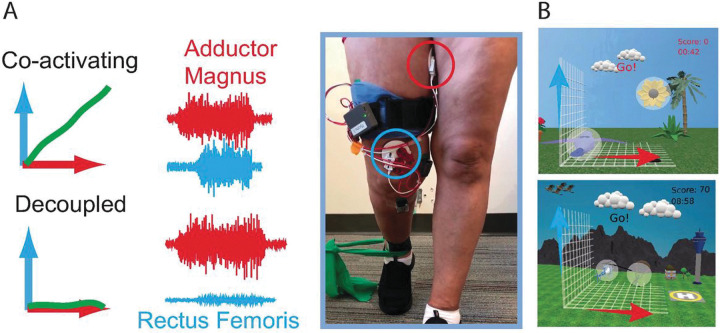
Here, we extend MINT conditioning to stroke survivors with leg impairment. The aim of this pilot study was to assess the safety and feasibility of using MINT to reduce abnormal co-activation between hip adductors and knee extensors and assess any effects on gait. Nine stroke survivors with moderate to severe gait impairment received six hours of MINT conditioning over six sessions, either in the laboratory or at home.

RESULTS

MINT participants completed a mean of 159 repetitions per session without any adverse events. Further, participants learned to isolate their muscles effectively, resulting in a mean reduction of co-activation of 70% compared to baseline. Moreover, gait speed increased by a mean of 0.15 m/s, more than the minimum clinically important difference. Knee flexion angle increased substantially, and hip circumduction decreased.

CONCLUSION

MINT conditioning is safe, feasible at home, and enables reduction of co-activation in the leg. Further investigation of MINT's potential to improve leg movement and function after stroke is warranted. Abnormal co-activation of hip adductors and knee extensors may contribute to impaired gait after stroke.

TRIAL REGISTRATION

This study was registered at ClinicalTrials.gov (NCT03401762, Registered 15 January 2018, https://clinicaltrials.gov/study/NCT03401762?tab=history&a=4).

摘要

背景

行走能力是中风后生活质量的一个重要因素。已表明髋内收肌和膝伸肌的共同激活与步态障碍相关。我们之前已经表明,使用肌电接口进行神经康复训练(MINT)可以减少中风幸存者手臂的异常肌肉共同激活。

方法

在此,我们将MINT训练扩展到有腿部损伤的中风幸存者。这项初步研究的目的是评估使用MINT减少髋内收肌和膝伸肌之间异常共同激活的安全性和可行性,并评估其对步态的任何影响。九名有中度至重度步态障碍的中风幸存者在实验室或家中接受了六个疗程、共六小时的MINT训练。

结果

MINT训练的参与者平均每个疗程完成159次重复,且未出现任何不良事件。此外,参与者学会了有效分离肌肉,与基线相比,共同激活平均减少了70%。而且,步态速度平均提高了0.15米/秒,超过了最小临床重要差异。膝关节屈曲角度大幅增加,髋部环转减少。

结论

MINT训练是安全的,可在家中进行,并且能够减少腿部的共同激活。有必要进一步研究MINT改善中风后腿部运动和功能的潜力。髋内收肌和膝伸肌的异常共同激活可能导致中风后的步态障碍。

试验注册

本研究已在ClinicalTrials.gov注册(NCT03401762,2018年1月15日注册,https://clinicaltrials.gov/study/NCT03401762?tab=history&a=4)。
https://cdn.ncbi.nlm.nih.gov/pmc/blobs/a2e0/10602191/530f4e88a92b/nihpp-rs3398815v1-f0004.jpg
https://cdn.ncbi.nlm.nih.gov/pmc/blobs/a2e0/10602191/606700a59e2c/nihpp-rs3398815v1-f0001.jpg
https://cdn.ncbi.nlm.nih.gov/pmc/blobs/a2e0/10602191/5bd6f67e2ae5/nihpp-rs3398815v1-f0002.jpg
https://cdn.ncbi.nlm.nih.gov/pmc/blobs/a2e0/10602191/05983a183e9d/nihpp-rs3398815v1-f0003.jpg
https://cdn.ncbi.nlm.nih.gov/pmc/blobs/a2e0/10602191/530f4e88a92b/nihpp-rs3398815v1-f0004.jpg
https://cdn.ncbi.nlm.nih.gov/pmc/blobs/a2e0/10602191/606700a59e2c/nihpp-rs3398815v1-f0001.jpg
https://cdn.ncbi.nlm.nih.gov/pmc/blobs/a2e0/10602191/5bd6f67e2ae5/nihpp-rs3398815v1-f0002.jpg
https://cdn.ncbi.nlm.nih.gov/pmc/blobs/a2e0/10602191/05983a183e9d/nihpp-rs3398815v1-f0003.jpg
https://cdn.ncbi.nlm.nih.gov/pmc/blobs/a2e0/10602191/530f4e88a92b/nihpp-rs3398815v1-f0004.jpg

相似文献

1
Myoelectric interface for neurorehabilitation conditioning to reduce abnormal leg co-activation after stroke: a pilot study.用于神经康复训练以减少中风后异常腿部共同激活的肌电接口:一项试点研究。
Res Sq. 2023 Oct 9:rs.3.rs-3398815. doi: 10.21203/rs.3.rs-3398815/v1.
2
Myoelectric interface for neurorehabilitation conditioning to reduce abnormal leg co-activation after stroke: a pilot study.用于神经康复调节的肌电接口,以减少中风后异常腿部协同激活:一项初步研究。
J Neuroeng Rehabil. 2024 Jan 20;21(1):11. doi: 10.1186/s12984-024-01305-0.
3
Wearable myoelectric interface enables high-dose, home-based training in severely impaired chronic stroke survivors.可穿戴肌电接口能够让严重受损的慢性中风幸存者进行高剂量的居家训练。
Ann Clin Transl Neurol. 2021 Sep;8(9):1895-1905. doi: 10.1002/acn3.51442. Epub 2021 Aug 20.
4
Two weeks of ischemic conditioning improves walking speed and reduces neuromuscular fatigability in chronic stroke survivors.两周的缺血性预处理可改善慢性脑卒中幸存者的步行速度并降低神经肌肉疲劳性。
J Appl Physiol (1985). 2019 Mar 1;126(3):755-763. doi: 10.1152/japplphysiol.00772.2018. Epub 2019 Jan 17.
5
Myoelectric interface training enables targeted reduction in abnormal muscle co-activation.肌电接口训练可实现针对异常肌肉协同收缩的靶向减少。
J Neuroeng Rehabil. 2022 Jul 1;19(1):67. doi: 10.1186/s12984-022-01045-z.
6
Myoelectric Computer Interface Training for Reducing Co-Activation and Enhancing Arm Movement in Chronic Stroke Survivors: A Randomized Trial.肌电电脑接口训练对降低慢性中风幸存者的共同激活和增强手臂运动的效果:一项随机试验。
Neurorehabil Neural Repair. 2019 Apr;33(4):284-295. doi: 10.1177/1545968319834903. Epub 2019 Mar 19.
7
Changes in activation timing of knee and ankle extensors during gait are related to changes in heteronymous spinal pathways after stroke.中风后,步态期间膝关节和踝关节伸肌激活时间的变化与异源脊髓通路的变化有关。
J Neuroeng Rehabil. 2014 Oct 24;11:148. doi: 10.1186/1743-0003-11-148.
8
Contributions to the understanding of gait control.对步态控制理解的贡献。
Dan Med J. 2014 Apr;61(4):B4823.
9
Concurrent impact of bilateral multiple joint functional electrical stimulation and treadmill walking on gait and spasticity in post-stroke survivors: a pilot study.双侧多关节功能性电刺激联合跑步机行走对脑卒中后幸存者步态和痉挛的影响:一项初步研究。
Physiother Theory Pract. 2021 Dec;37(12):1368-1376. doi: 10.1080/09593985.2019.1685035. Epub 2019 Oct 30.
10
Necessity and Content of Swing Phase Gait Coordination Training Post Stroke; A Case Report.脑卒中后摆动期步态协调训练的必要性及内容;病例报告
Brain Sci. 2021 Nov 12;11(11):1498. doi: 10.3390/brainsci11111498.

本文引用的文献

1
Myoelectric interface training enables targeted reduction in abnormal muscle co-activation.肌电接口训练可实现针对异常肌肉协同收缩的靶向减少。
J Neuroeng Rehabil. 2022 Jul 1;19(1):67. doi: 10.1186/s12984-022-01045-z.
2
Portable, open-source solutions for estimating wrist position during reaching in people with stroke.便携式、开源的解决方案,用于估计中风患者在伸手过程中的手腕位置。
Sci Rep. 2021 Nov 18;11(1):22491. doi: 10.1038/s41598-021-01805-2.
3
Wearable myoelectric interface enables high-dose, home-based training in severely impaired chronic stroke survivors.
可穿戴肌电接口能够让严重受损的慢性中风幸存者进行高剂量的居家训练。
Ann Clin Transl Neurol. 2021 Sep;8(9):1895-1905. doi: 10.1002/acn3.51442. Epub 2021 Aug 20.
4
Myoelectric Computer Interface Training for Reducing Co-Activation and Enhancing Arm Movement in Chronic Stroke Survivors: A Randomized Trial.肌电电脑接口训练对降低慢性中风幸存者的共同激活和增强手臂运动的效果:一项随机试验。
Neurorehabil Neural Repair. 2019 Apr;33(4):284-295. doi: 10.1177/1545968319834903. Epub 2019 Mar 19.
5
Hip circumduction is not a compensation for reduced knee flexion angle during gait.髋关节外展不是步态中膝关节屈曲角度减小的代偿。
J Biomech. 2019 Apr 18;87:150-156. doi: 10.1016/j.jbiomech.2019.02.026. Epub 2019 Mar 8.
6
Manipulating post-stroke gait: Exploiting aberrant kinematics.中风后步态的操控:利用异常运动学
J Biomech. 2018 Jan 23;67:129-136. doi: 10.1016/j.jbiomech.2017.11.031. Epub 2017 Dec 6.
7
Predicting Home and Community Walking Activity Poststroke.预测中风后家庭及社区步行活动情况
Stroke. 2017 Feb;48(2):406-411. doi: 10.1161/STROKEAHA.116.015309. Epub 2017 Jan 5.
8
Reducing The Cost of Transport and Increasing Walking Distance After Stroke: A Randomized Controlled Trial on Fast Locomotor Training Combined With Functional Electrical Stimulation.降低中风后的运输成本并增加步行距离:一项关于快速运动训练结合功能性电刺激的随机对照试验。
Neurorehabil Neural Repair. 2016 Aug;30(7):661-70. doi: 10.1177/1545968315619696. Epub 2015 Nov 30.
9
Aerobic, Resistance, and Cognitive Exercise Training Poststroke.中风后的有氧、抗阻和认知运动训练
Stroke. 2015 Jul;46(7):2012-6. doi: 10.1161/STROKEAHA.114.006649. Epub 2015 May 26.
10
Frontal plane compensatory strategies associated with self-selected walking speed in individuals post-stroke.中风后个体中与自我选择步行速度相关的额状面代偿策略。
Clin Biomech (Bristol). 2014 May;29(5):518-22. doi: 10.1016/j.clinbiomech.2014.03.013. Epub 2014 Apr 13.