Matsuda Kazuki, Han Xiaobo, Matsuda Naoki, Yamanaka Makoto, Suzuki Ikuro
Department of Electronics, Graduate School of Engineering, Tohoku Institute of Technology, 35-1 Yagiyama Kasumicho, Taihaku-ku, Sendai 982-8577, Japan.
Business Creation Division Organs on Chip Project, Usio Inc., 1-6-5 Marunouchi, Chiyoda-ku, Tokyo 100-8150, Japan.
Toxics. 2023 Oct 10;11(10):848. doi: 10.3390/toxics11100848.
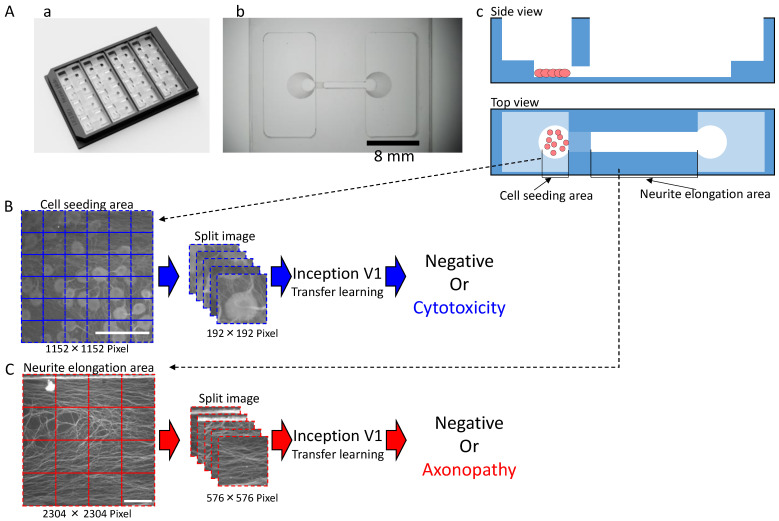
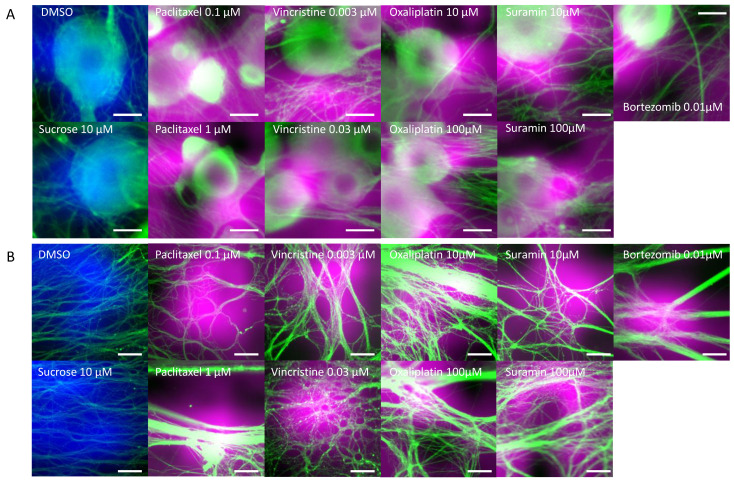
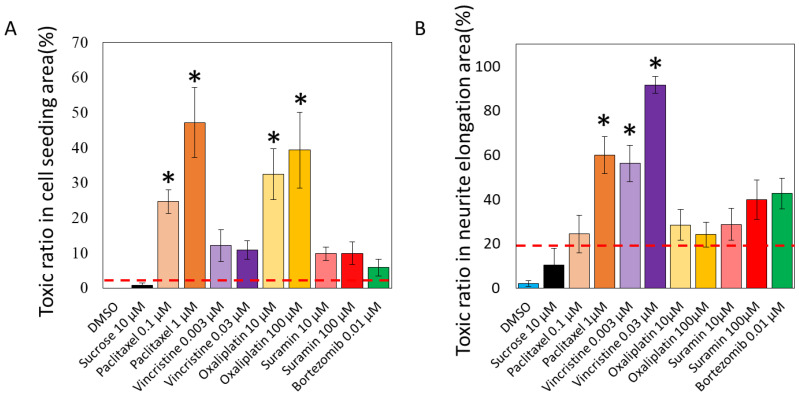
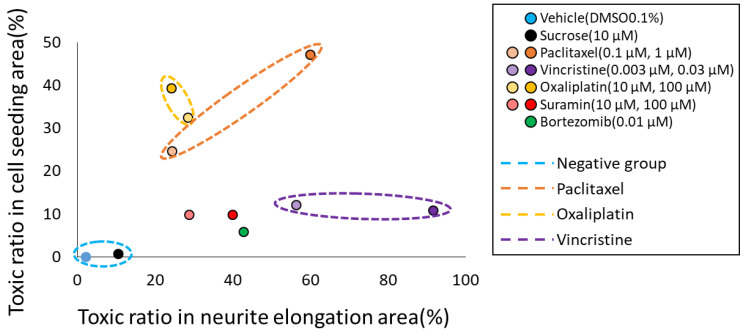
Several anticancer drugs used in cancer therapy induce chemotherapy-induced peripheral neuropathy (CIPN), leading to dose reduction or therapy cessation. Consequently, there is a demand for an in vitro assessment method to predict CIPN and mechanisms of action (MoA) in drug candidate compounds. In this study, a method assessing the toxic effects of anticancer drugs on soma and axons using deep learning image analysis is developed, culturing primary rat dorsal root ganglion neurons with a microphysiological system (MPS) that separates soma from neural processes and training two artificial intelligence (AI) models on soma and axonal area images. Exposing the control compound DMSO, negative compound sucrose, and known CIPN-causing drugs (paclitaxel, vincristine, oxaliplatin, suramin, bortezomib) for 24 h, results show the somatic area-learning AI detected significant cytotoxicity for paclitaxel (* < 0.05) and oxaliplatin (* < 0.05). In addition, axonal area-learning AI detected significant axonopathy with paclitaxel (* < 0.05) and vincristine (* < 0.05). Combining these models, we detected significant toxicity in all CIPN-causing drugs (** < 0.01) and could classify anticancer drugs based on their different MoA on neurons, suggesting that the combination of MPS-based culture segregating soma and axonal areas and AI image analysis of each area provides an effective evaluation method to predict CIPN from low concentrations and infer the MoA.
癌症治疗中使用的几种抗癌药物会引发化疗诱导的周围神经病变(CIPN),导致剂量减少或治疗中断。因此,需要一种体外评估方法来预测候选药物化合物中的CIPN和作用机制(MoA)。在本研究中,开发了一种使用深度学习图像分析评估抗癌药物对胞体和轴突毒性作用的方法,利用微生理系统(MPS)培养原代大鼠背根神经节神经元,该系统将胞体与神经突起分离,并在胞体和轴突区域图像上训练两个人工智能(AI)模型。用对照化合物二甲基亚砜(DMSO)、阴性化合物蔗糖以及已知会导致CIPN的药物(紫杉醇、长春新碱、奥沙利铂、苏拉明、硼替佐米)处理24小时,结果显示,胞体区域学习AI检测到紫杉醇(<0.05)和奥沙利铂(<0.05)具有显著的细胞毒性。此外,轴突区域学习AI检测到紫杉醇(<0.05)和长春新碱(<0.05)具有显著的轴突病变。结合这些模型,我们检测到所有导致CIPN的药物都有显著毒性(**<0.01),并且可以根据它们对神经元的不同作用机制对抗癌药物进行分类,这表明基于MPS的将胞体和轴突区域分离的培养方法与对每个区域的AI图像分析相结合,提供了一种从低浓度预测CIPN并推断作用机制的有效评估方法。