School of Medicine and Public Health, College of Health Medicine and Wellbeing, University of Newcastle, Callaghan, New South Wales, Australia.
PsychoOncology Service, Department of Consultation Liaison Psychiatry, Calvary Mater Newcastle, Waratah, New South Wales, Australia.
J Med Radiat Sci. 2024 Mar;71(1):100-109. doi: 10.1002/jmrs.736. Epub 2023 Oct 27.
Research indicates that the immobilisation mask required for radiation therapy (RT) for head and neck cancers can provoke intense anxiety. However, little is known about the rates of this anxiety, whether it changes over a course of treatment and how it is managed in clinical practice. This study aimed to describe the rates and patterns of situational anxiety in patients undergoing RT for head and neck cancer and the use of anxiety management interventions in current clinical practice in a major regional cancer setting in New South Wales, Australia.
Situational anxiety rates and patterns were assessed at five time points using the State-Trait Anxiety Inventory prior to treatment planning (SIM), the first three treatment sessions (Tx 1, Tx 2 and Tx 3) and treatment 20 (Tx 20). Sessions were observed to record the use of general supportive interventions (music and support person) and anxiety-specific interventions (break from the mask, relaxation techniques and anxiolytic medication). Sociodemographic and clinical information was extracted from the medical record.
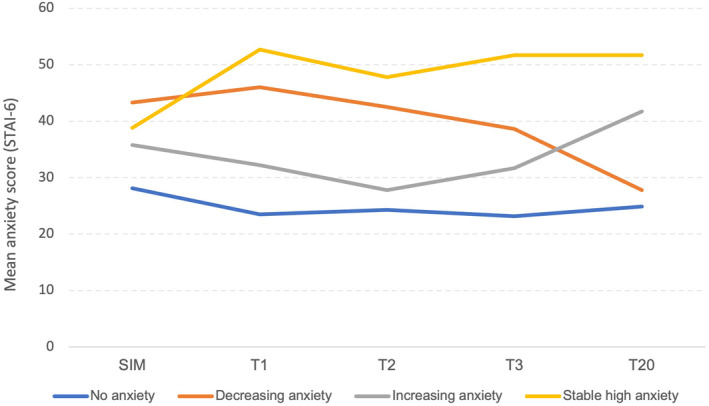
One hundred and one patients were recruited. One-third had clinically significant anxiety at any of the first three time points (33.3-40%), and a quarter at Tx 3 (26.4%) and Tx 20 (23.4%). Of the sample, 55.4% had available data for categorisation into one of four pattern groups: 'No Anxiety' (46.4%); 'Decreasing Anxiety' (35.7%); 'Increasing Anxiety' (7.1%); and 'Stable High Anxiety' (10.7%). Most participants had social support present at SIM (53.5%) and listened to music during treatment (86.7-92.9%). Few participants received relaxation techniques alone (1.2-2.3%). Anxiolytic medication was provided for 10% of patients at some stage during the treatment journey and 5% required a break from the mask at SIM, with frequency decreasing throughout the treatment course.
In this regional cancer setting, situational anxiety was common, but generally decreased throughout treatment. Some patients experience persistent or increasing anxiety, with up to 10% of patients receiving specific anxiety management interventions.
研究表明,头颈部癌症放射治疗(RT)所需的固定面罩会引发强烈的焦虑。然而,目前对于这种焦虑的发生率、它是否会随着治疗过程而变化以及在临床实践中如何管理知之甚少。本研究旨在描述在澳大利亚新南威尔士州一个主要地区癌症中心接受头颈部癌症 RT 的患者的情境性焦虑发生率和模式,以及当前临床实践中使用的焦虑管理干预措施。
使用状态-特质焦虑量表(State-Trait Anxiety Inventory)在治疗计划前(SIM)、前三个治疗疗程(Tx1、Tx2 和 Tx3)和治疗第 20 次(Tx20)时评估 5 个时间点的情境性焦虑发生率和模式。观察记录了一般支持性干预措施(音乐和支持人员)和焦虑特异性干预措施(从面罩中休息、放松技术和抗焦虑药物)的使用情况。从病历中提取了社会人口统计学和临床信息。
共招募了 101 名患者。三分之一的患者在前三个时间点中的任何一个时间点都有临床显著的焦虑(33.3%-40%),四分之一的患者在 Tx3(26.4%)和 Tx20(23.4%)时也有焦虑。在样本中,55.4%的患者有可用数据可归入以下四个模式组之一:“无焦虑”(46.4%);“焦虑逐渐下降”(35.7%);“焦虑逐渐增加”(7.1%);“焦虑持续高”(10.7%)。大多数患者在 SIM 时都有社会支持(53.5%),并在治疗期间听音乐(86.7%-92.9%)。很少有患者单独接受放松技术(1.2%-2.3%)。在治疗过程中的某个阶段,10%的患者接受了抗焦虑药物治疗,5%的患者在 SIM 时需要从面罩中休息,频率随着治疗过程的进行而降低。
在这个地区癌症中心,情境性焦虑很常见,但通常会随着治疗的进行而逐渐减轻。一些患者会经历持续或增加的焦虑,多达 10%的患者接受了特定的焦虑管理干预措施。