Bonsembiante Federico, Giordano Alessia, Gili Claudia, Mazzariol Sandro, Berlanda Michele, Guglielmini Carlo, Bedin Silvia, Gelain Maria Elena
Department of Animal Medicine, Production and Health, University of Padova, Viale Dell'Università 16, Legnaro, 35020 Padova, Italy.
Department of Comparative Biomedicine and Food Science, University of Padova, Viale Dell'Università 16, Legnaro, 35020 Padova, Italy.
Animals (Basel). 2023 May 24;13(11):1745. doi: 10.3390/ani13111745.
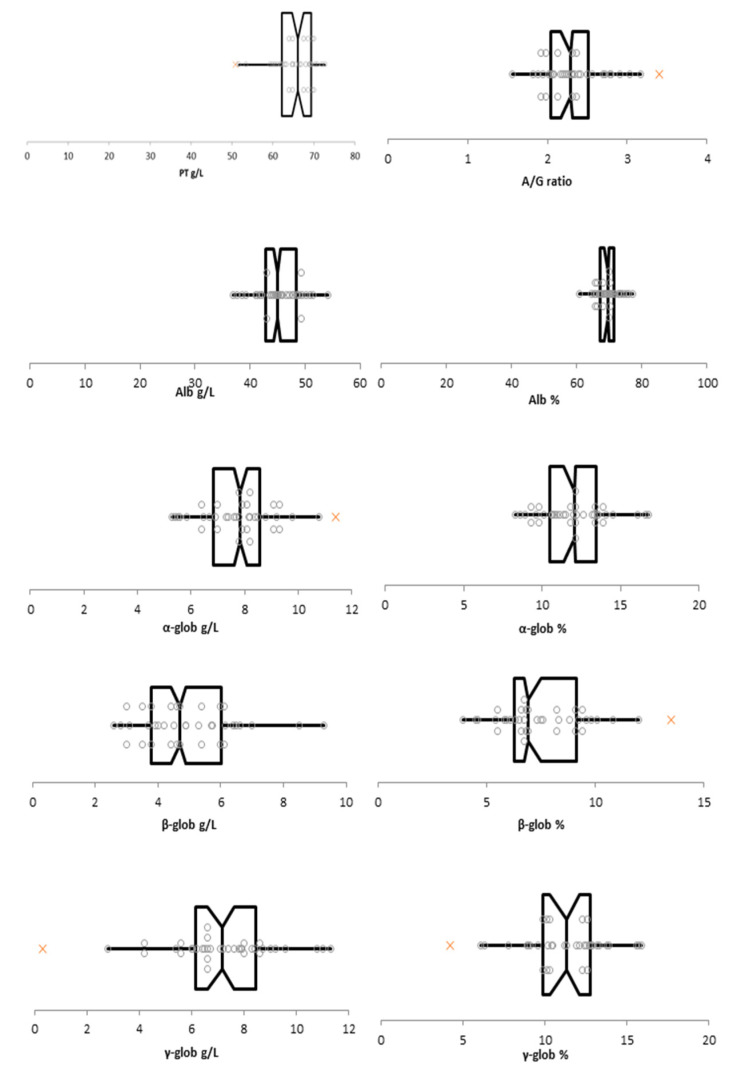
Serum protein electrophoresis (SPE) is the most used and reliable method to determine the percentage of serum protein subfractions. The interpretation of the kinetics of total proteins and albumin and globulin fractions is receiving increased attention in wild animals, as well as in domestic animals, due to the possibility of identifying typical pathologic patterns. However, the interpretation of these data had to be performed in light of an appropriate method-and species- specific reference intervals (RIs). In marine mammals, as well as other non-domestic species, specific attention should also be given to the different environment (free ranging vs. human managed) and the associated different exposure to environmental stimuli. The aim of this report was to establish RIs for the serum protein fractions evaluated using agarose gel electrophoresis (AGE) in bottlenose dolphins under human care. Peripheral blood samples were collected from 40 bottlenose dolphins during standard veterinary procedures to evaluate their health status. Total protein concentration was determined using the biuret method while AGE was performed using an automated system. A pooled dolphin's serum sample was used to determine the intra-assay and inter-assay imprecision of AGE. The RIs were calculated using an Excel spreadsheet with the Reference Value Advisor set of macroinstructions. The intra and inter-assay imprecisions were 1.2% and 2.5%, respectively, for albumin; 2.9% and 5.7%, respectively, for α-globulins; 3.8% and 4.0%, respectively, for β-globulins; and 3.4% and 4.8%, respectively, for γ-globulins. The total protein, albumin, α-globulin, β-globulin, and γ-globulin concentrations were 65.5 ± 5.4 g/L, 45.5 ± 4.9 g/L, 8.0 ± 1.0 g/L, 5.0 ± 2.0 g/L, and 7.0 ± 2.0 g/L, respectively. We established the RIs for the total protein and serum protein fractions using AGE in bottlenose dolphins under human care.
血清蛋白电泳(SPE)是测定血清蛋白亚组分百分比最常用且可靠的方法。由于能够识别典型的病理模式,总蛋白、白蛋白和球蛋白组分动力学的解读在野生动物和家畜中都受到了越来越多的关注。然而,这些数据的解读必须依据适当的方法和物种特异性参考区间(RI)来进行。在海洋哺乳动物以及其他非家养物种中,还应特别关注不同的环境(自由放养与人工管理)以及与之相关的对环境刺激的不同暴露情况。本报告的目的是为人工饲养的宽吻海豚建立使用琼脂糖凝胶电泳(AGE)评估血清蛋白组分的参考区间。在标准兽医程序中从40只宽吻海豚采集外周血样本,以评估它们的健康状况。使用双缩脲法测定总蛋白浓度,同时使用自动化系统进行AGE检测。使用一份混合的海豚血清样本测定AGE的批内和批间不精密度。使用带有“参考值顾问”宏指令集的Excel电子表格计算参考区间。白蛋白的批内和批间不精密度分别为1.2%和2.5%;α球蛋白分别为2.9%和5.7%;β球蛋白分别为3.8%和4.0%;γ球蛋白分别为3.4%和4.8%。总蛋白、白蛋白、α球蛋白、β球蛋白和γ球蛋白浓度分别为65.5±5.4g/L、45.5±4.9g/L、8.0±1.0g/L、5.0±2.0g/L和7.0±2.0g/L。我们为人工饲养的宽吻海豚建立了使用AGE测定总蛋白和血清蛋白组分的参考区间。