Hamamoto Wataru, Onoyama Takumi, Kawahara Shiho, Sakamoto Yuri, Koda Hiroki, Yamashita Taro, Takeda Yohei, Matsumoto Kazuya, Harada Kenichi, Yamaguchi Naoyuki, Isomoto Hajime
Department of Gastroenterology and Nephrology, Faculty of Medicine, Tottori University, Nishi-cho 36-1, Yonago 683-8504, Japan.
Department of Gastroenterology and Hepatology, Nagasaki University Graduate School of Biological Sciences, 1-7-1 Sakamoto, Nagasaki 852-8501, Japan.
J Clin Med. 2023 Oct 21;12(20):6663. doi: 10.3390/jcm12206663.
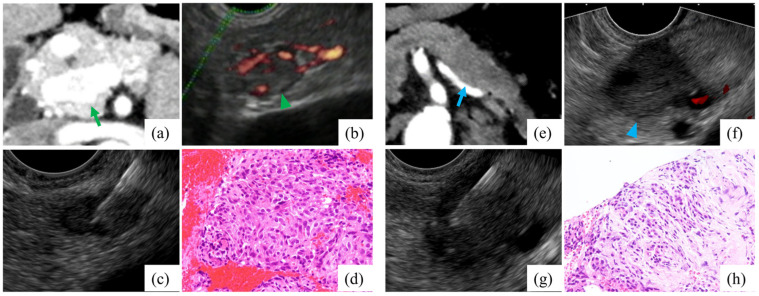
Endoscopic ultrasound-guided fine-needle biopsy (EUS-FNB) is a common technique for diagnosing pancreatic lesions with high accuracy and a low incidence of procedural adverse events. However, occasional adverse events, particularly bleeding, may occur. Procedures for hypervascular lesions are considered important, but their risks are unknown. We aimed to evaluate the safety and diagnostic yield of EUS-FNB for hypervascular pancreatic solid lesions. This study included 301 patients with 308 solid pancreatic lesions who underwent EUS-FNB between May 2011 and December 2018. We performed propensity-score matching to balance clinical differences between hypervascular and hypovascular lesions and analyzed 52 lesions. We compared the safety and diagnostic performance of propensity score-matched cohorts. The sensitivity, specificity, and accuracy rates of EUS-FNB for hypervascular lesions were 94.7%, 100%, and 96.2%, and those for hypovascular lesions were 80.0%, 100%, and 84.6%, respectively. There was no difference in diagnostic performance between hypervascular and hypovascular lesions. Furthermore, adverse events occurred in only one patient (pancreatitis) in the hypovascular group. There were no significant differences in the occurrence of adverse events between hypervascular and hypovascular lesions (0% vs. 3.8%, = 1.000). Therefore, EUS-FNB may be safe with a high diagnostic yield, even for hypervascular solid pancreatic lesions.
内镜超声引导下细针穿刺活检(EUS-FNB)是诊断胰腺病变的常用技术,具有较高的准确性和较低的操作不良事件发生率。然而,偶尔也可能发生不良事件,尤其是出血。对于富血管性病变的操作被认为很重要,但其风险尚不清楚。我们旨在评估EUS-FNB对富血管性胰腺实性病变的安全性和诊断率。本研究纳入了2011年5月至2018年12月期间接受EUS-FNB的301例患者,共308个胰腺实性病变。我们进行倾向评分匹配以平衡富血管性病变和乏血管性病变之间的临床差异,并分析了52个病变。我们比较了倾向评分匹配队列的安全性和诊断性能。EUS-FNB对富血管性病变的敏感性、特异性和准确率分别为94.7%、100%和96.2%,对乏血管性病变的敏感性、特异性和准确率分别为80.0%、100%和84.6%。富血管性病变和乏血管性病变在诊断性能上没有差异。此外,乏血管性病变组仅1例患者发生不良事件(胰腺炎)。富血管性病变和乏血管性病变在不良事件发生率上没有显著差异(0%对3.8%,P = 1.000)。因此,即使对于富血管性胰腺实性病变,EUS-FNB可能也是安全的,且诊断率较高。