Gera Kriti, Kahramangil Doga, Fenton Graeme A, Martir Daniela, Rodriguez Diana N, Ijaz Zohaib, Lin Rick Y, Rogers Sherise C, Ramnaraign Brian H, George Thomas J, Hong Young-Rock, Hughes Steven J, Nassour Ibrahim, Sahin Ilyas
Department of Medicine, University of Florida College of Medicine, Gainesville, FL 32610, USA.
Division of Hematology and Oncology, Department of Medicine, University of Florida College of Medicine, Gainesville, FL 32610, USA.
Cancers (Basel). 2023 Oct 19;15(20):5055. doi: 10.3390/cancers15205055.
Gallbladder carcinoma (GBC) is a rare, aggressive malignancy comprising 0.5% of gastrointestinal cancers. It has poor survival outcomes due to its insidious onset, lack of standardized screening, and limited therapies. Advanced-stage diagnosis with liver, lymph node, and peritoneal metastasis is common, while bone metastasis is rare. The knowledge on bone metastasis in GBC is limited to case reports and small series, and its clinical significance is largely unexplored.
The study extracted the demographic and clinical variables of patients with metastatic (M1) gallbladder adenocarcinoma from the Surveillance, Epidemiology, and End Results (SEER) database between 2011 and 2020. Descriptive statistics were used to analyze the demographic characteristics. The multivariate Cox regression analysis was used to calculate the hazard ratio. The overall survival (OS) was assessed using the Kaplan-Meier method, and the log-rank test was utilized to compare the survival between the groups.
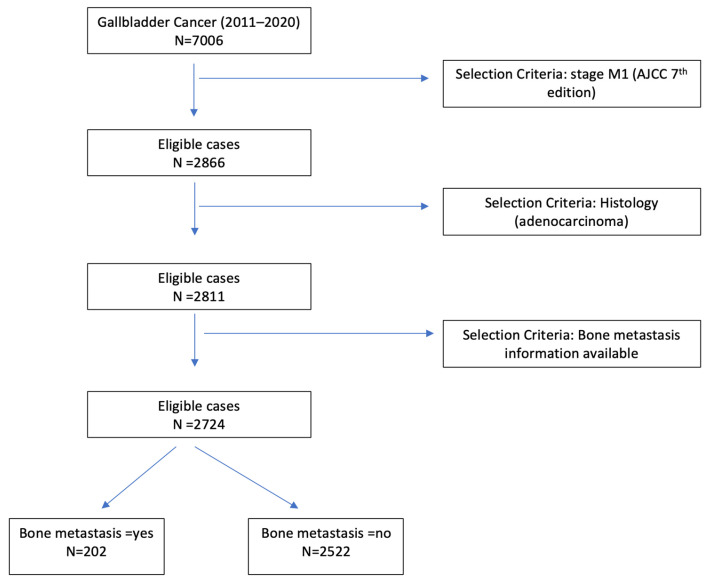
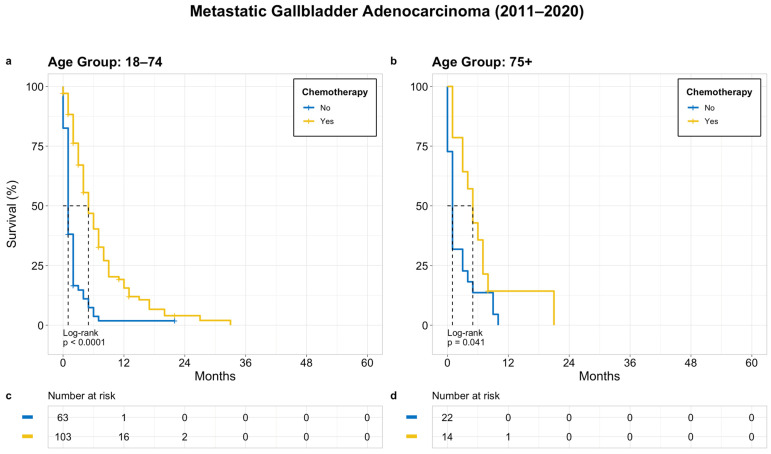
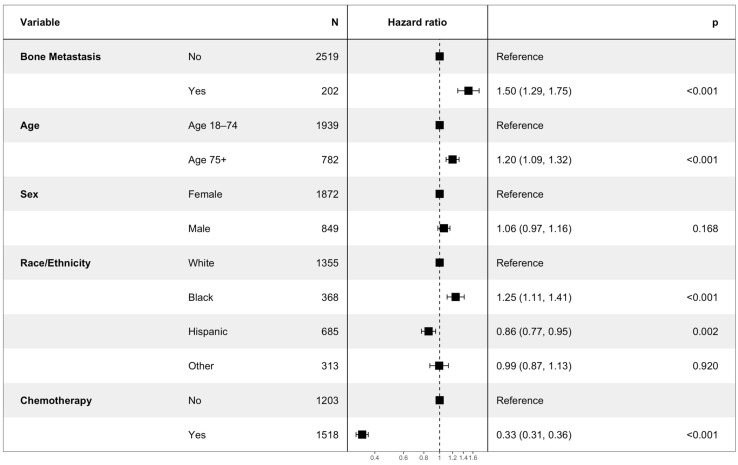
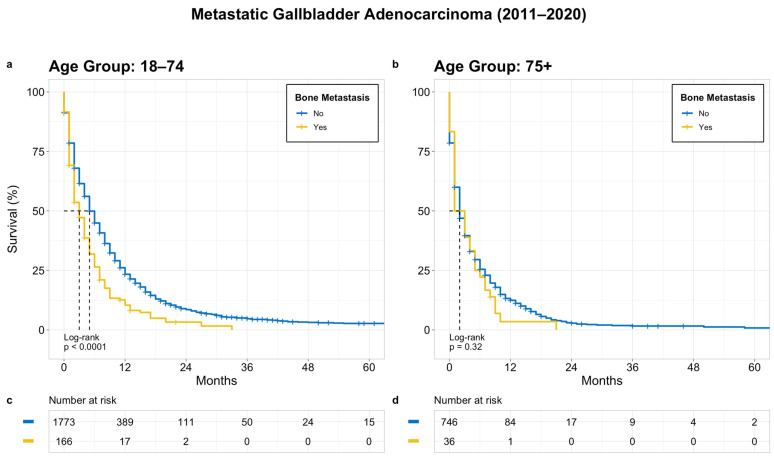
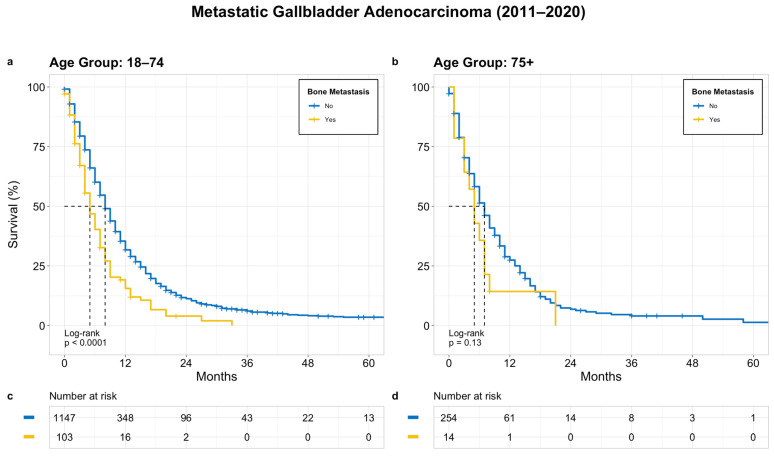
A total of 2724 patients were included in the study. A total of 69% of the patients were female, and the median age was 68 (range 24-90+). A total of 7.4% of the patients had bone metastasis on diagnosis. The multivariate Cox analysis identified bone metastasis as an independent mortality risk factor in metastatic GBC (HR 1.50, < 0.001). The patients were divided into two age groups: a younger age group (18-74 years) and an older age group (75+ years). In the younger group, the median OS with and without bone metastasis was 3 and 5 months, respectively ( < 0.0001). In the older age group, there was no significant difference in the OS between the patients with and without bone metastasis ( = 0.35). In the younger group who were treated with chemotherapy, the patients with bone metastasis had a significantly worse OS (median OS 5 months vs. 8 months, < 0.0001). In the untreated group, the patients with bone metastasis in the younger age group had a significantly worse OS (median OS 1 month vs. 2 months, = 0.014). In the patients with bone metastasis, those who did not receive chemotherapy had a significantly worse OS than those who were treated with chemotherapy in both age groups (younger age group: median OS 1 month vs. 5 months, < 0.0001 and older age group: median OS 1 month vs. 5 months, = 0.041).
Our findings suggest that the presence of bone metastasis in gallbladder adenocarcinoma is an independent prognostic factor associated with unfavorable survival outcomes in the younger age group (18-74 years). However, in the older age group (75+ years), the presence of bone metastasis did not impact the survival. Treatment with chemotherapy was associated with extended survival in all patients. Thus, early detection and aggressive management of bone metastasis, including the consideration of chemotherapy, may be crucial in improving the OS and quality of life for individuals with gallbladder adenocarcinoma.
胆囊癌(GBC)是一种罕见的侵袭性恶性肿瘤,占胃肠道癌症的0.5%。由于其发病隐匿、缺乏标准化筛查以及治疗方法有限,其生存结局较差。晚期诊断伴有肝、淋巴结和腹膜转移很常见,而骨转移则很少见。关于胆囊癌骨转移的知识仅限于病例报告和小样本系列研究,其临床意义在很大程度上尚未得到探索。
本研究从监测、流行病学和最终结果(SEER)数据库中提取了2011年至2020年间转移性(M1)胆囊腺癌患者的人口统计学和临床变量。采用描述性统计分析人口统计学特征。多变量Cox回归分析用于计算风险比。采用Kaplan-Meier方法评估总生存期(OS),并使用对数秩检验比较各组之间的生存期。
本研究共纳入2724例患者。共有69%的患者为女性,中位年龄为68岁(范围24 - 90 +岁)。共有7.4%的患者在诊断时出现骨转移。多变量Cox分析确定骨转移是转移性胆囊癌的独立死亡风险因素(HR 1.50,< 0.001)。患者分为两个年龄组:较年轻年龄组(18 - 74岁)和较年长年龄组(75 +岁)。在较年轻组中,有骨转移和无骨转移患者的中位OS分别为3个月和5个月(< 0.0001)。在较年长年龄组中,有骨转移和无骨转移患者的OS无显著差异(= 0.35)。在接受化疗的较年轻组中,有骨转移患者的OS明显更差(中位OS 5个月对8个月,< 0.0001)。在未治疗组中,较年轻年龄组有骨转移患者的OS明显更差(中位OS 1个月对2个月,= 0.014)。在有骨转移的患者中,两个年龄组中未接受化疗的患者的OS均明显比接受化疗的患者更差(较年轻年龄组:中位OS 1个月对5个月)。
我们的研究结果表明,胆囊腺癌中骨转移的存在是较年轻年龄组(18 - 74岁)生存结局不良的独立预后因素。然而,在较年长年龄组(75 +岁)中,骨转移的存在并未影响生存。化疗治疗与所有患者的生存期延长相关。因此,早期发现和积极处理骨转移,包括考虑化疗,对于改善胆囊腺癌患者的OS和生活质量可能至关重要。