Rejtő Sándor Faculty of Light Industry and Environmental Engineering, Institute of Environmental Engineering and Natural Science, Óbuda University, Doberdó út 6, H-1034 Budapest, Hungary.
Department of Organic Chemistry, Semmelweis University, Hőgyes Endre Street 7, H-1092 Budapest, Hungary.
Int J Mol Sci. 2023 Oct 10;24(20):15051. doi: 10.3390/ijms242015051.
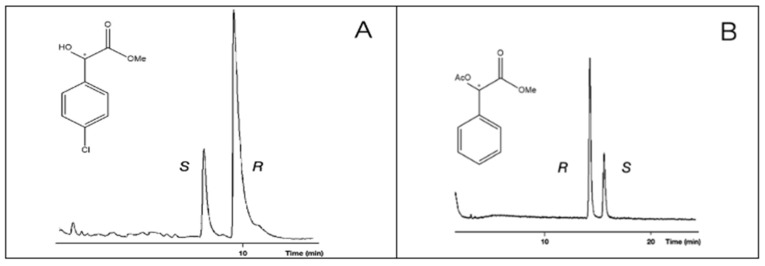
Frequently, a good chiral separation is the result of long trial and error processes. The three-point interaction mechanisms require the fair geometrical fitting and functional group compatibility of the interacting groups. Structure-chiral selectivity correlations are guidelines that can be established via trough systematic studies using model compounds. The enantiorecognition of the test compounds was studied on an octakis 2,3-Di-O-acetyl-6-O-tert-butyldimethylsilyl-gamma-cyclodextrin (TBDMSDAGCD) chiral selector. In our work, mandelic acid and its variously substituted compounds were used as model compounds to establish adaptable rules for other enantiomeric pairs. The mandelic acid and its modified compounds were altered at both their carboxyl and hydroxyl positions to test the key interaction forces of the chiral recognition processes. Ring- and alkyl-substituted mandelic acid derivatives were also used in our experiments. The chiral selectivity values of 20 test compounds were measured and extrapolated to 100 °C. The hydrogen donor abilities of test compounds improved their chiral selectivities. The inclusion phenomenon also played a role in chiral recognition processes in several cases. Enantiomer elution reversals were observed for different derivatives of hydroxyl groups, providing evidence for the multimodal character of the selector. The results of our research can serve as guidelines to achieve appropriate chiral separation for other enantiomeric pairs.
通常,良好的手性分离是长期反复试验的结果。三点相互作用机制需要相互作用基团的公平几何拟合和官能团兼容性。结构-手性选择性相关性是可以通过使用模型化合物进行系统研究来建立的指南。测试化合物的对映体识别在八(2,3-二-O-乙酰基-6-O-叔丁基二甲基硅基-γ-环糊精(TBDMSDAGCD)手性选择剂上进行研究。在我们的工作中,扁桃酸及其各种取代的化合物被用作模型化合物,以建立其他对映体对的适应性规则。扁桃酸及其修饰的化合物在羧基和羟基位置都发生了改变,以测试手性识别过程中的关键相互作用力。还在实验中使用了环和烷基取代的扁桃酸衍生物。测量了 20 种测试化合物的手性选择性值,并外推至 100°C。测试化合物的氢键供体能力提高了它们的手性选择性。在某些情况下,包合现象在手性识别过程中也发挥了作用。观察到不同羟基取代基的对映体洗脱反转,为选择器的多模态特性提供了证据。我们研究的结果可以作为实现其他对映体适当手性分离的指导。