
脂润滑条件下42CrMo4/17NiCrMo6-4摩擦学行为的影响因素分析
Analysis of Influencing Factors on the Tribological Behavior of 42CrMo4/17NiCrMo6-4 under Grease Lubrication.
作者信息
Wu Fenghe, Jiang Zhanpeng, Liu Zijian, Sun Yingbing, Li Xiang
机构信息
Department of Mechanical Engineering, Yanshan University, Qinhuangdao 066004, China.
出版信息
Materials (Basel). 2023 Oct 15;16(20):6699. doi: 10.3390/ma16206699.
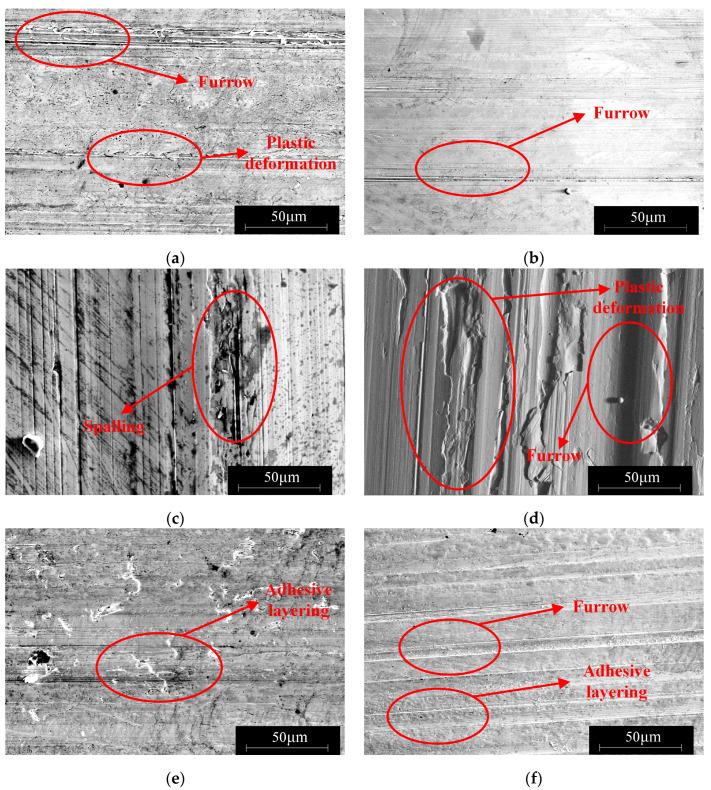
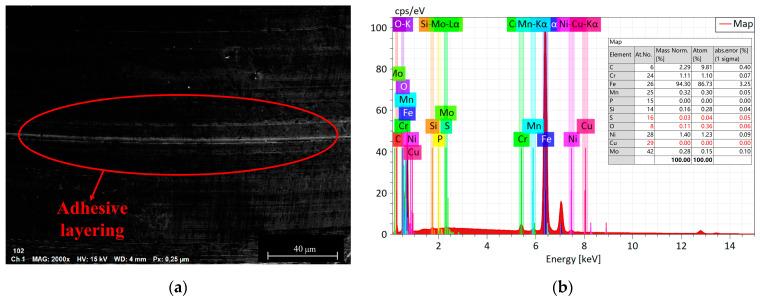
The tribological behavior of 42CrMo4/17NiCrMo6-4 under grease lubrication was explored in terms of load, speed, hardness matching, and lubrication quantity. Optical microscopy, scanning electron microscopy, and a surface profilometer were used to investigate the wear mechanism. The results show that hardness matching has the greatest impact on the wear resistance and friction reduction of the friction pair, followed by the load factor, with the impacts of speed and lubricant quantity being minor. Increasing the hardness of 42CrMo4 reduces the friction coefficient and wear volume of the friction pair substantially. When the maximum surface hardness of 42CrMo4 was compared with the lowest surface hardness, the friction coefficient was reduced by 21.5%, and the wear volume was reduced by 87.2%. Abrasive wear is the sort of wear failure that was seen, and as the hardness of 42CrMo4 increased, more severe fatigue wear appeared on 17NiCrMo6-4. While the wear volume initially increases and subsequently lowers with increasing load, the friction coefficient initially decreases and then stabilizes. A synergistic combination of abrasive and adhesive wear occurs under high load, changing the wear type from abrasive wear under low load. The wear volume is decreased by the sticky layer generated under high load conditions, which achieves superior wear prevention. This study is anticipated to offer recommendations for designing gears' required hardness under various operating circumstances.
研究了42CrMo4/17NiCrMo6-4在润滑脂润滑条件下的摩擦学行为,涉及载荷、速度、硬度匹配和润滑量等方面。采用光学显微镜、扫描电子显微镜和表面轮廓仪研究磨损机制。结果表明,硬度匹配对摩擦副的耐磨性和减摩性能影响最大,其次是载荷因素,速度和润滑量的影响较小。提高42CrMo4的硬度可大幅降低摩擦副的摩擦系数和磨损量。当42CrMo4的最大表面硬度与最低表面硬度相比时,摩擦系数降低了21.5%,磨损量降低了87.2%。观察到的磨损失效类型为磨粒磨损,随着42CrMo4硬度的增加,17NiCrMo6-4上出现了更严重的疲劳磨损。磨损量随载荷增加先增大后减小,摩擦系数先减小后稳定。在高载荷下,磨粒磨损和粘着磨损协同作用,使磨损类型从低载荷下的磨粒磨损转变。高载荷条件下产生的粘性层降低了磨损量,实现了优异的耐磨性能。本研究有望为设计不同工况下齿轮所需硬度提供建议。




 Zotero 插件