Festuccia Claudio, Corrado Miriam, Rossetti Alessandra, Castelli Riccardo, Lodola Alessio, Gravina Giovanni Luca, Tognolini Massimiliano, Giorgio Carmine
Department of Biotechnological and Applied Clinical Sciences, University of L'Aquila, Via Vetoio (Coppito), 67100 L'Aquila, Italy.
Department of Food and Drug, University of Parma, Parco Area delle Scienze 27/A, 43124 Parma, Italy.
Pharmaceuticals (Basel). 2023 Oct 13;16(10):1452. doi: 10.3390/ph16101452.
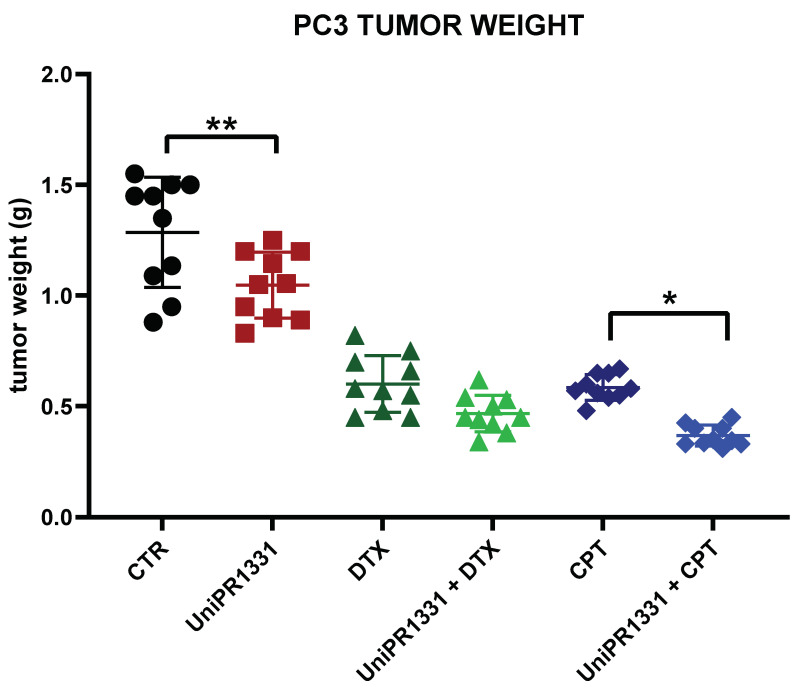
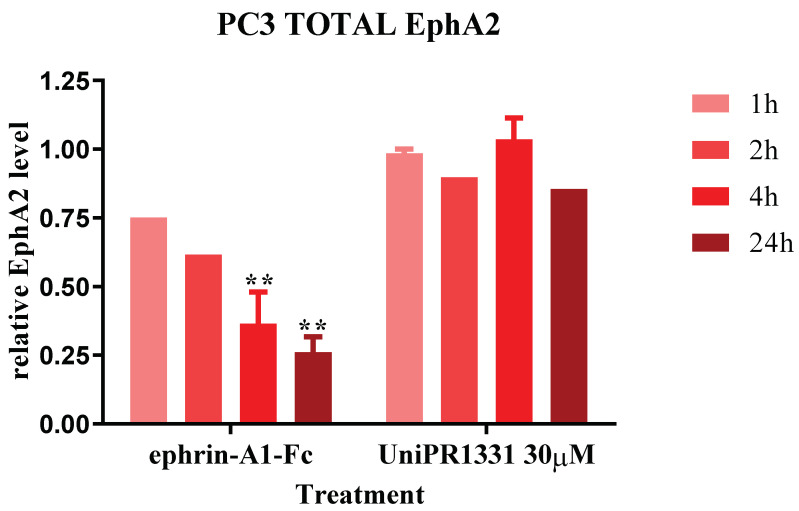
The Eph kinases are the largest receptor tyrosine kinases (RTKs) family in humans. PC3 human prostate adenocarcinoma cells are a well-established model for studying Eph-ephrin pharmacology as they naturally express a high level of EphA2, a promising target for new cancer therapies. A pharmacological approach with agonists did not show significant efficacy on tumor growth in prostate orthotopic murine models, but reduced distal metastasis formation. In order to improve the comprehension of the pharmacological targeting of Eph receptors in prostate cancer, in the present work, we investigated the efficacy of Eph antagonism both in vitro and in vivo, using UniPR1331, a small orally bioavailable Eph-ephrin interaction inhibitor. UniPR1331 was able to inhibit PC3 cells' growth in vitro in a dose-dependent manner, affecting the cell cycle and inducing apoptosis. Moreover, UniPR1331 promoted the PC3 epithelial phenotype, downregulating epithelial mesenchymal transition (EMT) markers. As a consequence, UniPR1331 reduced in vitro PC3 migration, invasion, and vasculomimicry capabilities. The antitumor activity of UniPR1331 was confirmed in vivo when administered alone or in combination with cytotoxic drugs in PC3-xenograft mice. Our results demonstrated that Eph antagonism is a promising strategy for inhibiting prostate cancer growth, especially in combination with cytotoxic drugs.
Eph激酶是人类最大的受体酪氨酸激酶(RTK)家族。PC3人前列腺腺癌细胞是研究Eph-ephrin药理学的成熟模型,因为它们天然高表达EphA2,这是一种新型癌症治疗的有前景的靶点。在前列腺原位小鼠模型中,使用激动剂的药理学方法对肿瘤生长未显示出显著疗效,但减少了远处转移的形成。为了更好地理解前列腺癌中Eph受体的药理学靶向作用,在本研究中,我们使用一种口服生物利用度良好的小分子Eph-ephrin相互作用抑制剂UniPR1331,研究了Eph拮抗作用在体外和体内的疗效。UniPR1331能够在体外以剂量依赖的方式抑制PC3细胞的生长,影响细胞周期并诱导细胞凋亡。此外,UniPR1331促进了PC3上皮表型,下调上皮-间质转化(EMT)标志物。因此,UniPR1331降低了体外PC3细胞的迁移、侵袭和血管生成拟态能力。当单独给药或与细胞毒性药物联合给药于PC3异种移植小鼠时,UniPR1331的抗肿瘤活性在体内得到证实。我们的结果表明,Eph拮抗作用是抑制前列腺癌生长的一种有前景的策略,特别是与细胞毒性药物联合使用时。