Division of Pulmonary and Critical Care Medicine, Department of Internal Medicine, Tongji Hospital, Tongji Medical College, Huazhong University of Science and Technology, Wuhan, China.
Key Laboratory of Respiratory Diseases, National Clinical Research Center for Respiratory Diseases, National Health Commission of People's Republic of China, Wuhan, China.
Respir Res. 2023 Oct 28;24(1):260. doi: 10.1186/s12931-023-02557-5.
Severe asthma is associated with substantial mortality and has unmet therapeutic need. A subset of severe asthma is characterized by neutrophilic airway inflammation. Classically activated (or M1) macrophages which express IL-12 and IL-23 are associated with airway neutrophilia in asthma. Exogenous IL-25 was reported to suppress intestinal inflammation in animal models of inflammatory bowel diseases via suppressing IL-12 and IL-23 production. We hypothesize that IL-25 ameliorates airway neutrophilia via inhibiting macrophage M1 polarization and the expression of IL-12 and IL-23 in asthma.
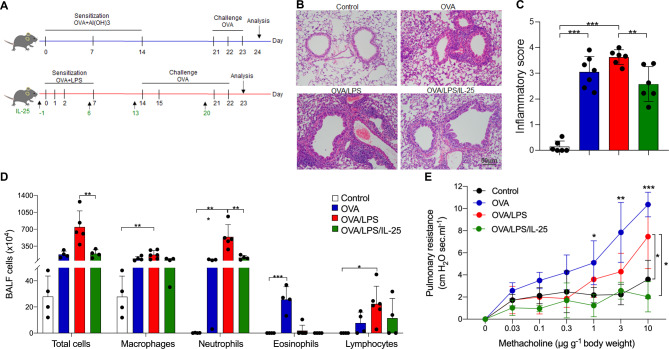
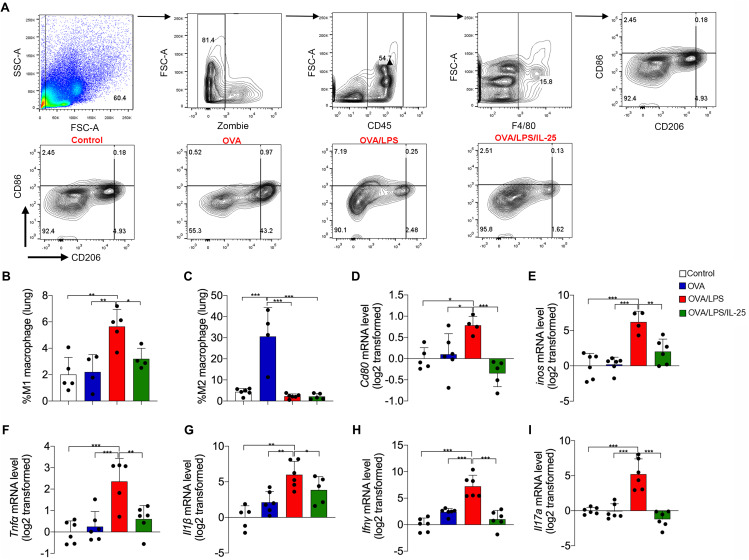
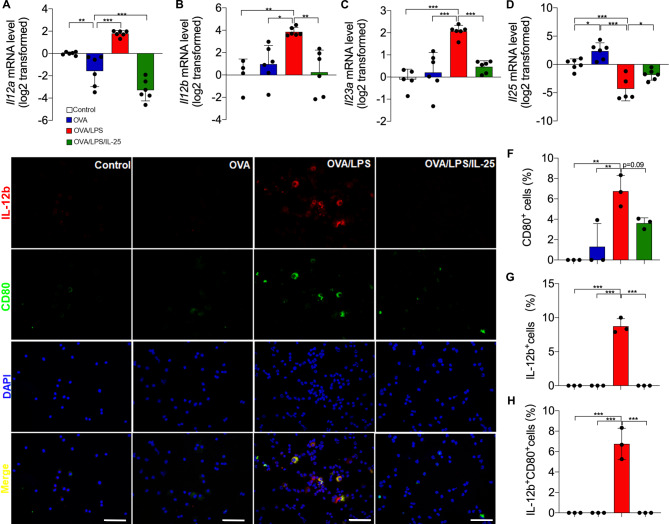
In a mouse model of neutrophil-dominant allergic airway inflammation, the effect of mouse recombinant IL-25 on airway inflammation were assessed by H&E staining and bronchoalveolar lavage (BAL) cell counting. The percentage of M1 macrophages in lung tissue and BAL cells were analyzed by flow cytometry. Quantitative PCR and immunostaining were performed to measure the expression of Il12, Il23, and inflammatory cytokines. Mechanistic experiments were performed in primary culture of macrophages from mouse lungs. The expression of IL-12, IL-23 and IL-25 in sputum was analyzed in a cohort of severe asthma and subjects with eosinophilic or non-eosinophilic asthma.
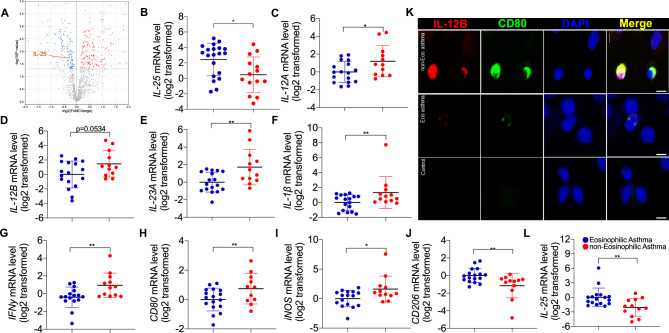
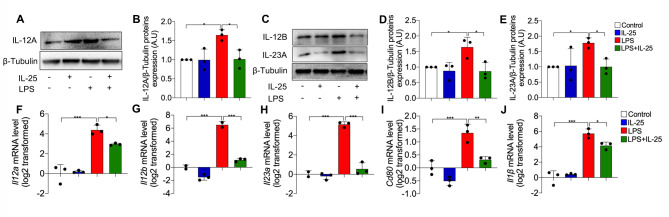
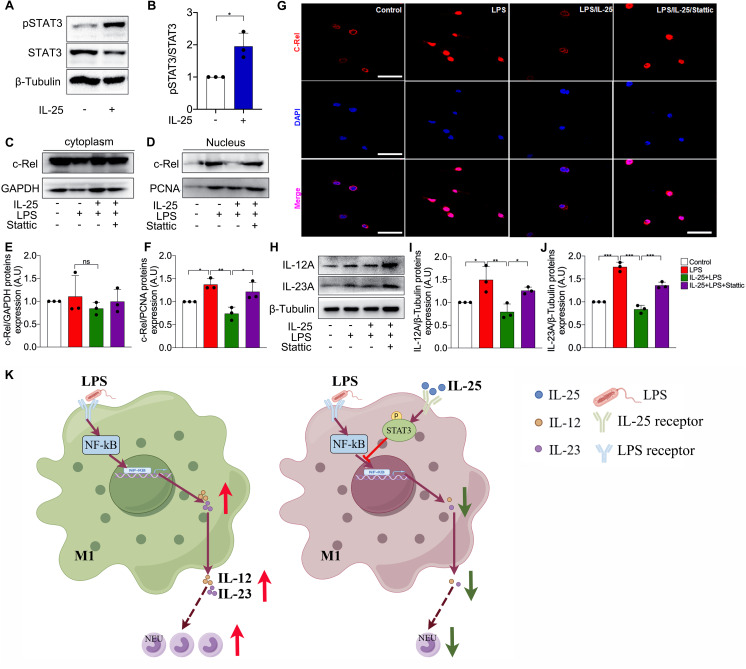
Intranasal administration of IL-25 markedly decreased the number of neutrophils in BAL cells in a murine model of neutrophil-dominant allergic airway inflammation. Moreover, exogenous IL-25 decreased the number of M1 macrophages, and reduced the expression of IL-12, IL-23 in the lungs of the mouse model. Exogenous IL-25 also inhibited the expression of inflammatory cytokines IL-1β, IFN-γ, TNF-α and IL-17 A. In vitro, IL-25 suppressed IL-12 and IL-23 expression in lipopolysaccharide (LPS)-stimulated primary culture of mouse pulmonary macrophages. Mechanistically, IL-25 inhibited LPS-induced c-Rel translocation to nucleus via STAT3-dependent signaling. In a cohort of severe asthma, IL-25 protein levels in sputum were significantly lower than control subjects. The transcript levels of IL-12 and IL-23 were increased whereas IL-25 transcripts were decreased in sputum cells from subjects with non-eosinophilic asthma compared to eosinophilic asthma.
IL-25 expression is downregulated in subjects with severe or non-eosinophilic asthma. Exogenous IL-25 ameliorates airway neutrophilia, at least in part, via inhibiting macrophage M1 polarization and the expression of IL-12 and IL-23.
重度哮喘与高死亡率相关,且存在未满足的治疗需求。一部分重度哮喘的特征是气道嗜中性粒细胞炎症。经典激活(或 M1)巨噬细胞表达 IL-12 和 IL-23,与哮喘中的气道嗜中性粒细胞有关。据报道,外源性 IL-25 通过抑制 IL-12 和 IL-23 的产生来抑制炎症性肠病动物模型中的肠道炎症。我们假设 IL-25 通过抑制巨噬细胞 M1 极化和 IL-12 和 IL-23 的表达来改善哮喘中的气道嗜中性粒细胞。
在嗜中性粒细胞占主导的变应性气道炎症的小鼠模型中,通过 H&E 染色和支气管肺泡灌洗(BAL)细胞计数评估小鼠重组 IL-25 对气道炎症的影响。通过流式细胞术分析肺组织和 BAL 细胞中 M1 巨噬细胞的百分比。通过定量 PCR 和免疫染色测量 Il12、Il23 和炎性细胞因子的表达。在来自小鼠肺部的原代巨噬细胞培养物中进行机制实验。在重度哮喘患者和嗜酸性粒细胞或非嗜酸性粒细胞哮喘患者的队列中分析痰液中 IL-12、IL-23 和 IL-25 的表达。
在嗜中性粒细胞占主导的变应性气道炎症的小鼠模型中,鼻内给予 IL-25 可显著减少 BAL 细胞中的中性粒细胞数量。此外,外源性 IL-25 减少了 M1 巨噬细胞的数量,并降低了小鼠模型中肺组织中 IL-12 和 IL-23 的表达。外源性 IL-25 还抑制了炎性细胞因子 IL-1β、IFN-γ、TNF-α 和 IL-17A 的表达。在体外,IL-25 抑制了脂多糖(LPS)刺激的原代培养的小鼠肺巨噬细胞中 IL-12 和 IL-23 的表达。从机制上讲,IL-25 通过 STAT3 依赖性信号抑制 LPS 诱导的 c-Rel 向核内易位。在重度哮喘患者的队列中,痰液中的 IL-25 蛋白水平明显低于对照组。与嗜酸性粒细胞哮喘相比,非嗜酸性粒细胞哮喘患者的痰液细胞中 IL-12 和 IL-23 的转录水平升高,而 IL-25 的转录水平降低。
重度或非嗜酸性粒细胞哮喘患者的 IL-25 表达下调。外源性 IL-25 通过抑制巨噬细胞 M1 极化和 IL-12 和 IL-23 的表达来改善气道嗜中性粒细胞。