Wagner Brandon, Kim Minseok, Chowdhury Mahbub, Vidales Pasos Emmanuel, Hizon Kimberly, Ghildiyal Pankaj, Zachariah Michael R, Mangolini Lorenzo
Materials Science and Engineering Program, University of California Riverside, 900 University Avenue, Riverside, California 92521, United States.
Department of Mechanical Engineering, University of California Riverside, 900 University Avenue, Riverside, California 92521, United States.
ACS Appl Mater Interfaces. 2023 Oct 29;15(44):51639-49. doi: 10.1021/acsami.3c12696.
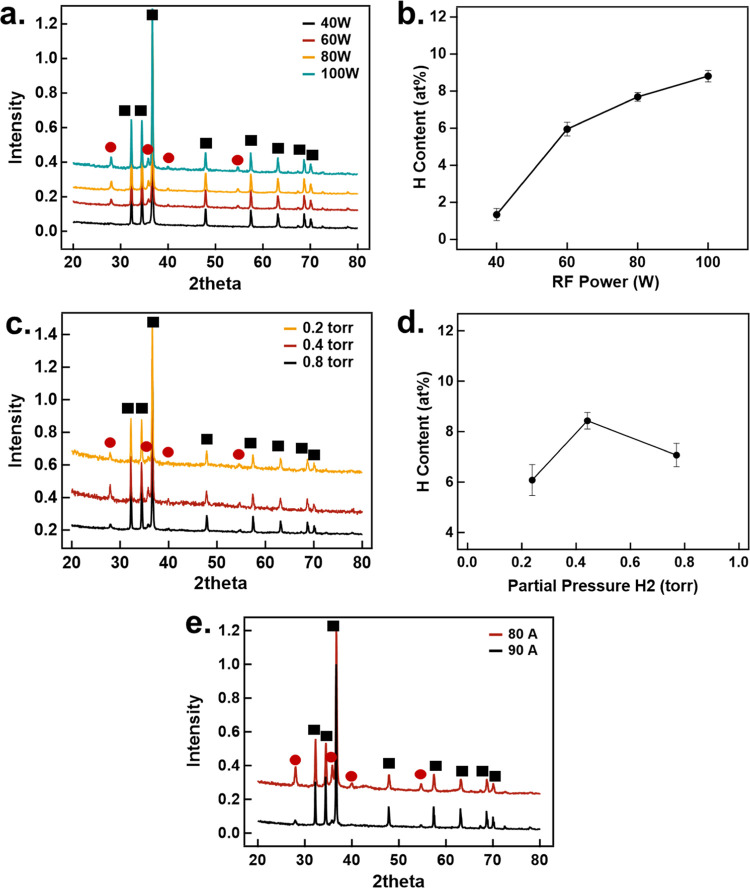
The hydrogenation of metal nanoparticles provides a pathway toward tuning their combustion characteristics. Metal hydrides have been employed as solid-fuel additives for rocket propellants, pyrotechnics, and explosives. Gas generation during combustion is beneficial to prevent aggregation and sintering of particles, enabling a more complete fuel utilization. Here, we discuss a novel approach for the synthesis of magnesium hydride nanoparticles based on a two-step aerosol process. Mg particles are first nucleated and grown via thermal evaporation, followed immediately by in-flight exposure to a hydrogen-rich low-temperature plasma. During the second step, atomic hydrogen generated by the plasma rapidly diffuses into the Mg lattice, forming particles with a significant fraction of MgH. We find that hydrogenated Mg nanoparticles have an ignition temperature that is reduced by ∼200 °C when combusted with potassium perchlorate as an oxidizer, compared to the non-hydrogenated Mg material. This is due to the release of hydrogen from the fuel, jumpstarting its combustion. In addition, characterization of the plasma processes suggests that a careful balance between the dissociation of molecular hydrogen and heating of the nanoparticles must be achieved to avoid hydrogen desorption during production and achieve a significant degree of hydrogenation.
金属纳米颗粒的氢化提供了一种调节其燃烧特性的途径。金属氢化物已被用作火箭推进剂、烟火和炸药的固体燃料添加剂。燃烧过程中产生气体有利于防止颗粒聚集和烧结,从而实现更完全的燃料利用。在此,我们讨论一种基于两步气溶胶过程合成氢化镁纳米颗粒的新方法。首先通过热蒸发使镁颗粒成核并生长,随后立即在飞行过程中暴露于富氢低温等离子体。在第二步中,等离子体产生的原子氢迅速扩散到镁晶格中,形成含有大量MgH的颗粒。我们发现,与未氢化的镁材料相比,当以高氯酸钾作为氧化剂燃烧时,氢化镁纳米颗粒的点火温度降低了约200°C。这是由于燃料中释放出氢气,引发了其燃烧。此外,对等离子体过程的表征表明,必须在分子氢的解离和纳米颗粒的加热之间实现仔细的平衡,以避免在生产过程中氢气解吸并实现显著程度的氢化。