Association for Social Development, Islamabad, Pakistan.
Directorate General of Health Services, Punjab, Pakistan.
Glob Health Sci Pract. 2023 Oct 30;11(5). doi: 10.9745/GHSP-D-23-00037.
Significant brain development in children occurs from birth to 2 years, with environment playing an important role. Stimulation interventions are widely known to be effective in enhancing early childhood development (ECD). This study aims to assess the feasibility and effectiveness of integrating ECD care delivered by lady health visitors (LHVs) at public health facilities in rural Pakistan.
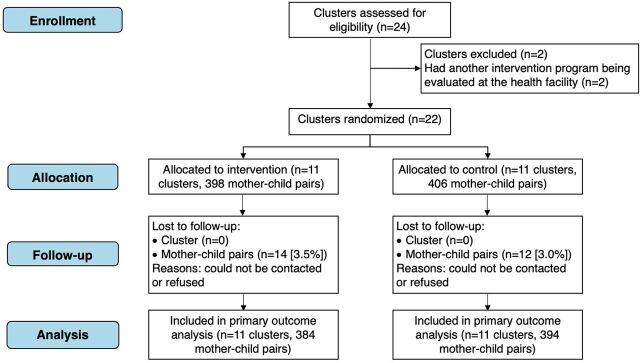
A cluster randomized controlled trial was conducted through public health facilities in 2 districts of Punjab, Pakistan. A total of 22 clusters (rural health centers and subdistrict hospitals) were randomly allocated to receive routine care (control: n=11 clusters, 406 mother-child pairs) or counseling (intervention: n=11 clusters, 398 mother-child pairs). All children aged 11-12 months without any congenital abnormality were eligible for enrollment. The intervention was delivered by the LHVs to mothers with children aged 12-24 months in 3 quarterly sessions.
The primary outcome was the prevention of ECD delays in children aged 24 months (assessed with the Ages and Stages Questionnaire-3). Analysis was done on an intention-to-treat basis. A total of 804 mother-child pairs were registered in the study, of which 26 (3.3%) pairs were lost to follow-up at the endpoint. The proportion of children with 2 or more developmental delays was significantly less in the intervention arm (13%) as compared to the control arm (41%) at an endpoint (odds ratio=0.21; 95% confidence interval=0.11, 0.42). Children in the intervention arm also had significantly better anthropometric measurements when aged 24 months than the children in the control arm.
The integrated ECD care intervention for children aged 12-24 months at public health facilities was found to be effective in enhancing ECD and reducing the proportion of children with global development delays.
儿童的大脑从出生到 2 岁之间发育迅速,环境在此过程中起着重要作用。刺激干预措施已被广泛证实能有效促进儿童早期发展(ECD)。本研究旨在评估在巴基斯坦农村地区公共卫生设施中由女健康访视员(LHVs)提供 ECD 护理的整合模式的可行性和有效性。
本研究在巴基斯坦旁遮普省的 2 个地区通过公共卫生设施开展了一项整群随机对照试验。共 22 个群组(农村卫生中心和分区医院)被随机分配接受常规护理(对照组:n=11 个群组,406 对母婴)或咨询(干预组:n=11 个群组,398 对母婴)。所有年龄在 11-12 个月且无任何先天异常的儿童均有资格入组。由 LHVs 向年龄在 12-24 个月的母亲及其子女每季度提供 3 次干预。
主要结局是预防 24 个月龄儿童的 ECD 发育迟缓(使用《年龄与阶段问卷-3》进行评估)。分析基于意向治疗原则进行。共有 804 对母婴在研究中注册,其中 26 对(3.3%)在终点随访时失访。干预组中存在 2 项或更多发育迟缓的儿童比例明显低于对照组(干预组为 13%,对照组为 41%)(比值比=0.21;95%置信区间=0.11,0.42)。在 24 个月龄时,干预组儿童的人体测量学指标也明显优于对照组。
在公共卫生设施中为 12-24 个月龄儿童提供的整合 ECD 护理干预措施被证实能有效促进 ECD,并降低存在全面发育迟缓的儿童比例。