Institute of Biotechnology, Life Sciences Center, Vilnius University, LT-10257 Vilnius, Lithuania.
Institute of Chemistry, Department of Chemistry and Geosciences, Vilnius University, LT-03225 Vilnius, Lithuania.
Acc Chem Res. 2023 Nov 21;56(22):3188-3197. doi: 10.1021/acs.accounts.3c00471. Epub 2023 Oct 30.
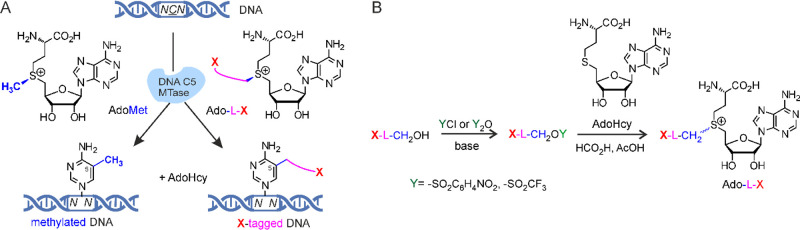
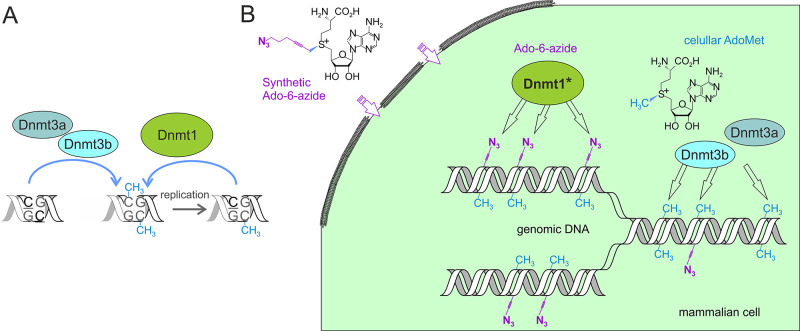
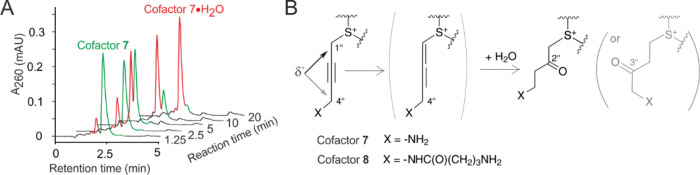
DNA is the genetic matter of life composed of four major nucleotides which can be further furnished with biologically important covalent modifications. Among the variety of enzymes involved in DNA metabolism, AdoMet-dependent methyltransferases (MTases) combine the recognition of specific sequences and covalent methylation of a target nucleotide. The naturally transferred methyl groups play important roles in biological signaling, but they are poor physical reporters and largely resistant to chemical derivatization. Therefore, an obvious strategy to unlock the practical utility of the methyltransferase reactions is to enable the transfer of "prederivatized" (extended) versions of the methyl group.However, previous enzymatic studies of extended AdoMet analogs indicated that the transalkylation reactions are drastically impaired as the size of the carbon chain increases. In collaborative efforts, we proposed that, akin to enhanced S2 reactivity of allylic and propargylic systems, addition of a π orbital next to the transferable carbon atom might confer the needed activation of the reaction. Indeed, we found that MTase-catalyzed transalkylations of DNA with cofactors containing a double or a triple C-C bond in the β position occurred in a robust and sequence-specific manner. Altogether, this breakthrough approach named mTAG (methyltransferase-directed transfer of activated groups) has proven instrumental for targeted labeling of DNA and other types of biomolecules (using appropriate MTases) including RNA and proteins.Our further work focused on the propargylic cofactors and their reactions with DNA cytosine-5 MTases, a class of MTases common for both prokaryotes and eukaryotes. Here, we learned that the 4-X-but-2-yn-1-yl (X = polar group) cofactors suffered from a rapid loss of activity in aqueous buffers due to susceptibility of the triple bond to hydration. This problem was remedied by synthetically increasing the separation between X and the triple bond from one to three carbon units (6-X-hex-2-ynyl cofactors). To further optimize the transfer of the bulkier groups, we performed structure-guided engineering of the MTase cofactor pocket. Alanine replacements of two conserved residues conferred substantial improvements of the transalkylation activity with M.HhaI and three other engineered bacterial C5-MTases. Of particular interest were CpG-specific DNA MTases (M.SssI), which proved valuable tools for studies of mammalian methylomes and chemical probing of DNA function.Inspired by the successful repurposing of bacterial enzymes, we turned to more complex mammalian C5-MTases (Dnmt1, Dnmt3A, and Dnmt3B) and asked if they could ultimately lead to mTAG labeling inside mammalian cells. Our efforts to engineer mouse Dnmt1 produced a variant (Dnmt1*) that enabled efficient Dnmt1-directed deposition of 6-azide-hexynyl groups on DNA in vitro. CRISPR-Cas9 editing of the corresponding codons in the genomic Dnmt1 alleles established endogenous expression of Dnmt1* in mouse embryonic stem cells. To circumvent the poor cellular uptake of AdoMet and its analogs, we elaborated their efficient internalization by electroporation, which has finally enabled selective catalysis-dependent azide tagging of natural Dnmt1 targets in live mammalian cells. The deposited chemical groups were then exploited as "click" handles for reading adjoining sequences and precise genomic mapping of the methylation sites. These findings offer unprecedented inroads into studies of DNA methylation in a wide range of eukaryotic model systems.
DNA 是生命的遗传物质,由四种主要核苷酸组成,这些核苷酸可以进一步进行生物重要的共价修饰。在涉及 DNA 代谢的各种酶中,AdoMet 依赖性甲基转移酶(MTases)结合了对特定序列的识别和对靶核苷酸的共价甲基化。天然转移的甲基基团在生物信号中起着重要作用,但它们是较差的物理报告基团,并且在很大程度上抵抗化学衍生化。因此,解锁甲基转移酶反应的实际用途的明显策略是允许转移“预衍生化”(扩展)版本的甲基。然而,先前对扩展的 AdoMet 类似物的酶研究表明,随着碳链长度的增加, transalkylation 反应受到严重损害。在合作努力下,我们提出,类似于烯丙基和炔丙基系统的 S2 反应性增强,在可转移碳原子旁边添加一个π轨道可能赋予反应所需的活化。事实上,我们发现 MTase 催化的带有辅因子的 DNA 反烷基化反应以稳健且序列特异性的方式发生,辅因子β位含有双键或三键的 C-C 键。总之,这种名为 mTAG(甲基转移酶指导的活化基团转移)的突破性方法已被证明是对 DNA 和其他类型的生物分子(使用适当的 MTases)包括 RNA 和蛋白质进行靶向标记的有效工具。
我们的进一步工作集中在炔丙基辅因子及其与 DNA 胞嘧啶-5 MTases 的反应上,DNA 胞嘧啶-5 MTases 是原核生物和真核生物共有的一类 MTases。在这里,我们了解到 4-X-丁-2-yn-1-基(X = 极性基团)辅因子由于三键对水合的敏感性,在水性缓冲液中迅速失去活性。通过合成将 X 和三键之间的距离从一个增加到三个碳原子单元(6-X-己-2-ynyl 辅因子)来解决此问题。为了进一步优化较大基团的转移,我们对 MTase 辅因子口袋进行了基于结构的工程改造。两个保守残基的丙氨酸替换赋予了 M.HhaI 和其他三种工程化的细菌 C5-MTases 的 transalkylation 活性的实质性改善。特别有趣的是 CpG 特异性 DNA MTases(M.SssI),它们是研究哺乳动物甲基组和 DNA 功能化学探测的有价值的工具。
受细菌酶成功重新利用的启发,我们转向更复杂的哺乳动物 C5-MTases(Dnmt1、Dnmt3A 和 Dnmt3B),并询问它们是否最终可以在哺乳动物细胞内实现 mTAG 标记。我们为工程化小鼠 Dnmt1 所做的努力产生了一种变体(Dnmt1*),该变体能够在体外有效地将 6-叠氮己基基团导向 Dnmt1 沉积在 DNA 上。在基因组 Dnmt1 等位基因中相应密码子的 CRISPR-Cas9 编辑建立了内源性表达的 Dnmt1*在小鼠胚胎干细胞中。为了避免 AdoMet 及其类似物的细胞摄取不良,我们通过电穿孔精心设计了它们的有效内化,这最终使天然 Dnmt1 靶标在活哺乳动物细胞中的选择性催化依赖性叠氮标记成为可能。然后,沉积的化学基团被用作“点击”处理,用于读取相邻序列并精确映射甲基化位点的基因组。这些发现为在广泛的真核模型系统中研究 DNA 甲基化提供了前所未有的途径。