School of Psychology, Victoria University of Wellington, Wellington, New Zealand.
School of Mathematics and Statistics, University of Canterbury, Christchurch, New Zealand.
Sci Rep. 2023 Oct 31;13(1):18699. doi: 10.1038/s41598-023-44713-3.
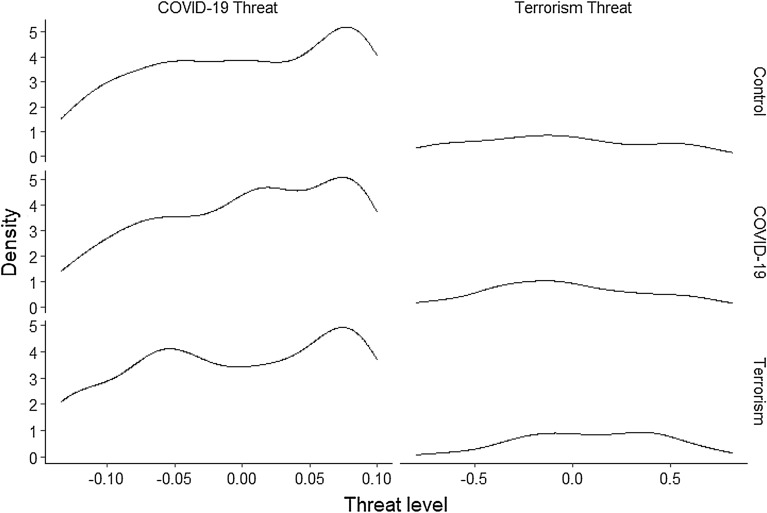
Authoritarianism is best conceptualised by three attitudinal clusters: Aggression, Submission, and Conventionalism. Once considered a fixed characteristic, recent observational research has demonstrated how the dimension of submission can fluctuate in response to COVID-19 threat as a means of maintaining collective security. However, this effect has not been investigated with other forms of threat, nor has it been supported experimentally. In the present study, we sought to test observational findings by priming 300 participants with either a COVID-19 threat, a domestic terrorism threat, or a non-threatening control. Levels of authoritarianism were tested before and after presentation of a prime and then the difference between the two measures could be compared between prime conditions. Results from a Bayesian multivariate regression analysis informed by observational findings suggested that participants who experienced the COVID-19 or terrorism primes reported higher levels of authoritarian submission after the prime compared to before the prime, relative to those who experienced the neutral control prime. In contrast, the aggression subfactor did not seem to elicit any change in response to threat, and the conventionalism subfactor showed a response only to the terrorism prime. We concluded that two different forms of societal threat could elicit changes in specific dimensions of authoritarianism over a very short time span. We caution against the common practice of treating authoritarianism as a unidimensional construct without careful consideration.
攻击性、顺从性和传统主义。虽然曾经被认为是一种固定的特征,但最近的观察研究表明,顺从维度可以根据 COVID-19 威胁的变化而波动,以维护集体安全。然而,这种效应尚未在其他形式的威胁中得到验证,也没有得到实验支持。在本研究中,我们试图通过用 COVID-19 威胁、国内恐怖主义威胁或非威胁性对照物对 300 名参与者进行启动来检验观察结果。在呈现启动后,测试参与者的威权主义水平,然后可以比较启动条件之间的两个测量值之间的差异。基于观察结果的贝叶斯多元回归分析的结果表明,与经历中性对照启动的参与者相比,经历 COVID-19 或恐怖主义启动的参与者在启动后报告的威权顺从性水平更高。相比之下,攻击性亚因素似乎没有对威胁产生任何反应,而传统主义亚因素仅对恐怖主义启动产生反应。我们得出结论,两种不同形式的社会威胁可以在很短的时间内引起威权主义特定维度的变化。我们警告不要在没有仔细考虑的情况下将威权主义视为一种单一维度的结构。