Egyptian Atomic Energy Authority, Nuclear Research Center, Radioisotopes Applications Division, Biological Applications Department, Cairo, P.O. 13759, Egypt.
Trop Anim Health Prod. 2023 Nov 1;55(6):388. doi: 10.1007/s11250-023-03805-y.
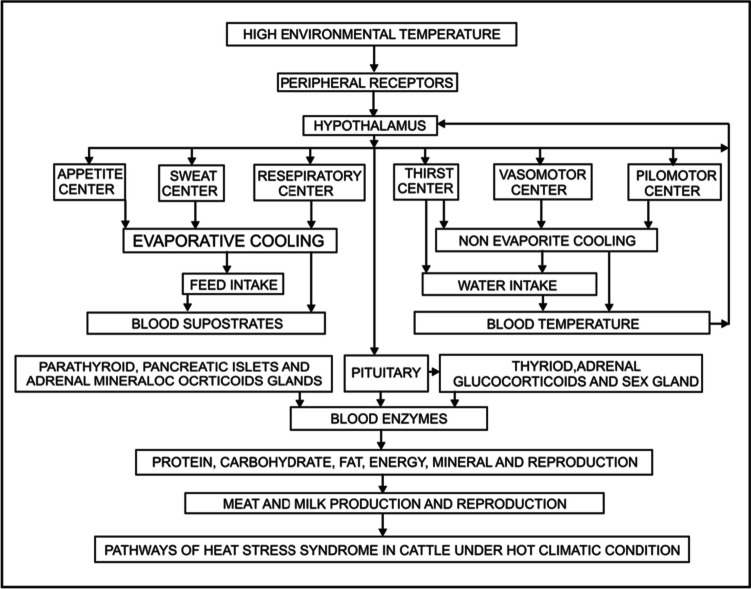
The optimal environments for ruminants are air temperatures between 13 and 20 °C, winds between 5 and 18 km/h, humidity levels between 55 and 65%, and a moderate amount of sunlight. In tropical and subtropical regions, climate is the top factor restricting animal growth and reproductive efficiency. The digestive system, blood biochemical components, and hormones all go through a range of physiological changes at high temperatures. Ruminant animals respond to heat stress by drinking more water, breathing more quickly, panting, and raising their rectal temperatures while reducing their activity levels, intake of roughage, and rumination. Blood metabolites and biochemical modifications are negatively impacted by the concentration of blood biochemical components and hormonal levels, particularly those of anabolic hormones, which are decreased as a result of the animals' exposure to high environmental temperatures. Changes in blood metabolite and hormone levels were influenced by the duration of exposure to high temperatures, the level of background heat, and the species, breed, and age of the animals. The major biological changes caused by heat stress have a negative impact on growth, milk production, and reproduction. Animals subjected to high environmental temperatures also undergo reductions in feed intake and feed efficiency. These changes eventually impair ruminant reproduction and production abilities.
反刍动物的最佳环境是空气温度在 13 到 20°C 之间,风速在 5 到 18 公里/小时之间,湿度在 55%到 65%之间,以及适量的阳光。在热带和亚热带地区,气候是限制动物生长和繁殖效率的首要因素。高温会使反刍动物的消化系统、血液生化成分和激素发生一系列生理变化。反刍动物通过多喝水、呼吸加快、喘气和提高直肠温度来应对热应激,同时减少活动水平、粗饲料摄入量和反刍。血液代谢物和生化修饰受到血液生化成分和激素水平浓度的负面影响,特别是合成代谢激素的水平会降低,这是由于动物暴露在高温环境中。血液代谢物和激素水平的变化受到高温暴露时间、背景热量水平以及动物的种类、品种和年龄的影响。热应激引起的主要生物学变化对生长、产奶和繁殖有负面影响。处于高温环境中的动物还会减少采食量和饲料效率。这些变化最终会损害反刍动物的繁殖和生产能力。