Ang Ju-Ying, Ooi Guat-See, Abd Aziz Fatimatuzzahra', Tong Seng-Fah
School of Pharmaceutical Sciences, Universiti Sains Malaysia, Gelugor, Pulau Pinang, Malaysia.
Clinical Research Centre (CRC), Hospital Raja Permaisuri Bainun, Ministry of Health, Ipoh, Perak, Malaysia.
J Pharm Policy Pract. 2023 Nov 3;16(1):134. doi: 10.1186/s40545-023-00645-x.
Health supplements and natural products are widely used by the general public to support physical function and prevent disease. Additionally, with the advent of e-commerce, these products have become easily accessible to the general public. Although several theoretical models have been used to explain the use of health supplements and natural products, empirical evidence on how consumers make decisions to purchase online health supplements and natural products remains limited.
In this study, a grounded theory approach was used to develop a substantive theoretical model with the aim of investigating the decision-making process of consumers when purchasing health supplements and natural products online. Malaysian adult consumers who had purchased these products via the Internet were either purposively or theoretically sampled. A total of 18 virtual in-depth interviews (IDIs) were conducted to elicit participants' experiences and priorities in relation to this activity. All the IDIs were audio-recorded and transcribed verbatim. The data were analysed using open coding, focus coding and theoretical coding. The analytical interpretations and theoretical concepts were recorded in research memos.
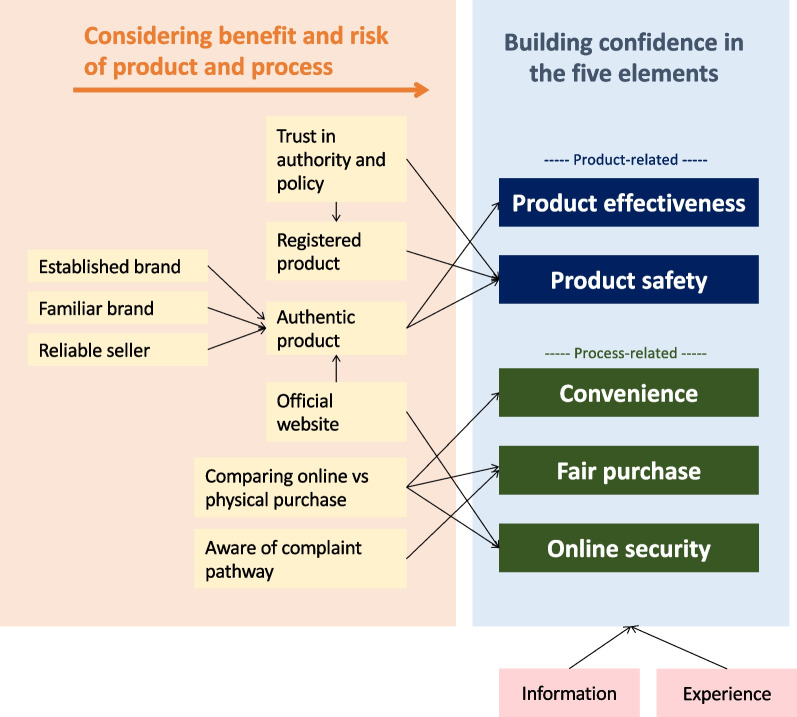
Consumers' decisions to purchase a health supplement or natural product over the Internet are based on a series of assessments regarding the perceived benefits and risks of this activity, which may be related to the product or the process. In the online marketplace, consumers attempt to choose products, online sellers, sales platforms and/or purchase mechanisms with lower perceived risk, which ultimately enhances their confidence in five elements related to the purchase: (1) product effectiveness, (2) product safety, (3) purchase convenience, (4) fair purchase and (5) online security. Consumers take an acceptable level of risk to purchase these products online, and this acceptable level is unique to each individual and is based on their perception of having control over the potential consequences if the worst-case scenario occurs.
In this study, a substantive theoretical model is developed to demonstrate how consumers decide to purchase online health supplements and natural products by accepting an acceptable level of risk associated with the product or process. The emerging model is potentially transferable to other populations in similar contexts.
健康补充剂和天然产品被广大公众广泛用于维持身体机能和预防疾病。此外,随着电子商务的出现,这些产品已变得易于被广大公众获取。尽管已有几种理论模型用于解释健康补充剂和天然产品的使用情况,但关于消费者如何做出购买在线健康补充剂和天然产品决策的实证证据仍然有限。
在本研究中,采用扎根理论方法来构建一个实质性理论模型,旨在调查消费者在网上购买健康补充剂和天然产品时的决策过程。通过目的抽样或理论抽样选取了通过互联网购买过这些产品的马来西亚成年消费者。总共进行了18次虚拟深度访谈(IDI),以了解参与者在这一活动中的经历和优先事项。所有IDI均进行了录音并逐字转录。使用开放式编码、聚焦编码和理论编码对数据进行分析。分析性解释和理论概念记录在研究备忘录中。
消费者在互联网上购买健康补充剂或天然产品的决策基于对该活动感知到的益处和风险的一系列评估,这可能与产品或过程有关。在在线市场中,消费者试图选择感知风险较低的产品、在线卖家、销售平台和/或购买机制,这最终增强了他们对与购买相关的五个要素的信心:(1)产品有效性,(2)产品安全性,(3)购买便利性,(4)公平购买,(5)网络安全。消费者愿意承担可接受水平的风险在网上购买这些产品,并且这个可接受水平因人而异,基于他们认为如果最坏情况发生能够控制潜在后果的认知。
在本研究中,构建了一个实质性理论模型,以展示消费者如何通过接受与产品或过程相关的可接受风险水平来决定购买在线健康补充剂和天然产品。这个新出现的模型有可能适用于类似背景下的其他人群。