Amphia Hospital, Breda, The Netherlands.
Amsterdam UMC, University of Amsterdam, Amsterdam, The Netherlands.
Cerebrovasc Dis Extra. 2023;13(1):97-104. doi: 10.1159/000534937. Epub 2023 Nov 6.
Acute mechanical thrombectomy (MT) is the preferred treatment for large vessel occlusion-related stroke. Histopathological research on the obtained occlusive embolic thrombus may provide information regarding the aetiology and pathology of the lesion to predict prognosis and propose possible future acute ischaemic stroke therapy.
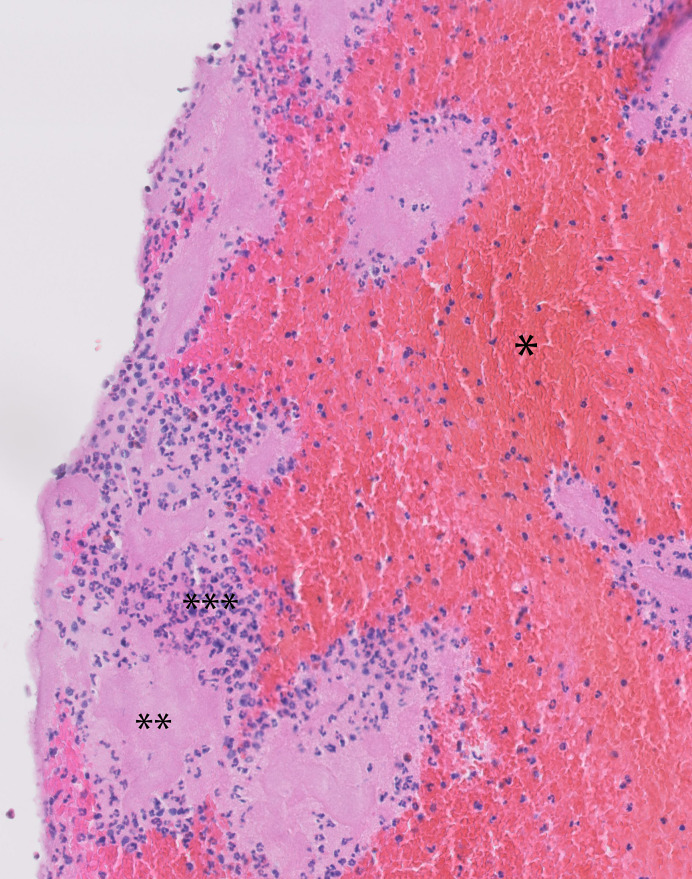
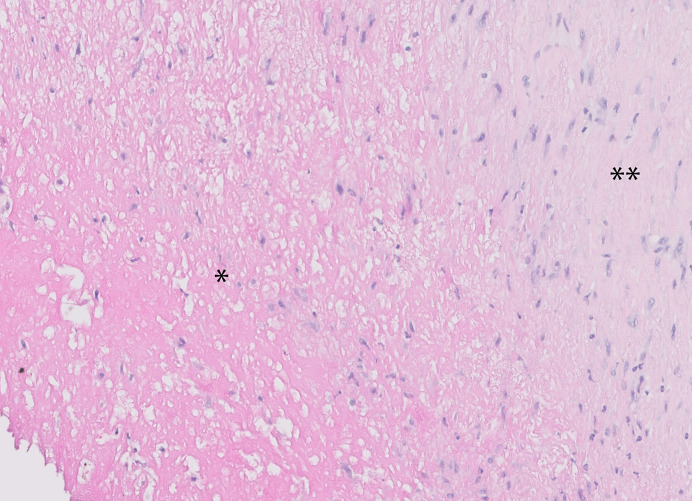
A total of 75 consecutive patients who presented to the Amphia Hospital with acute large vessel occlusion-related stroke and underwent MT were included in the study. The obtained thrombus materials were subjected to standard histopathological examination. Based on histological criteria, they were considered fresh (<1 day old) or old (>1 day old). Patients were followed for 2 years for documentation of all-cause mortality.
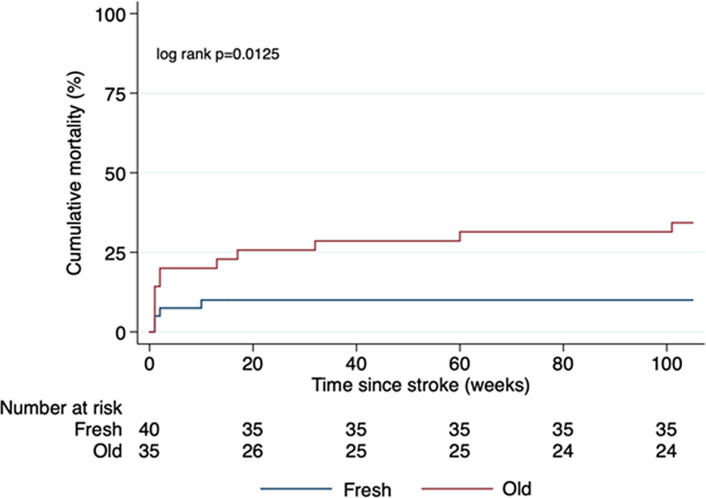
Thrombi were classified as fresh in 40 patients (53%) and as older in 35 patients (47%). Univariate Cox regression analysis showed that thrombus age, National Institutes of Health Stroke Scale at hospital admission, and patient age were associated with long-term mortality (p < 0.1). Multivariable Cox hazards and Kaplan-Meier analysis demonstrated that after extensive adjustment for clinical and procedural variables, thrombus age persisted in being independently associated with higher long-term mortality (hazard ratio: 3.34; p = 0.038, log-rank p = 0.013).
In this study, older thromboemboli are responsible for almost half of acute large ischaemic strokes. Moreover, the presence of an old thrombus is an independent predictor of mortality in acute large vessel occlusion-related stroke. More research is warranted regarding future therapies based on thrombus composition.
急性机械血栓切除术(MT)是治疗大血管闭塞相关卒中的首选方法。对获得的闭塞性栓子进行组织病理学研究,可以提供关于病变病因和病理学的信息,预测预后,并提出可能的未来急性缺血性卒中治疗方法。
本研究共纳入 75 例因急性大血管闭塞相关卒中在 Amphia 医院接受 MT 的连续患者。对获得的血栓材料进行标准组织病理学检查。根据组织学标准,将其分为新鲜(<1 天)或陈旧(>1 天)血栓。对患者进行 2 年随访,记录全因死亡率。
40 例(53%)血栓为新鲜血栓,35 例(47%)为陈旧血栓。单因素 Cox 回归分析显示,血栓年龄、入院时国立卫生研究院卒中量表评分和患者年龄与长期死亡率相关(p < 0.1)。多因素 Cox 风险和 Kaplan-Meier 分析表明,在广泛调整临床和操作变量后,血栓年龄仍然与较高的长期死亡率独立相关(风险比:3.34;p = 0.038,对数秩 p = 0.013)。
在这项研究中,陈旧血栓栓子几乎占急性大缺血性卒中的一半。此外,陈旧血栓的存在是大血管闭塞相关卒中患者死亡的独立预测因素。基于血栓成分的未来治疗方法需要进一步研究。