State Key Laboratory of Respiratory Diseases, National Clinical Research Center for Respiratory Diseases, Guangzhou Institute of Respiratory Health, The First Affiliated Hospital of Guangzhou Medical University, Guangzhou, China.
Department of Respiratory Medicine, The Affiliated Hospital of Guizhou Medical University, Guiyang, Guizhou, China.
BMJ Open Respir Res. 2023 Nov;10(1). doi: 10.1136/bmjresp-2022-001568.
Idiopathic pulmonary fibrosis is a progressive fibrotic lung disease with limited therapeutic options and high lethality, related to alveolar type II epithelial (ATII) cell dysregulation, the abnormal repair of alveolar epithelial cells and activation of fibroblasts promote the development of pulmonary fibrosis. Fatty acid binding protein 1 (FABP1) was significantly downregulated in the fibrotic state by proteomics screening in our previous date, and the ATII cell dysregulation can be mediated by FABP1 via regulating fatty acid metabolism and intracellular transport. The aim of this study was to evaluate the role and potential mechanism of FABP1 in the development of pulmonary fibrosis.
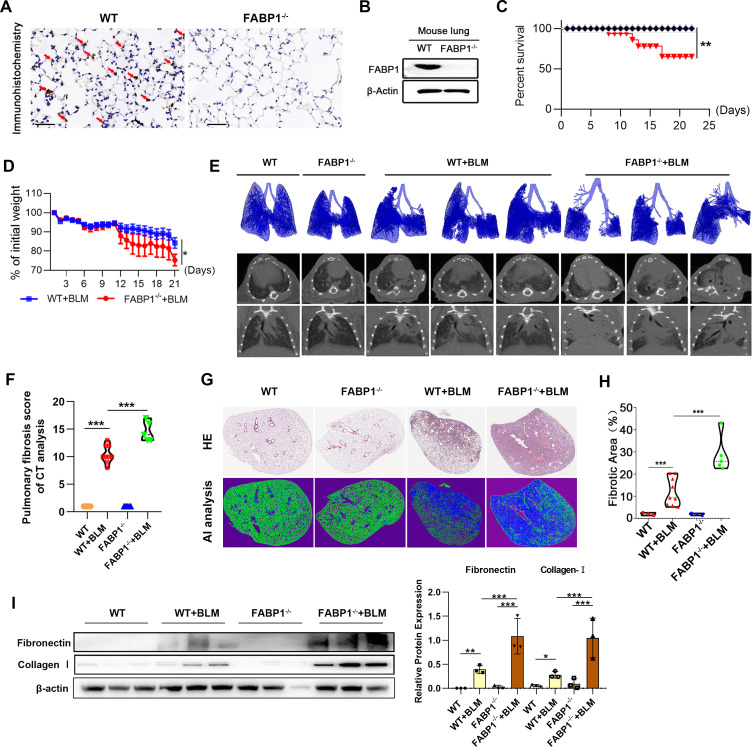
Proteomics screening was used to detect changes of the protein profiles in two different types (induced by bleomycin and silica, respectively) of pulmonary fibrosis models. The localisation of FABP1 in mouse lung was detected by Immunofluorescence and immunohistochemistry. Experimental methods such as lung pathology, micro-CT, western blotting, small animal imaging in vivo, EdU, etc were used to verify the role of FABP1 in pulmonary fibrosis.
The expression of FABP1 in the mouse lung was significantly reduced in the model of pulmonary fibrosis from our proteomic analysis and immunological methods, the double immunofluorescence staining showed that FABP1 was mainly localised in type II alveolar epithelial cells. Additionally, the expression of FABP1 was negatively correlated with the progression of pulmonary fibrosis. Further in vivo and in vitro experiments showed that overexpression of FABP1 alleviated pulmonary fibrosis by protecting alveolar epithelium from injury and promoting cell survival.
Our findings provide a proof-of-principle that FABP1 may represent an effective treatment for pulmonary fibrosis by regulating alveolar epithelial regeneration, which may be associated with the fatty acid metabolism in ATII cells.
特发性肺纤维化是一种进行性肺纤维化疾病,治疗选择有限,死亡率高,与肺泡 II 型上皮(ATII)细胞失调、肺泡上皮细胞的异常修复和成纤维细胞的激活有关,这些都促进了肺纤维化的发展。通过我们之前的蛋白质组学筛选,发现脂肪酸结合蛋白 1(FABP1)在纤维化状态下显著下调,并且 FABP1 可以通过调节脂肪酸代谢和细胞内转运来介导 ATII 细胞失调。本研究旨在评估 FABP1 在肺纤维化发展中的作用及其潜在机制。
蛋白质组学筛选用于检测两种不同类型(分别由博莱霉素和二氧化硅诱导)的肺纤维化模型中蛋白质谱的变化。通过免疫荧光和免疫组织化学检测 FABP1 在小鼠肺中的定位。通过肺病理学、微 CT、Western blot、小动物体内成像、EdU 等实验方法验证 FABP1 在肺纤维化中的作用。
从我们的蛋白质组学分析和免疫方法中发现,FABP1 在小鼠肺纤维化模型中的表达显著降低,双免疫荧光染色显示 FABP1 主要定位于 II 型肺泡上皮细胞。此外,FABP1 的表达与肺纤维化的进展呈负相关。进一步的体内和体外实验表明,过表达 FABP1 通过保护肺泡上皮免受损伤和促进细胞存活来减轻肺纤维化。
我们的研究结果提供了一个原理性的证据,表明 FABP1 通过调节肺泡上皮细胞再生,可能代表一种有效的治疗肺纤维化的方法,这可能与 ATII 细胞中的脂肪酸代谢有关。