Division of Orthopedic Surgery, Department of Regenerative and Transplant Medicine, Niigata University Graduate School of Medical and Dental Sciences, 1-757, Asahimachi Dori, Chuo-ku, Niigata, 951-8510, Japan.
Department of Mechanical Engineering, Faculty of Engineering, University of Miyazaki, Miyazaki, Japan.
J Orthop Surg Res. 2023 Nov 9;18(1):850. doi: 10.1186/s13018-023-04340-0.
The examination of femoral cortical bone thickness in patients with rheumatoid arthritis (RA) has been notably limited in prior research. We aimed to compare femoral cortical thickness in patients with rheumatoid arthritis (RA) and healthy controls and to investigate the association between femoral cortical thickness and clinical parameters within the RA group.
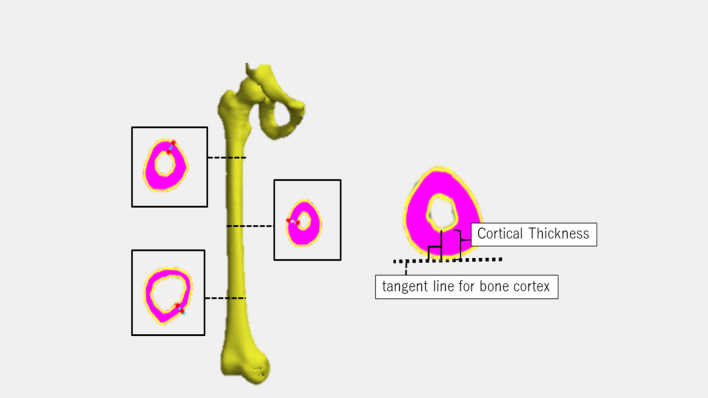
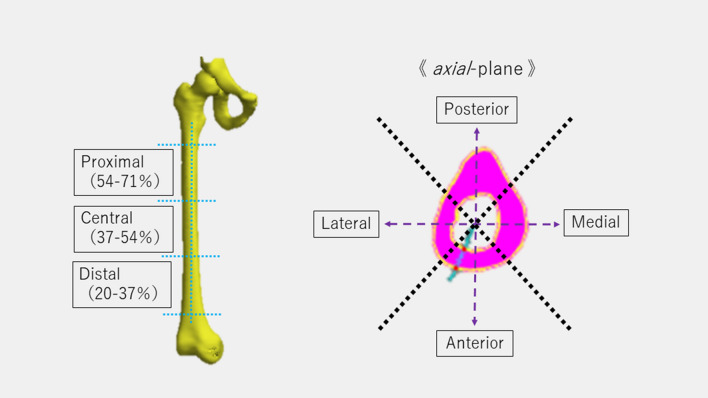
Forty-four patients (58 limbs) with RA who underwent total knee arthroplasty were enrolled. Preoperative computed tomography images of the lower limbs were analyzed. The femoral cortex was divided into the proximal, central, and distal diaphysis regions and further into the anterior, posterior, medial, and lateral regions. The divisions were measured using Stradwin® software and standardized by femoral length. Femoral cortical thickness was compared between RA and healthy control (n = 25) groups. Correlation analyses between standardized cortical thickness and disease parameters were performed in the RA group.
The RA group had significantly lower standardized femoral cortical thickness at the anterior and medial distal diaphysis than healthy controls. Standardized proximal lateral and central lateral in the RA group were significantly larger than those in the healthy control groups. Standardized femoral cortical thickness was significantly correlated with bone mineral density (BMD) in 11 areas, except the posterior central diaphysis, and with body mass index in 8 areas, except the central posterior, distal lateral, distal anterior, and distal medial diaphysis.
Femoral cortical thinning was noted in patients with RA complicated with destructive knee, particularly at the anterior and medial distal diaphysis. Femoral cortical thickness was significantly correlated with BMD and body mass index (BMI); thus, patients with RA and low BMD and BMI should be cared for to prevent fragility fractures.
既往研究中对类风湿关节炎(RA)患者股骨皮质骨厚度的检查明显受限。我们旨在比较类风湿关节炎(RA)患者和健康对照组的股骨皮质厚度,并探讨 RA 组中股骨皮质厚度与临床参数之间的相关性。
共纳入 44 例(58 侧)接受全膝关节置换术的 RA 患者。分析下肢术前 CT 图像。将股骨皮质分为近段、中段和远段骨干,并进一步分为前、后、内、外侧区域。使用 Stradwin®软件进行分区测量,并通过股骨长度标准化。比较 RA 和健康对照组(n=25)之间的股骨皮质厚度。在 RA 组中进行标准化皮质厚度与疾病参数之间的相关性分析。
与健康对照组相比,RA 组在前侧和内侧远骨干的标准化股骨皮质厚度明显降低。RA 组的标准化近外侧和中央外侧明显大于健康对照组。标准化股骨皮质厚度与 11 个部位的骨密度(BMD)显著相关,除后中央骨干外,与 8 个部位的体重指数(BMI)显著相关,除中央后、远外侧、远前、远内侧骨干外。
患有破坏性膝关节炎的 RA 患者存在股骨皮质变薄,尤其是在前侧和内侧远骨干。股骨皮质厚度与 BMD 和 BMI 显著相关;因此,应注意 RA 患者和低 BMD 和 BMI 的患者,以预防脆性骨折。