
高压氧治疗坏死性软组织感染导致脓毒症患者的关键途径和基因改变(HBOmic 研究)。
Key pathways and genes that are altered during treatment with hyperbaric oxygen in patients with sepsis due to necrotizing soft tissue infection (HBOmic study).
机构信息
Department of Anesthesiology, Copenhagen University Hospital, Rigshospitalet, Inge Lehmanns Vej 6, 2100, Copenhagen, Denmark.
Department of Clinical Medicine, University of Copenhagen, Copenhagen, Denmark.
出版信息
Eur J Med Res. 2023 Nov 10;28(1):507. doi: 10.1186/s40001-023-01466-z.
BACKGROUND
For decades, the basic treatment strategies of necrotizing soft tissue infections (NSTI) have remained unchanged, primarily relying on aggressive surgical removal of infected tissue, broad-spectrum antibiotics, and supportive intensive care. One treatment strategy that has been proposed as an adjunctive measure to improve patient outcomes is hyperbaric oxygen (HBO) treatment. HBO treatment has been linked to several immune modulatory effects; however, investigating these effects is complicated due to the disease's acute life-threatening nature, metabolic and cell homeostasis dependent variability in treatment effects, and heterogeneity with respect to both patient characteristics and involved pathogens. To embrace this complexity, we aimed to explore the underlying biological mechanisms of HBO treatment in patients with NSTI on the gene expression level.
METHODS
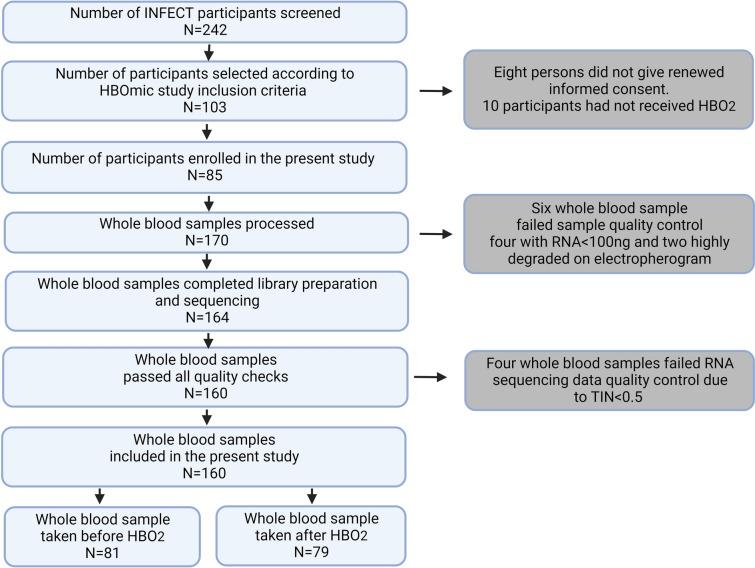
We conducted an observational cohort study on prospective collected data, including 85 patients admitted to the intensive care unit (ICU) for NSTI. All patients were treated with one or two HBO treatments and had one blood sample taken before and after the intervention. Total RNAs from blood samples were extracted and mRNA purified with rRNA depletion, followed by whole-transcriptome RNA sequencing with a targeted sequencing depth of 20 million reads. A model for differentially expressed genes (DEGs) was fitted, and the functional aspects of the obtained set of genes was predicted with GO (Gene Ontology) and KEGG (Kyoto Encyclopedia of genes and Genomes) enrichment analyses. All analyses were corrected for multiple testing with FDR.
RESULTS
After sequential steps of quality control, a final of 160 biological replicates were included in the present study. We found 394 protein coding genes that were significantly DEGs between the two conditions with FDR < 0.01, of which 205 were upregulated and 189 were downregulated. The enrichment analysis of these DEGs revealed 20 GO terms in biological processes and 12 KEGG pathways that were significantly overrepresented in the upregulated DEGs, of which the term; "adaptive immune response" (GO:0002250) (FDR = 9.88E-13) and "T cell receptor signaling pathway" (hsa04660) (FDR = 1.20E-07) were the most significant. Among the downregulated DEGs two biological processes were significantly enriched, of which the GO term "apoptotic process" (GO:0006915) was the most significant (FDR = 0.001), followed by "Positive regulation of T helper 1 cell cytokine production" (GO:2000556), and "NF-kappa B signaling pathway" (hsa04064) was the only KEGG pathway that was significantly overrepresented (FDR = 0.001).
CONCLUSIONS
When one or two sessions of HBO treatment were administered to patients with a dysregulated immune response and systemic inflammation due to NSTI, the important genes that were regulated during the intervention were involved in activation of T helper cells and downregulation of the disease-induced highly inflammatory pathway NF-κB, which was associated with a decrease in the mRNA level of pro-inflammatory factors.
TRIAL REGISTRATION
Biological material was collected during the INFECT study, registered at ClinicalTrials.gov (NCT01790698).
背景
几十年来,坏死性软组织感染(NSTI)的基本治疗策略一直没有改变,主要依靠积极的手术切除感染组织、广谱抗生素和支持性重症监护。一种被提议作为改善患者预后的辅助治疗策略是高压氧(HBO)治疗。HBO 治疗与多种免疫调节作用有关;然而,由于疾病的急性危及生命的性质、治疗效果的代谢和细胞内稳态依赖性变异性以及患者特征和涉及病原体的异质性,研究这些作用变得复杂。为了应对这种复杂性,我们旨在从基因表达水平上探讨 HBO 治疗 NSTI 患者的潜在生物学机制。
方法
我们对前瞻性收集的数据进行了观察性队列研究,包括因 NSTI 住进 ICU 的 85 名患者。所有患者均接受一次或两次 HBO 治疗,并在干预前后各采集一次血样。从血样中提取总 RNA,并通过 rRNA 耗竭进行 mRNA 纯化,然后进行靶向测序深度为 2000 万条读长的全转录组 RNA 测序。拟合差异表达基因(DEGs)模型,并通过 GO(基因本体论)和 KEGG(京都基因与基因组百科全书)富集分析预测获得的基因集的功能方面。所有分析均采用 FDR 进行了多重检验校正。
结果
经过质量控制的连续步骤,最终有 160 个生物学重复被纳入本研究。我们发现了 394 个蛋白编码基因在两种条件之间存在显著的 DEGs,FDR<0.01,其中 205 个上调,189 个下调。这些 DEGs 的富集分析显示,在上调的 DEGs 中,有 20 个生物过程中的 GO 术语和 12 个 KEGG 途径显著过表达,其中术语“适应性免疫反应”(GO:0002250)(FDR=9.88E-13)和“T 细胞受体信号通路”(hsa04660)(FDR=1.20E-07)最为显著。在下调的 DEGs 中,有两个生物学过程显著富集,其中 GO 术语“凋亡过程”(GO:0006915)最为显著(FDR=0.001),其次是“辅助性 T 细胞细胞因子产生的正调控”(GO:2000556)和“NF-kappa B 信号通路”(hsa04064),这是唯一显著过表达的 KEGG 途径(FDR=0.001)。
结论
当因 NSTI 导致免疫反应失调和全身炎症的患者接受一次或两次 HBO 治疗时,干预过程中调节的重要基因参与了 T 辅助细胞的激活和疾病诱导的高度炎症途径 NF-κB 的下调,这与促炎因子的 mRNA 水平降低有关。
试验注册
生物材料是在 INFECT 研究中收集的,并在 ClinicalTrials.gov 注册(NCT01790698)。


 Zotero 插件