Papadelis Christos, Ntolkeras Georgios, Tokatly Latzer Itay, DiBacco Melissa L, Afacan Onur, Warfield Simon, Shi Xutong, Roullet Jean-Baptiste, Gibson K Michael, Pearl Phillip L
Jane and John Justin Institute for Mind Health, Cook Children's Health Care System, Fort Worth, TX 76104, USA.
School of Medicine, Texas Christian University, Fort Worth, TX 76129, USA.
Brain Commun. 2023 Oct 25;5(6):fcad291. doi: 10.1093/braincomms/fcad291. eCollection 2023.
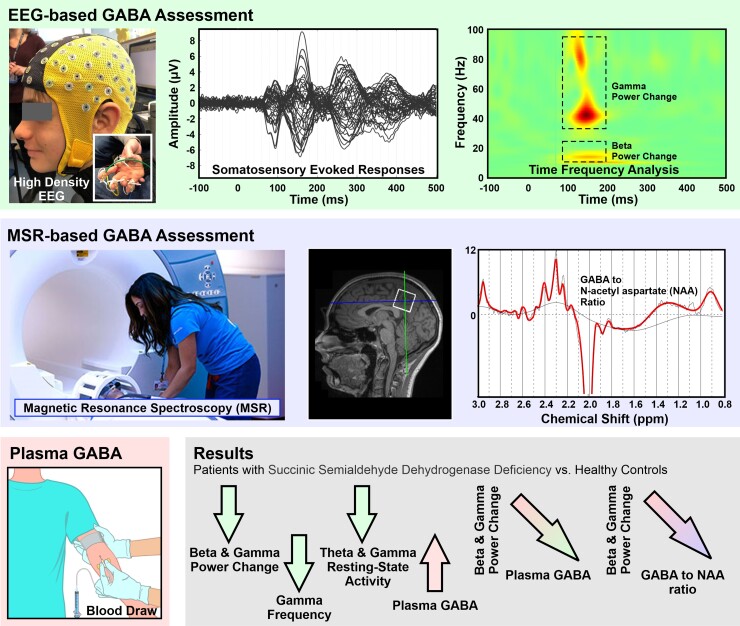
Succinic semialdehyde dehydrogenase deficiency is a rare autosomal recessively inherited metabolic disorder of γ-aminobutyric acid catabolism manifested by intellectual disability, expressive aphasia, movement disorders, psychiatric ailments and epilepsy. Subjects with succinic semialdehyde dehydrogenase deficiency are characterized by elevated γ-aminobutyric acid and related metabolites, such as γ-guanidinobutyric acid, and an age-dependent downregulation of cerebral γ-aminobutyric acid receptors. These findings indicate impaired γ-aminobutyric acid and γ-aminobutyric acid sub-type A (GABA) receptor signalling as major factors underlying the pathophysiology of this neurometabolic disorder. We studied the cortical oscillation patterns and their relationship with γ-aminobutyric acid metabolism in 18 children affected by this condition and 10 healthy controls. Using high-density EEG, we recorded somatosensory cortical responses and resting-state activity. Using electrical source imaging, we estimated the relative power changes (compared with baseline) in both stimulus-evoked and stimulus-induced responses for physiologically relevant frequency bands and resting-state power. Stimulus-evoked oscillations are phase locked to the stimulus, whereas induced oscillations are not. Power changes for both evoked and induced responses as well as resting-state power were correlated with plasma γ-aminobutyric acid and γ-guanidinobutyric acid concentrations and with cortical γ-aminobutyric acid measured by proton magnetic resonance spectroscopy. Plasma γ-aminobutyric acid, γ-guanidinobutyric acid and cortical γ-aminobutyric acid were higher in patients than in controls ( < 0.001 for both). Beta and gamma relative power were suppressed for evoked responses in patients versus controls ( < 0.01). No group differences were observed for induced activity ( > 0.05). The mean gamma frequency of evoked responses was lower in patients versus controls ( = 0.002). Resting-state activity was suppressed in patients for theta ( = 0.011) and gamma ( < 0.001) bands. Evoked power changes were inversely correlated with plasma γ-aminobutyric acid and with γ-guanidinobutyric acid for beta ( < 0.001) and gamma ( < 0.001) bands. Similar relationships were observed between the evoked power changes and cortical γ-aminobutyric acid for all tested areas in the beta band ( < 0.001) and for the posterior cingulate gyrus in the gamma band ( < 0.001). We also observed a negative correlation between resting-state activity and plasma γ-aminobutyric acid and γ-guanidinobutyric acid for theta ( < 0.001; = 0.003), alpha ( = 0.003; = 0.02) and gamma ( = 0.02; = 0.01) bands. Our findings indicate that increased γ-aminobutyric acid concentration is associated with reduced sensory-evoked beta and gamma activity and impaired neuronal synchronization in patients with succinic semialdehyde dehydrogenase deficiency. This further elucidates the pathophysiology of this neurometabolic disorder and serves as a potential biomarker for therapeutic trials.
琥珀酸半醛脱氢酶缺乏症是一种罕见的常染色体隐性遗传的γ-氨基丁酸分解代谢障碍性疾病,表现为智力残疾、表达性失语、运动障碍、精神疾病和癫痫。琥珀酸半醛脱氢酶缺乏症患者的特征是γ-氨基丁酸及相关代谢产物(如γ-胍基丁酸)水平升高,以及大脑γ-氨基丁酸受体随年龄增长而下调。这些发现表明,γ-氨基丁酸和γ-氨基丁酸A亚型(GABA)受体信号受损是这种神经代谢紊乱病理生理学的主要因素。我们研究了18名受此病影响的儿童和10名健康对照者的皮质振荡模式及其与γ-氨基丁酸代谢的关系。我们使用高密度脑电图记录体感皮质反应和静息状态活动。通过电源成像,我们估计了生理相关频段的刺激诱发反应和刺激诱导反应以及静息状态功率的相对功率变化(与基线相比)。刺激诱发振荡与刺激锁相,而诱导振荡则不然。诱发反应和诱导反应的功率变化以及静息状态功率与血浆γ-氨基丁酸和γ-胍基丁酸浓度以及通过质子磁共振波谱测量的皮质γ-氨基丁酸相关。患者的血浆γ-氨基丁酸、γ-胍基丁酸和皮质γ-氨基丁酸均高于对照组(两者均<0.001)。与对照组相比,患者诱发反应的β和γ相对功率受到抑制(<0.01)。诱导活动未观察到组间差异(>0.05)。与对照组相比,患者诱发反应的平均γ频率较低(=0.002)。患者静息状态活动在θ频段(=0.011)和γ频段(<0.001)受到抑制。诱发功率变化与血浆γ-氨基丁酸以及β频段(<0.001)和γ频段(<0.001)的γ-胍基丁酸呈负相关。在β频段(<0.001)的所有测试区域以及γ频段的后扣带回(<0.001)中,诱发功率变化与皮质γ-氨基丁酸之间也观察到类似关系。我们还观察到静息状态活动与血浆γ-氨基丁酸和γ-胍基丁酸在θ频段(<0.001;=0.003)、α频段(=0.003;=0.02)和γ频段(=0.02;=0.01)呈负相关。我们的研究结果表明,γ-氨基丁酸浓度升高与琥珀酸半醛脱氢酶缺乏症患者感觉诱发的β和γ活动减少以及神经元同步受损有关。这进一步阐明了这种神经代谢紊乱的病理生理学,并可作为治疗试验的潜在生物标志物。