• 文献检索
  • 文档翻译
  • 深度研究
  • 学术资讯
  • Suppr Zotero 插件Zotero 插件
  • 邀请有礼
  • 套餐&价格
  • 历史记录
应用&插件
Suppr Zotero 插件Zotero 插件浏览器插件Mac 客户端Windows 客户端微信小程序
定价
高级版会员购买积分包购买API积分包
服务
文献检索文档翻译深度研究API 文档MCP 服务
关于我们
关于 Suppr公司介绍联系我们用户协议隐私条款
关注我们

Suppr 超能文献

核心技术专利:CN118964589B侵权必究
粤ICP备2023148730 号-1Suppr @ 2026

文献检索

告别复杂PubMed语法,用中文像聊天一样搜索,搜遍4000万医学文献。AI智能推荐,让科研检索更轻松。

立即免费搜索

文件翻译

保留排版,准确专业,支持PDF/Word/PPT等文件格式,支持 12+语言互译。

免费翻译文档

深度研究

AI帮你快速写综述,25分钟生成高质量综述,智能提取关键信息,辅助科研写作。

立即免费体验

香荚兰生理活性变化及其与心材形成的关系。

Changes in the physiological activity of parenchyma cells in Dalbergia odorifera xylem and its relationship with heartwood formation.

机构信息

Key Laboratory of National Forestry and Grassland Administration for Fast‑Growing Tree Breeding and Cultivation in Central and Southern China, College of Forestry, Guangxi University, Nanning, 530004, China.

出版信息

BMC Plant Biol. 2023 Nov 14;23(1):559. doi: 10.1186/s12870-023-04592-2.

DOI:10.1186/s12870-023-04592-2
PMID:37957552
原文链接:https://pmc.ncbi.nlm.nih.gov/articles/PMC10644609/
Abstract

BACKGROUND

The formation of a tree's heartwood gives the wood properties such as natural decay resistance and aesthetic color, and often directly determines the value of wood products. Regulating the quantity and quality of heartwood is of great importance to the use of wood. However, the mechanism of heartwood formation has been poorly understood.

RESULTS

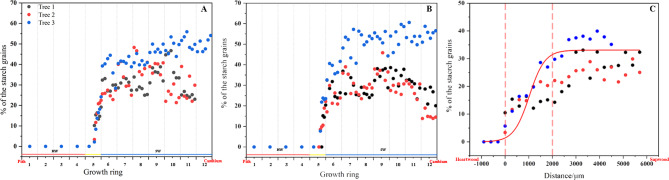
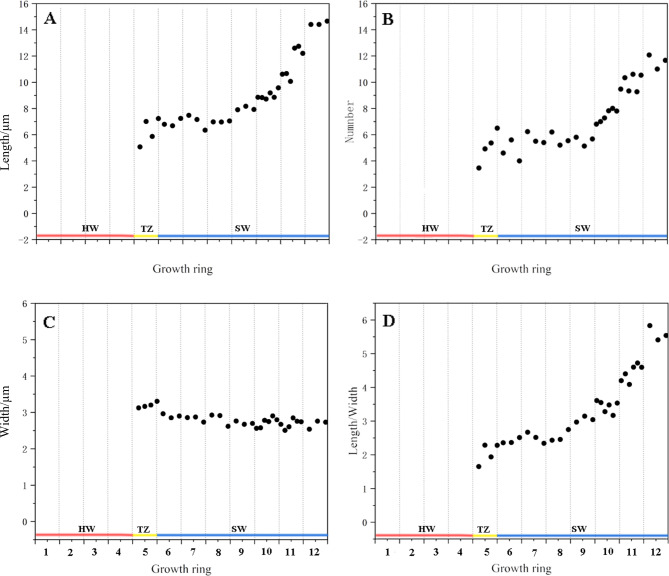
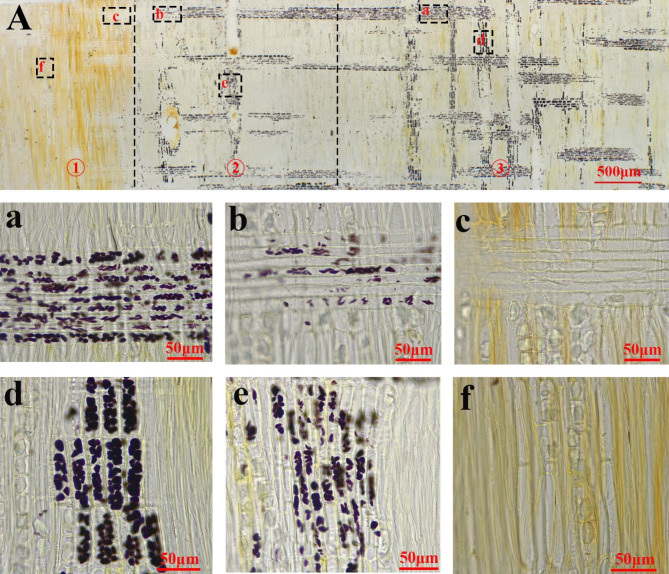
Using Dalbergia odorifera as the study species, the number of starch grains, the morphology of the nuclei, the changes in the content of water and secondary metabolites were observed continuously in the radial direction of the xylem. The results show that from the outer toward inner sapwood, the starch grains are abundant, the length to diameter ratio of the nuclei is decreasing, and the morphology changes from elongated elliptical and then to round. In the outer transition zone, the starch grains begin to decrease abruptly and the nuclei shrink at a slower rate, with a radial width of approximately 2 mm. In the inner transition zone, the heartwood color begins to appear, the starch grains disappear and a few nuclei with reduced fluorescence are present, with a radial width of approximately 1 mm. Heartwood formation after complete disappearance of the nuclei. The moisture content of the heartwood is higher than that of the sapwood, and the inner transition zone is where the content rises. The secondary metabolites of the heartwood begin to accumulate in large quantities in the inner transition zone.

CONCLUSION

Based on the physiological changes of parenchyma cells in the xylem, the radial width of the transition zone of Dalbergia odorifera is clearly defined as approximately 3 mm. Both the water and secondary metabolite abrupt changes occur at the final stage of programmed cell death, and neither is a direct cause of programmed cell death in parenchyma cells.

摘要

背景

树木心材的形成赋予木材天然的抗腐性和美观的颜色等特性,往往直接决定木材制品的价值。调控心材的数量和质量对于木材的利用具有重要意义。然而,心材形成的机制尚未得到充分理解。

结果

以降香黄檀为研究对象,连续观察心材木质部的径向方向上淀粉粒数量、细胞核形态、水分和次生代谢物含量的变化。结果表明,从外向内的边材,淀粉粒丰富,细胞核的长径比减小,形态由狭长的椭圆形变为圆形。在外过渡区,淀粉粒开始急剧减少,细胞核收缩速度较慢,径向宽度约为 2mm。在内过渡区,心材颜色开始显现,淀粉粒消失,出现少数荧光减弱的细胞核,径向宽度约为 1mm。心材形成完全后细胞核消失。心材的含水量高于边材,内过渡区是含水量上升的区域。心材的次生代谢物开始在内过渡区大量积累。

结论

基于木质部薄壁细胞的生理变化,明确界定降香黄檀的过渡区径向宽度约为 3mm。水分和次生代谢物的急剧变化都发生在程序性细胞死亡的最后阶段,二者都不是薄壁细胞程序性死亡的直接原因。
https://cdn.ncbi.nlm.nih.gov/pmc/blobs/6ca9/10644609/091f84cee0d4/12870_2023_4592_Fig7_HTML.jpg
https://cdn.ncbi.nlm.nih.gov/pmc/blobs/6ca9/10644609/162e362148cf/12870_2023_4592_Fig1_HTML.jpg
https://cdn.ncbi.nlm.nih.gov/pmc/blobs/6ca9/10644609/43d8cac1160f/12870_2023_4592_Fig2_HTML.jpg
https://cdn.ncbi.nlm.nih.gov/pmc/blobs/6ca9/10644609/41a16c3c07d5/12870_2023_4592_Fig4_HTML.jpg
https://cdn.ncbi.nlm.nih.gov/pmc/blobs/6ca9/10644609/11f5277bf491/12870_2023_4592_Fig5_HTML.jpg
https://cdn.ncbi.nlm.nih.gov/pmc/blobs/6ca9/10644609/6dbb3835b5b7/12870_2023_4592_Fig6_HTML.jpg
https://cdn.ncbi.nlm.nih.gov/pmc/blobs/6ca9/10644609/091f84cee0d4/12870_2023_4592_Fig7_HTML.jpg
https://cdn.ncbi.nlm.nih.gov/pmc/blobs/6ca9/10644609/162e362148cf/12870_2023_4592_Fig1_HTML.jpg
https://cdn.ncbi.nlm.nih.gov/pmc/blobs/6ca9/10644609/43d8cac1160f/12870_2023_4592_Fig2_HTML.jpg
https://cdn.ncbi.nlm.nih.gov/pmc/blobs/6ca9/10644609/41a16c3c07d5/12870_2023_4592_Fig4_HTML.jpg
https://cdn.ncbi.nlm.nih.gov/pmc/blobs/6ca9/10644609/11f5277bf491/12870_2023_4592_Fig5_HTML.jpg
https://cdn.ncbi.nlm.nih.gov/pmc/blobs/6ca9/10644609/6dbb3835b5b7/12870_2023_4592_Fig6_HTML.jpg
https://cdn.ncbi.nlm.nih.gov/pmc/blobs/6ca9/10644609/091f84cee0d4/12870_2023_4592_Fig7_HTML.jpg

相似文献

1
Changes in the physiological activity of parenchyma cells in Dalbergia odorifera xylem and its relationship with heartwood formation.香荚兰生理活性变化及其与心材形成的关系。
BMC Plant Biol. 2023 Nov 14;23(1):559. doi: 10.1186/s12870-023-04592-2.
2
Water, starch, and nuclear behavior in ray parenchyma during heartwood formation of 'Jinsi'.‘金丝’心材形成过程中射线薄壁细胞内的水分、淀粉及细胞核行为
Heliyon. 2024 Feb 27;10(5):e27231. doi: 10.1016/j.heliyon.2024.e27231. eCollection 2024 Mar 15.
3
Genome-wide characterization of post-transcriptional processes related to wood formation in Dalbergia odorifera.香脂豆木形成过程中转录后相关的全基因组特征分析。
BMC Genomics. 2024 Apr 16;25(1):372. doi: 10.1186/s12864-024-10300-7.
4
Positional differences in the micro- and ultra-structural variations of ray parenchyma cells during the transformation from sapwood to heartwood.边材向心材转变过程中射线薄壁细胞微观和超微结构变化的位置差异。
Front Plant Sci. 2024 Sep 3;15:1431818. doi: 10.3389/fpls.2024.1431818. eCollection 2024.
5
Changes in Non-Structural Carbohydrates, Wood Properties and Essential Oil During Chemically-Induced Heartwood Formation in .化学诱导的心材形成过程中,非结构性碳水化合物、木材性质和精油的变化 。 需注意,原文中“in.”后面似乎缺少具体内容,翻译可能会不够完整准确。
Front Plant Sci. 2020 Aug 13;11:1161. doi: 10.3389/fpls.2020.01161. eCollection 2020.
6
The accumulation pattern of ferruginol in the heartwood-forming Cryptomeria japonica xylem as determined by time-of-flight secondary ion mass spectrometry and quantity analysis.通过飞行时间二次离子质谱法和定量分析确定的铁杉醇在心材形成的日本柳杉木质部中的积累模式。
Ann Bot. 2014 May;113(6):1029-36. doi: 10.1093/aob/mcu028. Epub 2014 Mar 20.
7
Cambial Age Influences PCD Gene Expression during Xylem Development and Heartwood Formation.形成层年龄影响木质部发育和心材形成过程中细胞程序性死亡基因的表达。
Plants (Basel). 2023 Dec 4;12(23):4072. doi: 10.3390/plants12234072.
8
Differences in Chemical Constituents between Heartwood and Sapwood and Their Effect on Wood Color.心材与边材的化学成分差异及其对木材颜色的影响。
Molecules. 2022 Nov 17;27(22):7978. doi: 10.3390/molecules27227978.
9
Molecular Mechanism Underlying Mechanical Wounding-Induced Flavonoid Accumulation in T. Chen, an Endangered Tree That Produces Chinese Rosewood.机械损伤诱导珍稀濒危植物降香黄檀黄酮积累的分子机制。
Genes (Basel). 2020 Apr 28;11(5):478. doi: 10.3390/genes11050478.
10
Function of the R2R3-MYB Transcription Factors in and Their Relationship with Heartwood Formation.R2R3-MYB 转录因子的功能及其与心材形成的关系。
Int J Mol Sci. 2023 Aug 4;24(15):12430. doi: 10.3390/ijms241512430.

引用本文的文献

1
Patterns of Heartwood Formation and Its Key Response Signaling Molecules in T. Chen.陈木心材形成模式及其关键响应信号分子
Int J Mol Sci. 2025 May 12;26(10):4629. doi: 10.3390/ijms26104629.
2
Heartwood/Sapwood Characteristics of Oliv. Trunks and Their Relationship with Soil Physicochemical Properties in the Lower Tarim River, Northwest China.中国西北塔里木河下游橄榄树干的心材/边材特征及其与土壤理化性质的关系
Plants (Basel). 2025 Jan 7;14(2):154. doi: 10.3390/plants14020154.
3
Advances in the Study of Heartwood Formation in Trees.

本文引用的文献

1
Integrated Transcriptomic, Metabolomic, and Physiological Analyses Reveal New Insights into Fragrance Formation in the Heartwood of .整合转录组学、代谢组学和生理学分析揭示了. 心材中香气形成的新见解
Int J Mol Sci. 2022 Nov 14;23(22):14044. doi: 10.3390/ijms232214044.
2
Differential Gene Profiling of the Heartwood Formation Process in Hayata Xylem Tissues.心材形成过程中 Hayata 木质部组织的差异基因表达谱分析。
Int J Mol Sci. 2020 Jan 31;21(3):960. doi: 10.3390/ijms21030960.
3
Selection and Validation of Reference Genes for Gene Expression Studies by RT-PCR in Dalbergia odorifera.
树木心材形成的研究进展
Life (Basel). 2025 Jan 14;15(1):93. doi: 10.3390/life15010093.
4
Positional differences in the micro- and ultra-structural variations of ray parenchyma cells during the transformation from sapwood to heartwood.边材向心材转变过程中射线薄壁细胞微观和超微结构变化的位置差异。
Front Plant Sci. 2024 Sep 3;15:1431818. doi: 10.3389/fpls.2024.1431818. eCollection 2024.
5
Physiological, Biochemical, and Molecular Analyses Reveal Dark Heartwood Formation Mechanism in .生理生化和分子分析揭示 暗心材形成机制。
Int J Mol Sci. 2024 May 2;25(9):4974. doi: 10.3390/ijms25094974.
《基于 RT-PCR 的黄檀属树种基因表达研究中内参基因的选择与验证》
Sci Rep. 2019 Mar 4;9(1):3341. doi: 10.1038/s41598-019-39088-3.
4
A Review on the Medicinal Plant Species: Phytochemistry and Biological Activity.药用植物物种综述:植物化学与生物活性
Evid Based Complement Alternat Med. 2017;2017:7142370. doi: 10.1155/2017/7142370. Epub 2017 Dec 4.
5
Reassessing apoptosis in plants.重新评估植物细胞凋亡。
Nat Plants. 2017 Oct;3(10):773-779. doi: 10.1038/s41477-017-0020-x. Epub 2017 Sep 25.
6
Agatharesinol biosynthesis-related changes of ray parenchyma in sapwood sticks of Cryptomeria japonica during cell death.日本柳杉边材枝条中射线薄壁细胞在细胞死亡过程中与落叶松脂醇生物合成相关的变化。
Planta. 2016 May;243(5):1225-36. doi: 10.1007/s00425-016-2473-y. Epub 2016 Feb 19.
7
Seasonal variation of heartwood formation in Larix kaempferi.日本落叶松心材形成的季节性变化。
Tree Physiol. 2012 Dec;32(12):1497-508. doi: 10.1093/treephys/tps108. Epub 2012 Nov 6.
8
The function of intercellular spaces along the ray parenchyma in sapwood, intermediate wood, and heartwood of Cryptomeria japonica (Cupressaceae).日本柳杉(柏科)边材、中间材和心材射线薄壁组织中细胞间隙的功能。
Am J Bot. 2012 Sep;99(9):1553-61. doi: 10.3732/ajb.1200160. Epub 2012 Aug 23.
9
Nuclear DNA fragmentation during cell death of short-lived ray tracheids in the conifer Pinus densiflora.在针叶树赤松的短命射线管胞细胞死亡过程中核 DNA 碎片化。
J Plant Res. 2011 May;124(3):379-84. doi: 10.1007/s10265-010-0384-8. Epub 2010 Oct 30.
10
Involvement of peroxidases in the formation of the brown coloration of heartwood in Juglans nigra.过氧化物酶参与黑胡桃心材褐色形成过程。
J Exp Bot. 2002 Feb;53(367):303-11. doi: 10.1093/jexbot/53.367.303.