College of Pediatrics, Xinjiang Medical University, Urumqi, China.
Pediatric Cardiothoracic Surgery, First Affiliated Hospital of Xinjiang Medical University, Urumqi, China.
PLoS One. 2023 Nov 16;18(11):e0294335. doi: 10.1371/journal.pone.0294335. eCollection 2023.
Ischemic heart disease (IHD) has a high mortality in the population. Although serum creatinine (Cr) and serum total bilirubin (TBil) are rapid and readily available biomarkers in routine blood tests, there is a lack of literature on the prognostic value of combined Cr and TBil tests for IHD. This study aimed to evaluate a combined equation based on Cr and TBil to predict the long-term risk of death in IHD and to find indicators sensitive to the prognosis of IHD patients.
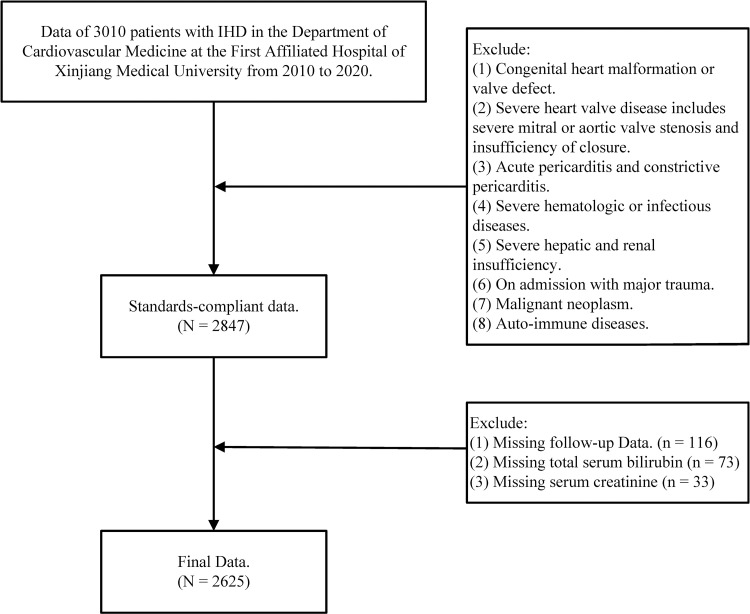
In this study, 2625 patients with IHD were included, and the combined value and combined equations of Cr and TBil were obtained by logistic regression analysis based on Cr and TBil collected at the time of admission. Patients were divided into four groups according to the quartiles of the combined value. COX proportional hazard regression model was used to analyze the risk factors for long-term death in IHD patients. Receiver operating characteristic (ROC) curves were used to evaluate the prognostic effect of Cr, TBil and combined value on long-term death events.
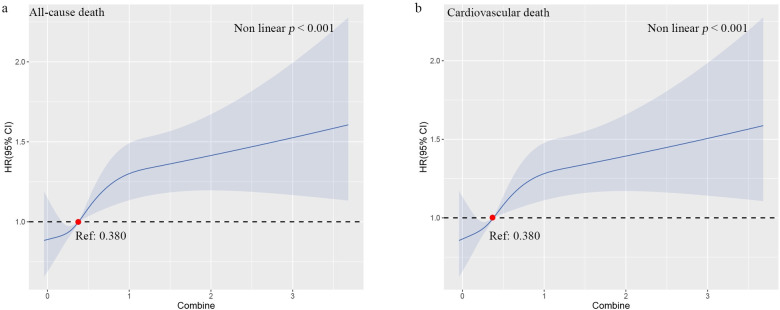
Logistic regression analysis was performed for long-term death events with Cr and TBil as independent variables, and the logit regression model was Logit(P) = 0.0129×TBil+0.007×Cr-0.417. Multifactorial Cox regression analysis showed that high values of the equation were independent risk factors for long-term death events (all-cause death: HR 1.457, 95% CI 1.256-1.689, P<0.001; cardiovascular death: HR 1.452, 95% CI 1.244-1.695, P<0.001). Combined Cr and TBil value are more valuable in predicting long-term death (AUC: 0.609, 95% CI 0.587-0.630, P<0.001).
Combined Cr and TBil assay is superior to single biomarkers for predicting long-term death in patients with IHD. High values of the equation are independent predictors of long-term death and can be used to identify patients at high risk for IHD.
缺血性心脏病(IHD)在人群中的死亡率较高。虽然血清肌酐(Cr)和血清总胆红素(TBil)是常规血液检查中快速且易于获得的生物标志物,但关于 Cr 和 TBil 联合检测对 IHD 的预后价值的文献较少。本研究旨在评估基于 Cr 和 TBil 的联合方程,以预测 IHD 患者的长期死亡风险,并寻找对 IHD 患者预后敏感的指标。
本研究纳入了 2625 例 IHD 患者,根据入院时收集的 Cr 和 TBil 值,通过逻辑回归分析得到 Cr 和 TBil 的联合值和联合方程。根据联合值的四分位数将患者分为四组。采用 COX 比例风险回归模型分析 IHD 患者长期死亡的危险因素。采用受试者工作特征(ROC)曲线评估 Cr、TBil 和联合值对长期死亡事件的预测效果。
以 Cr 和 TBil 为自变量进行长期死亡事件的逻辑回归分析,得到对数回归模型 Logit(P)=0.0129×TBil+0.007×Cr-0.417。多因素 Cox 回归分析显示,方程的高值是长期死亡事件的独立危险因素(全因死亡:HR 1.457,95%CI 1.256-1.689,P<0.001;心血管死亡:HR 1.452,95%CI 1.244-1.695,P<0.001)。联合 Cr 和 TBil 值在预测长期死亡方面更有价值(AUC:0.609,95%CI 0.587-0.630,P<0.001)。
联合 Cr 和 TBil 检测优于单一生物标志物,可用于预测 IHD 患者的长期死亡。方程的高值是长期死亡的独立预测因子,可用于识别 IHD 高危患者。