Department of Clinical, Internal, Anesthesiology and Cardiovascular Sciences, Sapienza University of Rome, Viale del Policlinico, 155, 00161 Rome, Italy.
Department of Integrative Medical Sciences, Northeast Ohio Medical University, Rootstown, OH 44272, USA.
Int J Mol Sci. 2020 Oct 30;21(21):8118. doi: 10.3390/ijms21218118.
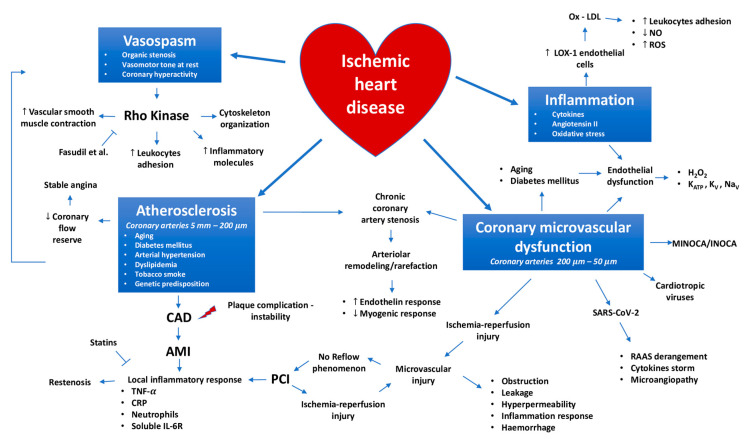
Ischemic heart disease still represents a large burden on individuals and health care resources worldwide. By conventions, it is equated with atherosclerotic plaque due to flow-limiting obstruction in large-medium sized coronary arteries. However, clinical, angiographic and autoptic findings suggest a multifaceted pathophysiology for ischemic heart disease and just some cases are caused by severe or complicated atherosclerotic plaques. Currently there is no well-defined assessment of ischemic heart disease pathophysiology that satisfies all the observations and sometimes the underlying mechanism to everyday ischemic heart disease ward cases is misleading. In order to better examine this complicated disease and to provide future perspectives, it is important to know and analyze the pathophysiological mechanisms that underline it, because ischemic heart disease is not always determined by atherosclerotic plaque complication. Therefore, in order to have a more complete comprehension of ischemic heart disease we propose an overview of the available pathophysiological paradigms, from plaque activation to microvascular dysfunction.
缺血性心脏病仍然是全球个人和医疗保健资源的沉重负担。根据惯例,它等同于由于大-中型冠状动脉中的血流限制阻塞导致的动脉粥样硬化斑块。然而,临床、血管造影和尸检结果表明,缺血性心脏病存在多方面的病理生理学,只有一些病例是由严重或复杂的动脉粥样硬化斑块引起的。目前,还没有一种能够满足所有观察结果的、明确的缺血性心脏病病理生理学评估方法,有时导致日常缺血性心脏病病房病例的潜在机制存在误导性。为了更好地研究这种复杂的疾病并提供未来的展望,了解和分析其潜在的病理生理学机制非常重要,因为缺血性心脏病并不总是由动脉粥样硬化斑块并发症决定的。因此,为了更全面地理解缺血性心脏病,我们提出了一个概述,介绍了从斑块激活到微血管功能障碍的可用病理生理学范例。