Department of Neurology, Oregon Health and Science University, Portland, OR 97239, USA.
Department of Radiology, Tianjin Medical University General Hospital, China.
Neuroimage Clin. 2023;40:103541. doi: 10.1016/j.nicl.2023.103541. Epub 2023 Nov 11.
Investigate the brain functional networks associated with motor impairment in people with Parkinson's disease (PD).
PD is primarily characterized by motor dysfunction. Resting-state functional connectivity (RsFC) offers a unique opportunity to non-invasively characterize brain function. In this study, we hypothesized that the motor dysfunction observed in people with PD involves atypical connectivity not only in motor but also in higher-level attention networks. Understanding the interaction between motor and non-motor RsFC that are related to the motor signs could provide insights into PD pathophysiology.
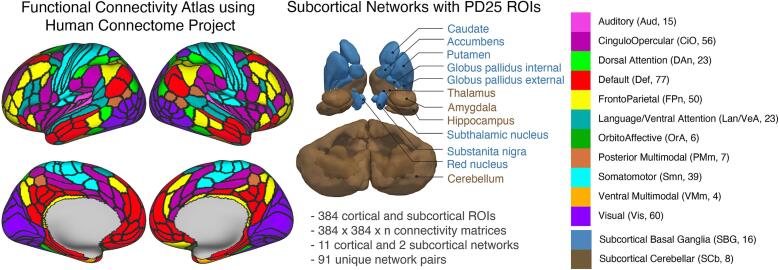
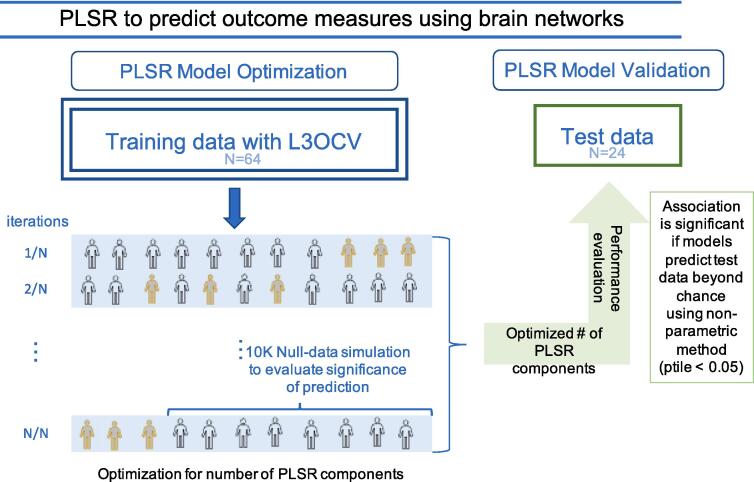
We used data from 88 people with PD (mean age: 68.2(SD:10), 55 M/33F) coming from 2 cohorts. Motor severity was assessed in practical OFF-medication state, using MDS-UPDRS Part-III motor scores (mean: 49 (SD:10)). RsFC was characterized using an atlas of 384 regions that were grouped into 13 functional networks. Associations between RsFC and motor severity were assessed independently for each RsFC using predictive modeling.
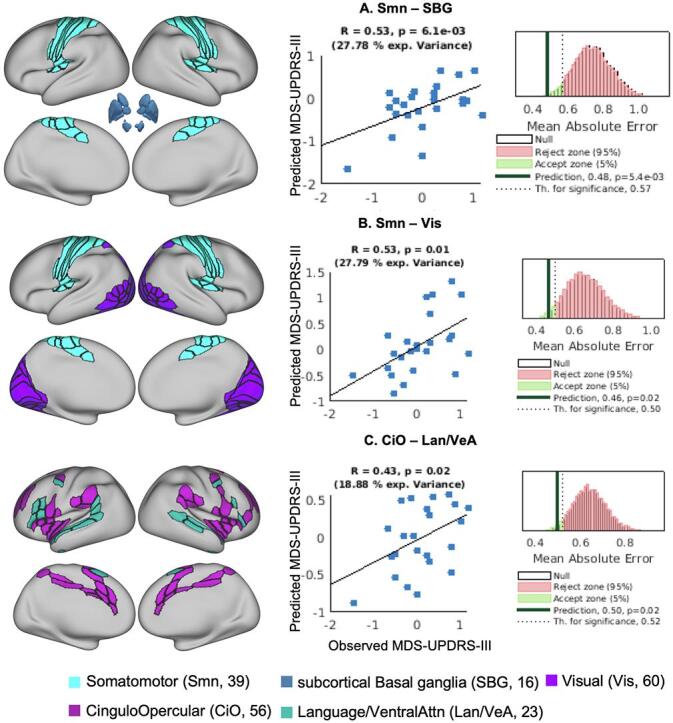
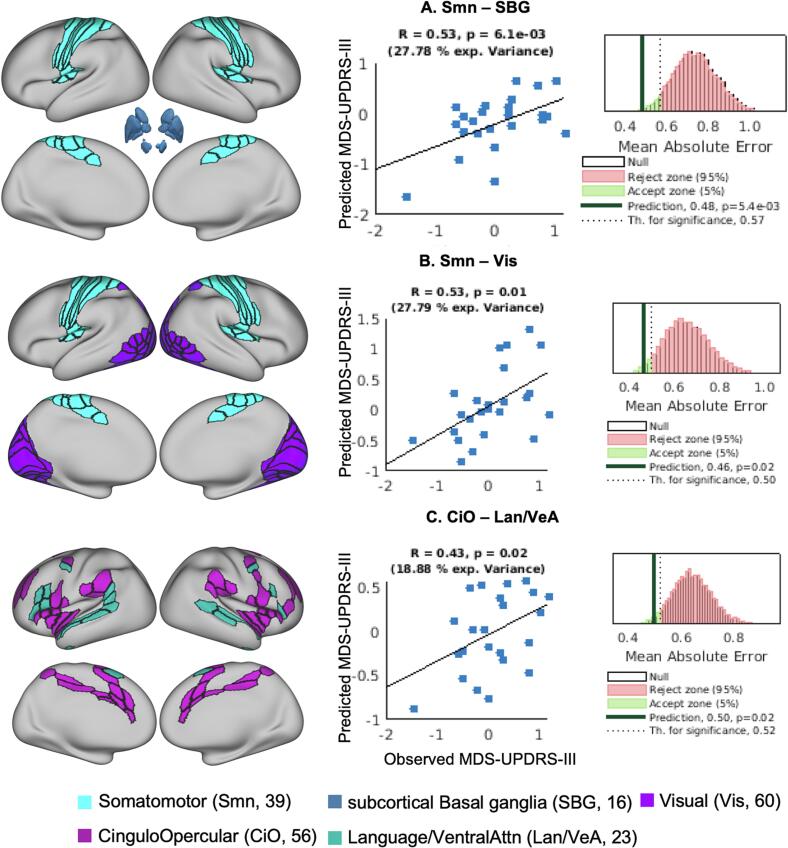
The top 5 % models that predicted the MDS-UPDRS-III motor scores with effect size >0.5 were the connectivity between (1) the somatomotor and Subcortical-Basal-ganglia, (2) somatomotor and Visual and (3) CinguloOpercular (CiO) and language/Ventral attention (Lan/VeA) network pairs.
Our findings suggest that, along with motor networks, visual- and attention-related cortical networks are also associated with the motor symptoms of PD. Non-motor networks may be involved indirectly in motor-coordination. When people with PD have deficits in motor networks, more attention may be needed to carry out formerly automatic motor functions, consistent with compensatory mechanisms in parkinsonian movement disorders.
探究帕金森病(PD)患者运动障碍相关的脑功能网络。
PD 的主要特征是运动功能障碍。静息态功能连接(RsFC)为无创性描述大脑功能提供了独特的机会。在这项研究中,我们假设 PD 患者观察到的运动功能障碍不仅涉及运动网络,还涉及更高层次的注意力网络的异常连接。了解与运动体征相关的运动和非运动 RsFC 之间的相互作用,可以深入了解 PD 的病理生理学。
我们使用了来自 2 个队列的 88 名 PD 患者(平均年龄:68.2(SD:10),55 名男性/33 名女性)的数据。使用 MDS-UPDRS 第三部分运动评分(平均:49(SD:10))评估实际停药物状态下的运动严重程度。使用包含 384 个区域的图谱描述 RsFC,这些区域被分为 13 个功能网络。使用预测模型分别评估每个 RsFC 与运动严重程度之间的关联。
预测 MDS-UPDRS-III 运动评分的前 5%的模型,其效应量>0.5,包括(1)躯体感觉和皮质下基底节之间,(2)躯体感觉和视觉之间,(3)扣带前回和语言/腹侧注意网络之间的连接。
我们的发现表明,除了运动网络,与视觉和注意力相关的皮质网络也与 PD 的运动症状有关。非运动网络可能间接地参与运动协调。当 PD 患者的运动网络出现缺陷时,可能需要更多的注意力来执行以前自动的运动功能,这与帕金森运动障碍的补偿机制一致。