Department of Infectious Diseases, Aarhus University Hospital, Aarhus, Denmark.
Department of Clinical Medicine, Aarhus University, Aarhus, Denmark.
BMC Immunol. 2023 Nov 16;24(1):45. doi: 10.1186/s12865-023-00583-y.
SARS-CoV-2 remains a world-wide health issue. SARS-CoV-2-specific immunity is induced upon both infection and vaccination. However, defining the long-term immune trajectory, especially after infection, is limited. In this study, we aimed to further the understanding of long-term SARS-CoV-2-specific immune response after infection.
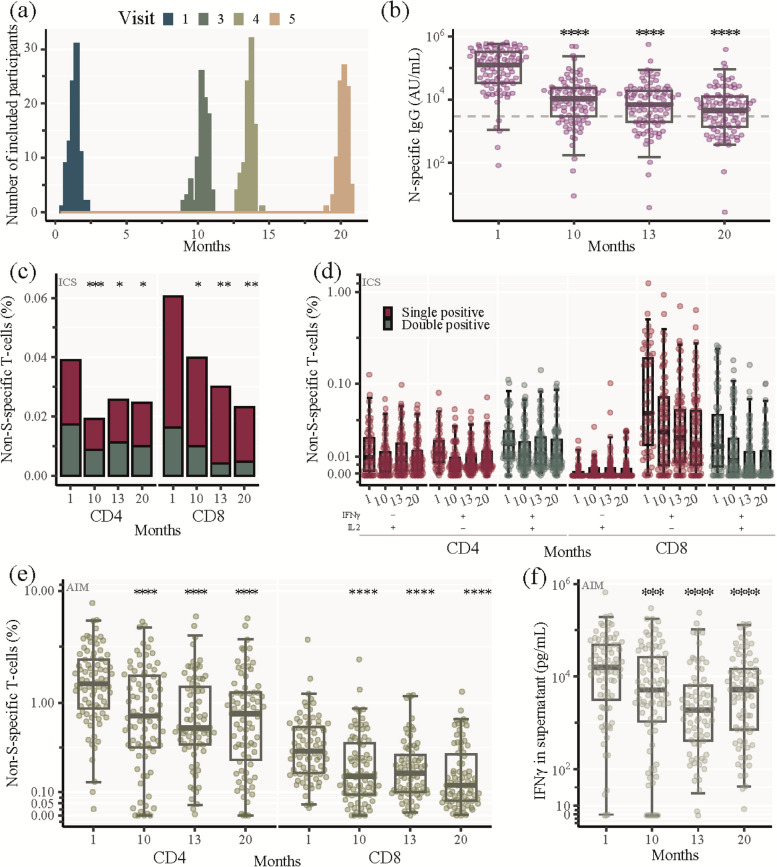
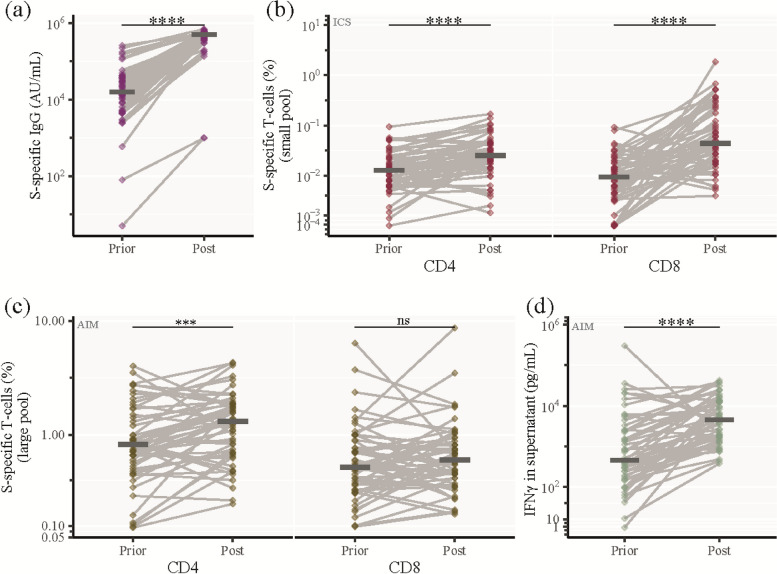
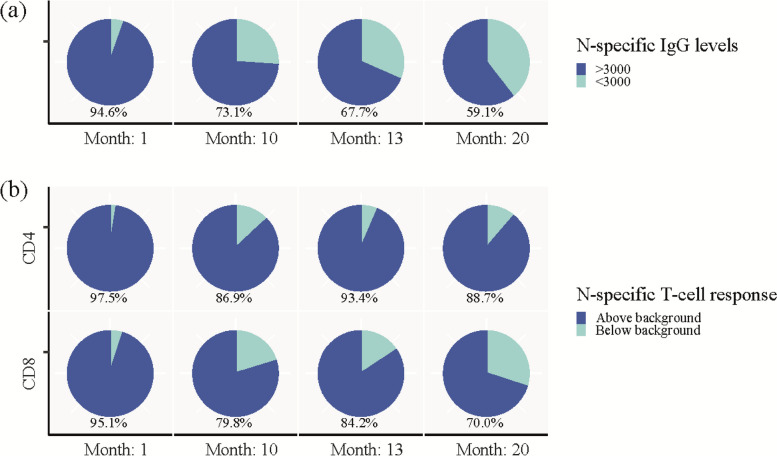
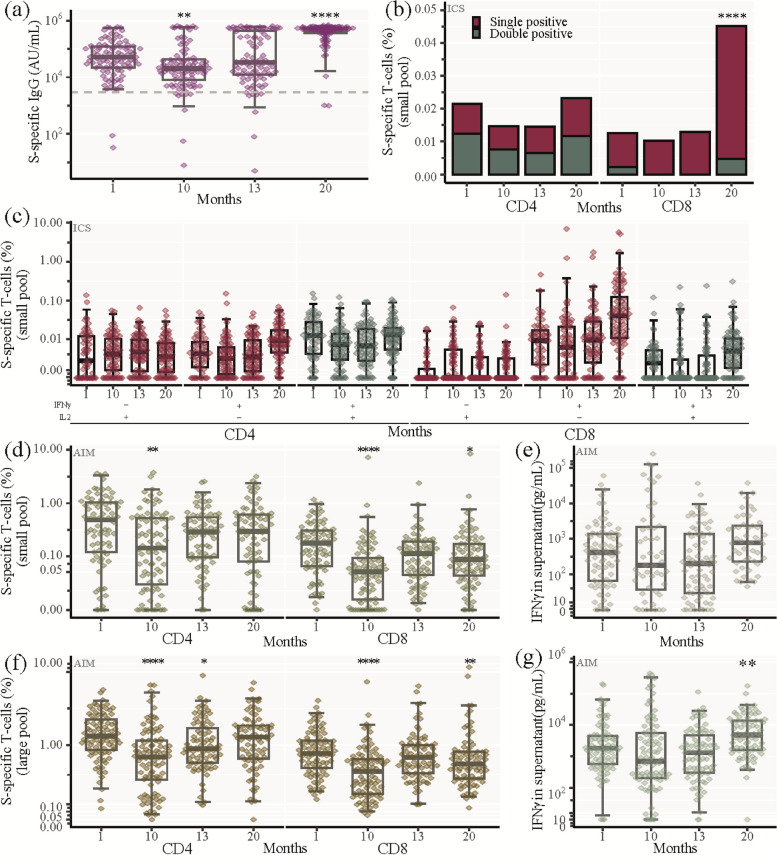
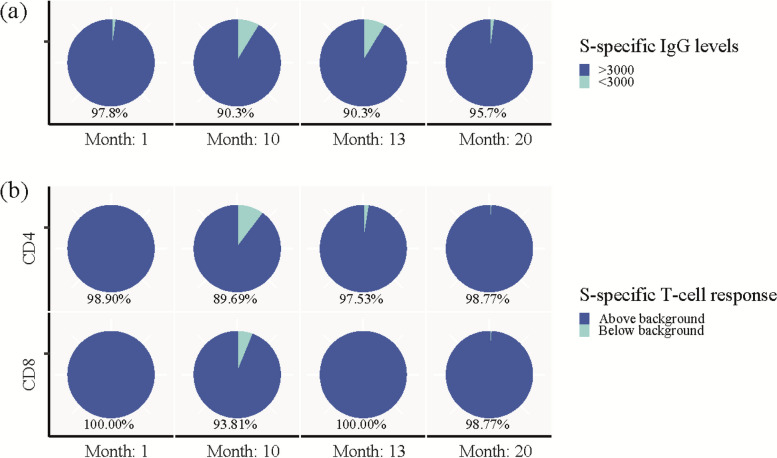
We conducted a longitudinal cohort study among 93 SARS-CoV-2 recovered individuals. Immune responses were continuously monitored for up to 20 months after infection. The humoral responses were quantified by Spike- and Nucleocapsid-specific IgG levels. T cell responses to Spike- and non-Spike epitopes were examined using both intercellular cytokine staining (ICS) assay and Activation-Induced marker (AIM) assay with quantification of antigen-specific IFNγ production. During the 20 months follow-up period, Nucleocapsid-specific antibody levels and non-Spike-specific CD4 + and CD8 + T cell frequencies decreased in the blood. However, a majority of participants maintained a durable immune responses 20 months after infection: 59% of the participants were seropositive for Nucleocapsid-specific IgG, and more than 70% had persisting non-Spike-specific T cells. The Spike-specific response initially decreased but as participants were vaccinated against COVID-19, Spike-specific IgG levels and T cell frequencies were boosted reaching similar or higher levels compared to 1 month post-infection. The trajectory of infection-induced SARS-CoV-2-specific immunity decreases, but for the majority of participants it persists beyond 20 months. The T cell response displays a greater durability. Vaccination boosts Spike-specific immune responses to similar or higher levels as seen after primary infection.
For most participants, the response persists 20 months after infection, and the cellular response appears to be more long-lived compared to the circulating antibody levels. Vaccination boosts the S-specific response but does not affect the non-S-specific response. Together, these findings support the understanding of immune contraction, and with studies showing the immune levels required for protection, adds to the knowledge of durability of protection against future SARS-CoV-2.
SARS-CoV-2 仍然是一个全球性的健康问题。感染和接种疫苗都会引起针对 SARS-CoV-2 的特异性免疫。然而,定义长期的免疫轨迹,特别是在感染后,是有限的。在这项研究中,我们旨在进一步了解感染后 SARS-CoV-2 特异性免疫的长期反应。
我们对 93 名 SARS-CoV-2 康复个体进行了纵向队列研究。在感染后长达 20 个月的时间内,连续监测免疫反应。通过 Spike 和 Nucleocapsid 特异性 IgG 水平来量化体液反应。使用细胞间细胞因子染色(ICS)测定和激活诱导标志物(AIM)测定,检测 Spike 和非 Spike 表位的 T 细胞反应,并定量测定抗原特异性 IFNγ产生。在 20 个月的随访期间,血液中 Nucleocapsid 特异性抗体水平以及非 Spike 特异性 CD4+和 CD8+T 细胞频率下降。然而,大多数参与者在感染后 20 个月仍保持持久的免疫反应:59%的参与者对 Nucleocapsid 特异性 IgG 呈阳性,超过 70%的人仍有持续的非 Spike 特异性 T 细胞。 Spike 特异性反应最初下降,但随着参与者接种 COVID-19 疫苗,Spike 特异性 IgG 水平和 T 细胞频率增加,达到与感染后 1 个月相似或更高的水平。感染诱导的 SARS-CoV-2 特异性免疫的轨迹下降,但对于大多数参与者来说,它在 20 个月后仍持续存在。T 细胞反应显示出更大的耐久性。疫苗接种可将 Spike 特异性免疫反应提高到与初次感染后相似或更高的水平。
对于大多数参与者来说,感染后 20 个月时反应仍持续存在,并且与循环抗体水平相比,细胞反应似乎更持久。疫苗接种可增强 S 特异性反应,但不影响非 S 特异性反应。这些发现共同支持对免疫收缩的理解,并且随着研究显示出对保护所需的免疫水平,为了解未来对 SARS-CoV-2 的保护的耐久性提供了更多的知识。